
Nigel Hitchin is emeritus Savilian Professor of Geometry at the University of Oxford. His main scientific contributions fall in the fields of differential geometry, algebraic geometry and mathematical physics, where he has opened new areas of research in an important number of themes. Among his many distinctions, he has won the Shaw Prize in Mathematical Sciences (2016), the Whitehead (1980) Berwick (1990) and Polya (2002) prizes of the London Mathematical Society, and the Sylvester Medal of the Royal Society (2000). He is a Fellow of the Royal Society (elected in 1991), an Honorary Fellow of Jesus College (elected in 1998), and a fellow of the American Mathematical Society (elected in 2012). He has been awarded Honorary Degrees (Doctor of Science) from the Universities of Bath (2003), Warwick (2014) and Derby (2023). He has previously been the chair of the ICMAT Hitchin Laboratory (2013–2015), co-chair of the ICMAT Donaldson–Hitchin Laboratory (2016–2020) and co-chair of the ICMAT Hitchin-Ngô Laboratory (2020-2024).

Ngô Bảo Châu is Francis and Rose Yuen Distinguished Service Professor at the Mathematics Department of the University of Chicago, USA. He also holds a Visiting Chair at the Collège de France (Paris) for 2020–2025, and is Scientific Director of the Vietnam Institute for Advanced Study in Mathematics since 2011. His main mathematical contributions fall in the fields of algebraic geometry, number theory and geometric representation theory. He is best known for his proof of the Fundamental Lemma of the Langlands Programme, for which he was awarded a Fields Medal in 2010. In his proof he uses in an essential way the Hitchin fibration of the moduli space of Higgs bundles introduced by Hitchin in 1987. Professor Ngô has many other distinctions and recognitions, including a Clay Research Award (2004), the Sophie Germain Prize given by the Académie des Sciences de Paris (2007), the Oberwolfach Prize (2007), the Légion d’honneur (2011), and an Honorary Doctoral Degree by the Vietnam National University (2011). He is a Fellow of the American Mathematical Society (2012), Member of the American Academy of Arts and Sciences (2012), Foreign Member of the Académie des Sciences de Paris (2016), and Honorary Member of the London Mathematical Society (2021). He has previously been co-chair of the ICMAT Hitchin-Ngô Laboratory (2020-2024).
Research field
Algebraic geometry, differential geometry and mathematical physics.
Research project
The Hitchin–Ngô Laboratory is an initiative of the Algebraic Geometry and Mathematical Physics group at ICMAT led by Oscar García-Prada. As in the previous edition, this Lab will be chaired jointly by Professors Nigel Hitchin and Ngô Bảo Châu for the period 2024–2028. Its main goal is to foster interaction and collaboration in the following research areas.
- The Hitchin system, Langlands duality and mirror symmetry
- Higgs bundles, character varieties and higher rank Teichmüller spaces
- Gauge theory, moduli spaces and geometric structures
Members
Faculty:
- Luis Álvarez Cónsul (ICMAT-CSIC)
- Emilio Franco (ICMAT-UAM)
- Mario García Fernández (ICMAT-CSIC)
- Oscar García Prada (ICMAT-CSIC) – Coordinator
- Guillermo Gallego (ICMAT-UAM)
- Tomás Gómez de Quiroga (ICMAT-CSIC)
- Nigel Hitchin (University of Oxford, UK) – Chair
- Jesus Martinez-Garcia (ICMAT-UAM)
- Ngô Bảo Châu (University of Chicago, USA) – Chair
Postdoctoral Researchers:
- Izar Alonso Lorenzo (ICMAT-CSIC)
- Giuseppe Barbaro (ICMAT-CSIC)
- Federico Giusti (ICMAT-CSIC)
- Leonardo Roa Leguizamon (ICMAT-CSIC)
- Nicholas Rungi (ICMAT-CSIC)
- Dario Weißmann (ICMAT-CSIC)
Research Students:
- Román Ahumada Gialanella (UAM, ICAI)
- Pablo Alvarado Seguel (ICMAT-UAM)
- Lucía Baena Ligero (ICMAT-UCM)
- Néstor Blázquez Hernán-Gómez (ICMAT-CSIC)
- Álvaro Díaz Martín (ICMAT-UAM)
- Miguel González González (ICMAT-UCM)
- Alfredo Llosa Lazo (ICMAT-UAM)
- Alejandro Plaza Gallán (ICMAT-UAM)
- Diego Ruiz Cases (ICMAT-UCM)
- Lucía Sobral Torres (ICMAT-UCM)
- Roberto Téllez Domínguez (ICMAT-CSIC)
- Manuel Timiraos López (ICMAT-UCM)
Activities
- Geometry Seminar ICMAT
- Christmas M3 Geometry Workshop (ICMAT, 19-20 December 2024)
- Special activity June 2025
- Special trimester (ICMAT, September – December 2026)
News
Visitors
- Nigel Hitchin (University of Oxford), 25-29 March 2025
- Nathanie Sagman (University of Luxembourg) 31 March – 4 April 2025
- Richard Wentworth (University of Maryland), 2-30 June 2025
- Peter Gothen (Universidade do Porto), 8-13 June 2025
- Asia Mainenti (Università di Torino), 8-14 June 2025
- Graeme Wilkin (University of York), 8-14 June 2025
- Nigel Hitchin (University of Oxford), 8-17 June 2025
- Steven Bradlow (University of Illinois at Urbana-Champaign), 9-23 June 2025
- Brian Collier (University of California at Riverside), 15-20 June 2025
- Guillermo Gallego (FU Berlin), 15-28 June 2025
- Jacques Hurtubise (McGill University, Montreal), 15-28 June 2025
- Gabriele Rembado (Universite de Montpellier), 15-28 June 2025
- Panagiotis Dimakis (University of Maryland), 16-27 June 2025
- Ramiro Lafuente (University of Queensland, Brisbane, Australia), 16-20 June 2025
- Junming Zhang (Nankai University), 7-26 September 2026
- Steven Bradlow (UIUC) 14-26 September 2026
- Marcos Jardim (Unicamp), 17-25 September 2026
- Jørgen Ellegaard Andersen (QM, University of Southern Denmark), 20-25 September 2026
- Olivier Biquard (Sorbonne Université), 20-25 September 2026
- Jean-Pierre Bourguignon (IHES), 20-24 September 2026
- Leticia Brambila Paz (CIMAT, Merida) 20-26 September 2026
- Sergey Cherkis (University of Arizona), 20-26 September 2026
- Brian Collier (UC Riverside), 20-26 September 2026
- Pavel Etingof (MIT), 21-25 September 2026
- Peter Gothen (Universidade do Porto), 20-25 September 2026
- Tamás Hausel (IST Austria, Vienna), 20-25 September 2026
- Jochen Heinloth (University of Duisburg–Essen), 20-25 September 2026
- Nigel Hitchin (University of Oxford), 20-25 September 2026
- Jacques Hurtubise (McGill University), 20-27 September 2026
- Steven Kerckhoff (Stanford University), 20-25 September 2026
- Qiongling Li (Nankai University), 20-25 September 2026
- Takuro Mochizuki (Kyoto University), 20-26 September 2026
- Ngô Bảo Châu (University of Hong Kong), 21-23 September 2026
- Andre Oliveira (Universidade do Porto), 20-24 September 2026
- Nathaniel Sagman (UNC Chapel Hill), 20-26 September 2026
- Laura Schaposnik (University of Illinois Chicago), 20-23 September 2026
- Carlos Simpson (Université Côte d’Azur), 22-26 September 2026
- Richard Wentworth (University of Maryland), 20-26 September 2026
- Zhiwei Yun (MIT), 20-26 September 2026
Hitchin-Ngô Laboratory - Shanghai
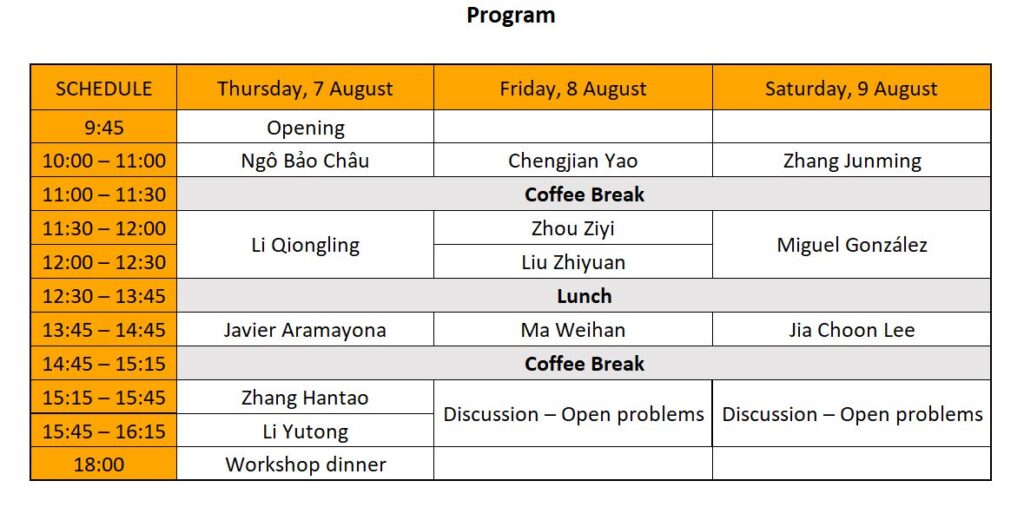
On July 2025 a section of the Hitchin-Ngô Laboratory has been established in Shanghai under the support of Feishu. The first activity will be the Geometry Workshop of the Hitchin-Ngô Laboratory, Feishu, Shanghai, 7-9 August 2025. Organizer: Oscar Garcia-Prada (laboratory coordinator).
Titles and abstracts:
Ngô Bảo Châu (University of Chicago)
Title: Hitchin fibration and endoscopy
Li Qiongling (Nankai University)
Title: Cyclic Higgs bundles and related geometry
Abstract: In this talk, I will discuss several geometric realizations of cyclic Higgs bundles, including affine spheres in ℝ³, maximal surfaces in ℍ²ⁿ, holomorphic curves in ℍ⁴², and A-surfaces, along with other special surfaces. If time permits, I will also outline some future research directions in this area.
Javier Aramayona (Institute of Mathematical Sciences – ICMAT, Madrid)
Title: Homomorphisms between mapping class groups
Abstract: We will survey the current understanding of homomorphisms between mapping class groups of surfaces. In particular, we will discuss the structure of such homomorphisms, often under various topological and algebraic constraints.
Zhang Hantao (University of Stony Brook)
Title: Global Kuranishi charts.
Abstract: Abouzaid, McLean, and Smith have constructed global Kuranishi charts for the moduli space of stable J-holomorphic curves.In this presentation, I will sketch the main ideas of their construction and outline the key steps of the proof.
Li Yutong (Shanghai Tech University)
Title: Perverse sheaves and the BBDG decomposition theorem for semismall maps.
Abstract: In this talk, I will introduce the concept of perverse sheaves, with intersection complexes as key objects. Then, I will outline the proof of the decomposition theorem of Beilinson, Bernstein, and Deligne for semismall maps, following the approach by de Cataldo and Migliorini in their 2002 paper The Hard Lefschetz Theorem and the topology of semismall maps.
Yao Chengjian (Shanghai Tech University)
Title: Einstein-Bogomol’nyi metrics and classical GIT quotient
Abstract: The Einstein-Bogomol’nyi equations in the study of Einstein-Maxwell-Higgs system shows a striking link with the classical GIT (Geometric Invariant Theory) stability condition about divisors on P^1. This provides a more geometrical and somehow unexpected way of understanding the EMH system, including the dynamics of its solutions. We will talk about this new “correspondence’’, and propose several unsolved questions related to its moduli space. The talk is partially based on joint works with Alvarez-Consul, Garcia-Fernandez, Garcia-Prada and Pingali in recent years.
Zhou Ziyi (Shanghai Tech University)
Title: The title of my talk may be: Toric G_2 manifolds.
Abstract: My talk is based on the paper “Toric geometry of G_2 manifolds” by Madsen-Swann. G_2 manifolds is important in both mathematics and physics. One of the major goals in the study of G_2 manifolds is to understand how to construct them explicitly. Madsen-Swann gives a correspondence between toric G_2-manifolds and solutions of a specific system of PDEs, similar to the well-known Gibbons-Hawking ansatz for hyperkähler 4-manifolds with S^1-symmetry.
Liu Zhiyuan (Universite Libre de Bruxelles)
Title: Seiberg-Witten Monopoles and Flat Connections
Abstract: I will introduce a generalization of Seiberg-Witten equaatons on 3-manifolds (the solutions are called monopoles), which consist of a linear Dirac equation together with a non-linear equation provided by some hyperKähler moment maps. This construction will extend the classical Seiberg-Witten theory, an Abelian gauge theory, to non-Abelian settings. Furthurmore, I will talk about the interpretation of such Seiberg-Witten monopoles in terms of flat harmonic connections.
Ma Weihan (Nankai University)
Title: Harmonic metrics of SO_0(n,n)-Higgs bundles in the Hitchin section on non-compact hyperbolic surfaces
Abstract: Let X be a Riemann surface. Hitchin constructed G-Higgs bundles in the Hitchin section for a split real form G of a complex simple Lie group,using the canonical line bundle K and some holomorphic differentials $q$. We study the case of SO_0(n,n). In our work, we establish the existence of harmonic metrics for these Higgs bundles, which are compatible with the SO_0(n,n)-structure on any non-compact hyperbolic Riemann surface. Furthermore, these harmonic metrics weakly dominate h_X, the natural diagonal harmonic metric induced by the unique complete K\”ahler hyperbolic metric g_X on X. Assuming these holomorphic differentials are all bounded with respect to g_X, we prove the uniqueness of such a harmonic metric.
Zhang Junming (Nankai University)
Title: Compact Relative SO_0(2,q)-Character Varieties of Punctured Spheres
Abstract: We prove that there are relative SO_0(2,q)-character varieties of the punctured sphere which are compact, totally non-hyperbolic and contain a dense representation. This work fills a remaining case of the results of Tholozan-Toulisse. Our approach relies on the non-abelian Hodge correspondence and we study the moduli space of parabolic SO_0(2,q)-Higgs bundles with some fixed weight. Additionally, we provide a construction based on Geometric Invariant Theory (GIT) to demonstrate that the considered moduli spaces can be viewed as a projective variety over the complex numbers. This is a joint work with Yu Feng.
Miguel González (Institute of Mathematical Sciences – ICMAT, Madrid)
Title: Compact components in relative character varieties for real lie groups of Hermitian type
Abstract: We present ongoing work in progress joint with Oscar Garcia-Prada and Junming Zhang attempting to find compact components in relative character varieties on the punctured sphere for arbitrary real Lie groups of Hermitian type. Our approach uses elements of the general theory of Higgs bundles for these groups which we extend to the parabolic bundle case. This generalises previous results of Tholozan-Toulisse and Feng-Zhang
Lee Jia Choon (University of Science and Technology of China, Hefei)
Title: Deligne-Simpson Problem via Spectral Correspondence
Abstract: The multiplicative Deligne-Simpson problem (DSP) asks the following question: given an n-tuple of conjugacy classes of matrices, can we choose $n$ matrices from these classes such that their product is the identity and they have no common invariant subspace? Another way to formulate the DSP is to ask for a criterion for the existence of irreducible local systems on the punctured sphere with prescribed monodromy data. Many works have been done in this direction using various methods by Simpson, Katz, Kostov, Crawley-Boevey, and Shaw. In this talk, I will present an alternative approach to the DSP by establishing a suitable spectral correspondence for parabolic Higgs bundles. If time permits, I will also explain how our result confirms a conjecture on the DSP by Balasubramanian-Distler-Donagi that arises from the study of 6D superconformal field theories. This is joint work with Sukjoo Lee.
Job Opportunities
- TBA


