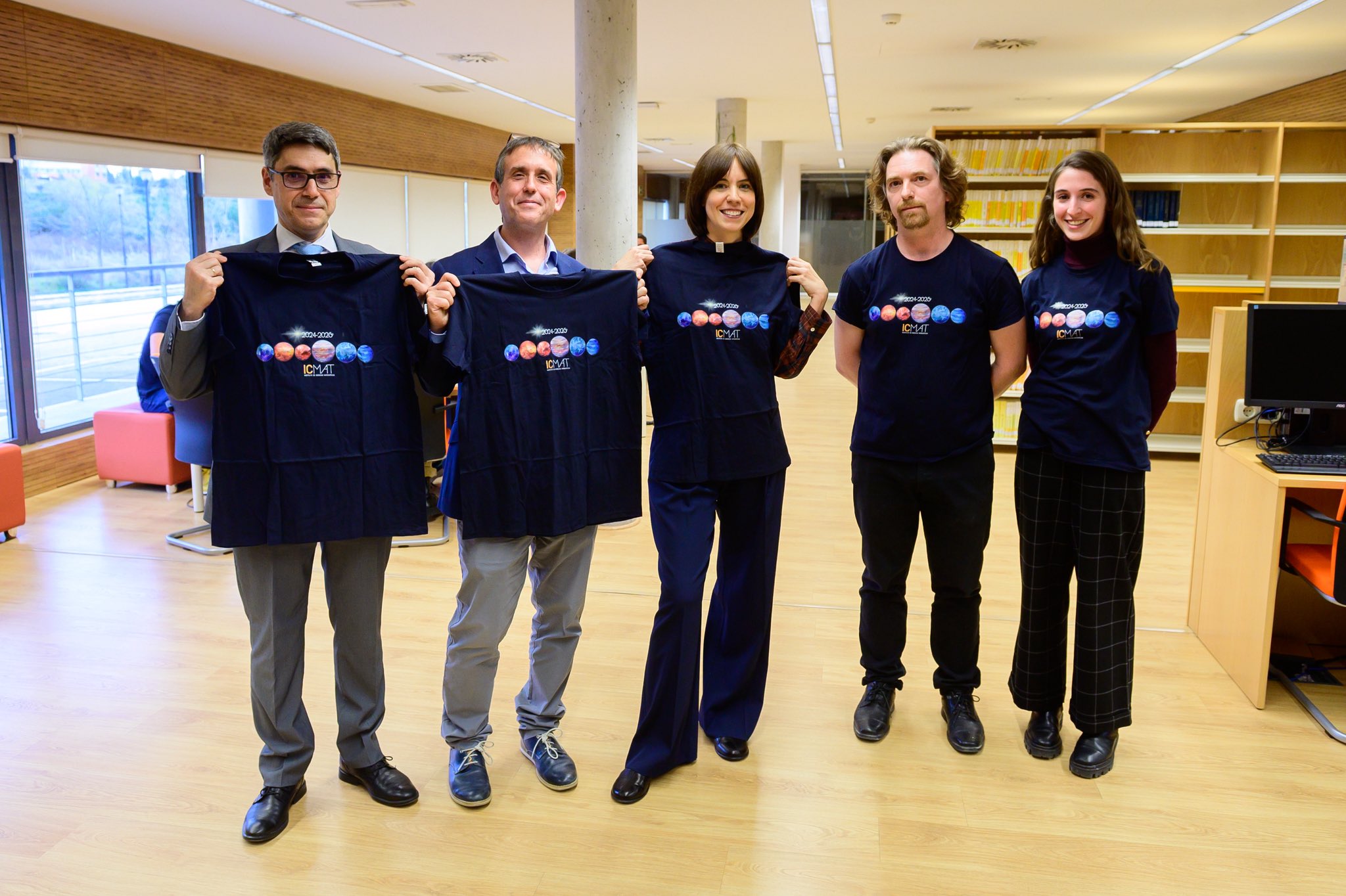
Diana Morant, in the centre, with (from left to right) José María Martell, Javier Aramayona, Andrei Jaikin and Laura Saenz, last Friday at ICMAT. Image: Ministry of Science, Innovation and Universities.
Last Friday, 20 March, the 140 students aged between 12 and 18 from the Pequeño Instituto de Matemáticas (PIM) and the four undergraduate Mathematics students from the Mathematics Intensive Program (MIP) were visited by Diana Morant, Minister of Science, Innovation and Universities. Morant spoke with the participants and showed interest in their early enthusiasm for mathematics. “Mathematics does not only explain the world, it makes it possible. Because it awakens critical thinking, creativity and the vocations that will build the future of our country,” Morant stated on her social media. José María Martell, Vice-President for Scientific and Technical Research at the Spanish National Research Council (CSIC), also attended ICMAT alongside Morant.
“It is exciting to see the passion and enthusiasm with which these young people engage with this discipline, their constant curiosity and their eagerness to face new challenges,” says Javier Aramayona, Director of ICMAT. With the MIP and the PIM, ICMAT strengthens its commitment to identifying and fostering mathematical talent.
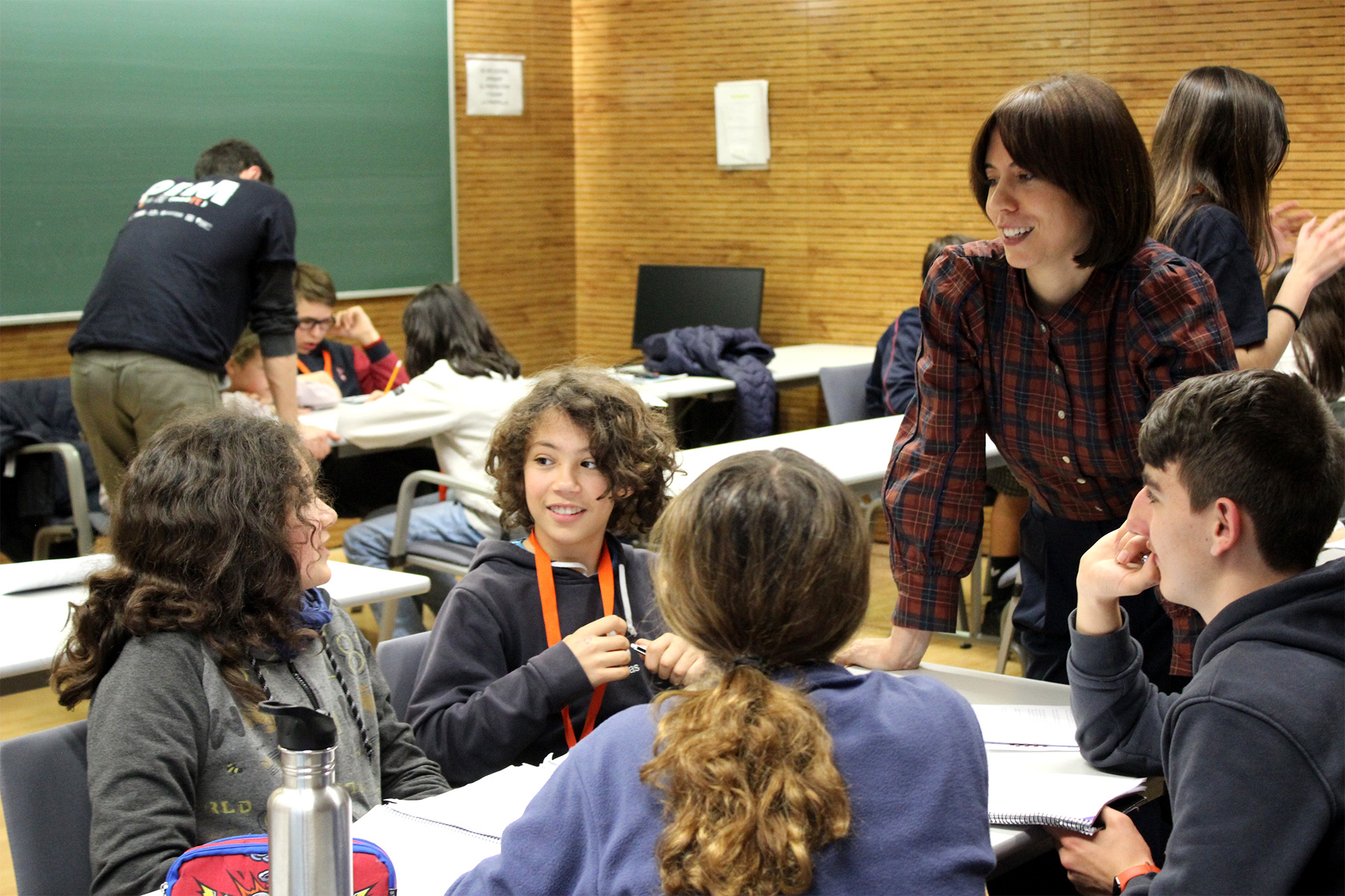
The Pequeño Instituto de Matemáticas brings together around 140 students aged between 12 and 18 every Friday at ICMAT, all interested in mathematics. Image: Laura M. Iraola/ICMAT.
Pequeño Instituto de Matemáticas (PIM)
The PIM aims to channel this interest in mathematics through collaborative problem solving. These are challenges different from those typically encountered in the classroom: students first tackle them individually at home and then share and compare their ideas in class, relying both on their peers and on the teaching team to reach a solution.
The teaching staff is made up of mathematics researchers from ICMAT and the Autonomous University of Madrid (UAM), as well as former students from previous editions of the PIM. Early interaction with researchers is essential, as it allows students, from the earliest stages of their education, to come into direct contact with the reality of mathematical research and to have access, first-hand, to a diverse range of role models.
The human dimension of the programme is also developed among the students themselves. One of the most positive outcomes of the PIM is the creation of bonds between students who share a passion for mathematics, which in many cases turn into friendships.
Now in its fourth edition, the programme brings together more than 150 students every Friday, from 17:30 to 20:00, at ICMAT—40% of them female. Participation is free of charge. Although regular registration for new students takes place at the end of May, with an entrance test at the beginning of June, it is possible to join during the academic year by submitting solutions to a set of exercises. These tests are not intended to select an elite group of students, but rather to assess candidates’ interest in mathematics and their abstract reasoning skills.
Mathematics Intensive Program (MIP)
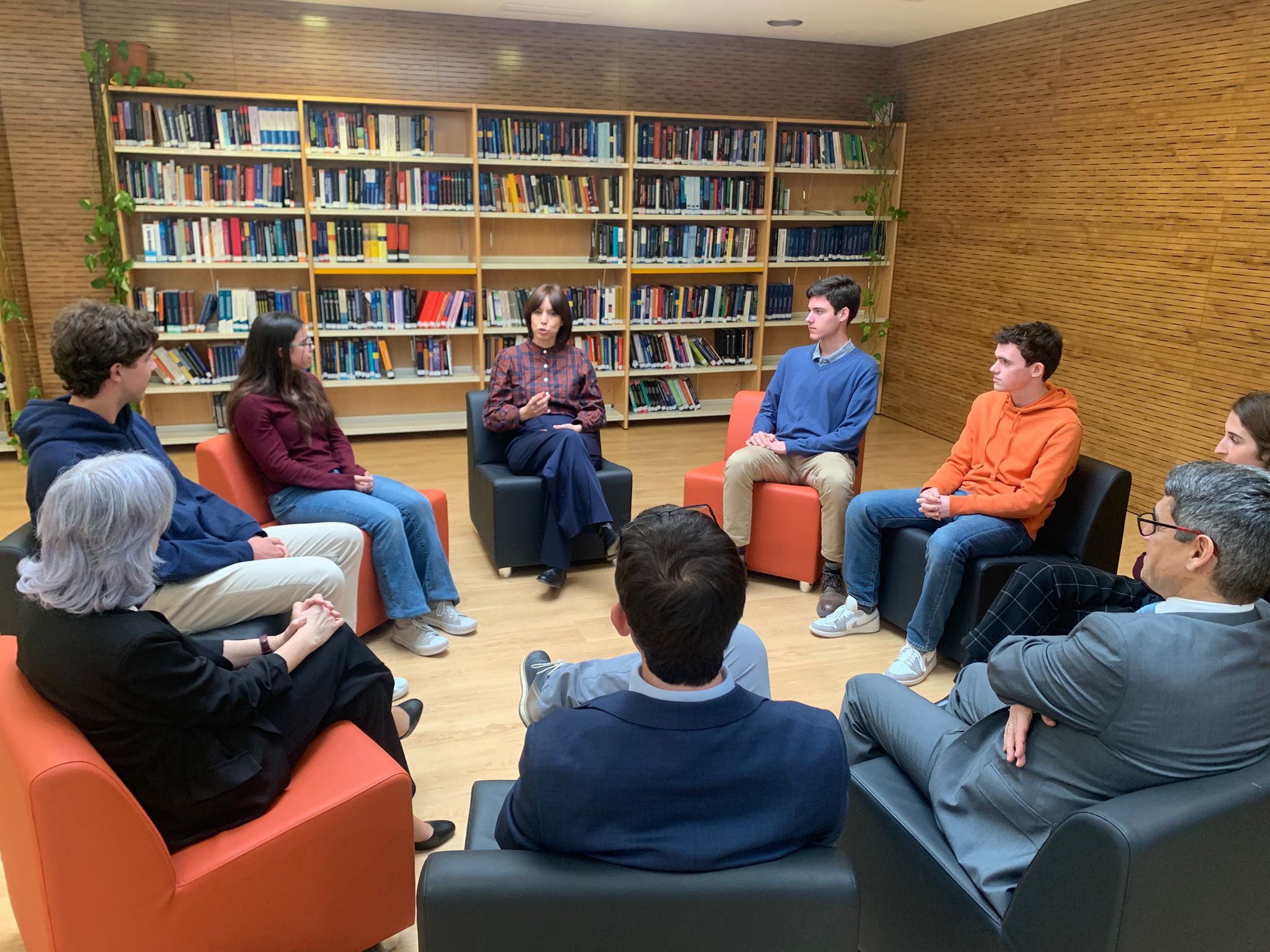
During her visit, the minister met the first four participants of ICMAT’s Mathematics Intensive Program (MIP). Image: Laura M. Iraola/ICMAT.
The aim of the MIP is to offer undergraduate Mathematics students a stimulating environment in which they can fully develop their potential, establish early contact with open problems and become familiar with the collaborative dimension of mathematical research. The programme is inspired by international models of excellence in education, such as those developed by the Scuola Normale Superiore di Pisa and the École Normale Supérieure in Paris. Many of the most renowned mathematicians, including Fields Medal winners and other prize recipients, have been trained at these institutions.
The first edition began in October 2025 with the participation of four first-year Mathematics undergraduates. Throughout their four years of study, they will work under the direct mentorship of ICMAT researchers, in addition to attending advanced courses, exclusive seminars and other activities. “The programme has shown me the real complexity of mathematics and has given me a much broader view of what it is and its applications,” says Sofía Paz, one of the four participants.
Upon completing their degree, those who finish the programme—completely free of charge for students—will receive a specific certificate issued by the CSIC recognising their participation.
The call for applications for the second edition of the MIP is now open. It is aimed at students who will begin a Mathematics degree in the 2026–2027 academic year at a university in the Community of Madrid. The deadline for submitting applications is 15 April, and applications can be made via the following form.
This is an automatic translation and may contain inaccuracies.