‘Mathematics at the Residencia’ series, 12 May, Women in Mathematics Day
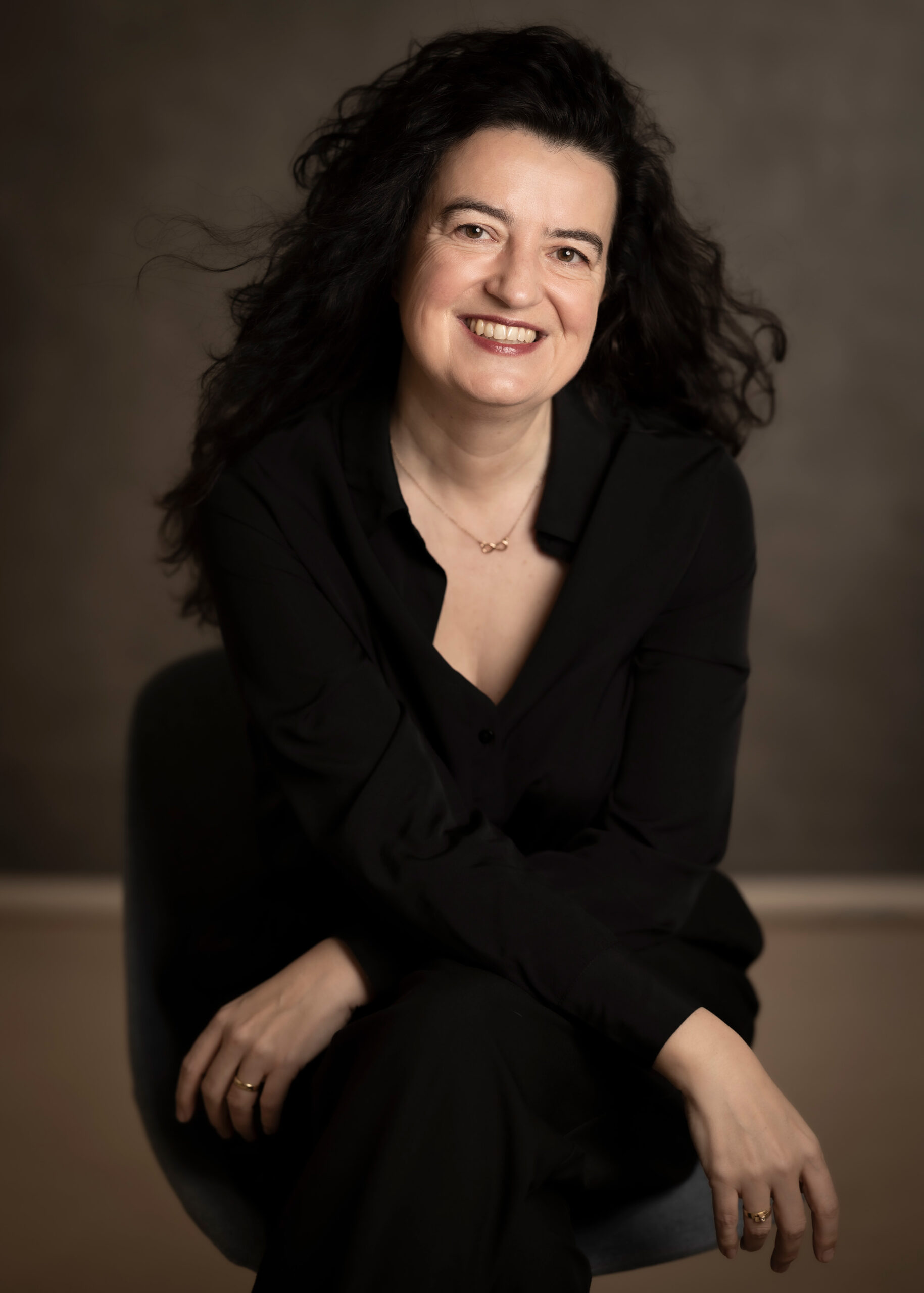
Ann Dooms presents “A picture says more than a thousand words, but which language does it speak?”. Image: VUB
Laura M. Iraola (ICMAT)
In 2025, it was estimated that 5.3 billion digital photographs were taken every day worldwide, that is, 62,000 photos every second. These images are made up of thousands of coloured pixels which, in addition to memories and emotions, can provide quantifiable information. So-called digital mathematics provides the theoretical basis for analysing these images and recognising patterns in digital data. This makes it possible to analyse paintings in depth, identify key structures in biomedical images and even obtain more reliable artificial intelligence models.
“Digital data are everywhere, but they do not speak for themselves. Mathematics is the language that allows us to extract their value,” says Ann Dooms, professor at the Vrije Universiteit Brussel (Belgium) and specialist in this field. “For a computer, an image is a numerical object with structure,” she explains. Mathematical tools make it possible to analyse these structures for many different purposes, from authenticating the author of a work of art to preserving fertility in women with cancer.
These are two of the projects that the researcher will present in “A picture is worth a thousand words, but what language does it speak?”. The talk is organised by the Institute of Mathematical Sciences (ICMAT) as part of the outreach series ‘Mathematics at the Residencia’. It is held in collaboration with the Residencia de Estudiantes and the CSIC’s Deputy Vice-Presidency for Scientific Culture and Citizen Science (VACC). The event also commemorates Women in Mathematics Day.
It will take place tomorrow, Tuesday 12 May, at 19:00 in the lecture hall of the Residencia de Estudiantes in Madrid. Admission is free until full capacity is reached, and the event can also be followed live via the following link.
Digital mathematics to improve cryopreservation or study the hidden brushstrokes of a work of art
In the case of images, so-called digital mathematics seeks mathematical building blocks that allow images to be decomposed and reconstructed. “In other words, we examine an image through its numerical structure, manipulate those data mathematically and then translate the result into information that a human being can interpret,” explains Dooms. To identify patterns in digital data, modelling is carried out using discrete and continuous structures, such as vectors in infinite-dimensional Hilbert spaces.
One of its applications, on which Dooms and her team are working in collaboration with the Centre for Reproductive Medicine at the Brussels University Hospital (UZ Brussel), makes it possible to identify high-quality oocytes for cryopreservation. “The aim is to preserve fertility in women who are about to undergo cancer treatment,” she explains. To achieve this, they extract meaningful information from ongoing fertility treatments and use it to mathematically model oocyte structures that may influence their quality, based on high-resolution digital microscopy images.
Another of her projects has applications in the history and restoration of works of art. High-resolution and multispectral digital images of artworks capture brushstrokes, cracks in the paint and even underlying drawings in great detail. Mathematical analysis can, for example, quantify style, detect and digitally remove the canvas, wood grain or cracks, and even reveal traces of restoration. “In this way, we can provide valuable tools to art historians and conservators, enabling them to examine fragile cultural heritage in a non-invasive way,” says the researcher.
Mathematics for more reliable artificial intelligence
Dooms has also applied these same ideas to the analysis of large language models (LLMs), which underpin various artificial intelligence tools. “Today, digital mathematics provides the language for understanding how AI algorithms extract structure from digital representations, as well as the limits and future possibilities of computation,” says Dooms. “The next step is not only to build larger models, but models that are mathematically better understood, more reliable, more transparent and more closely connected to the structure of the problem,” she concludes.
Specifically, Dooms has worked on the development of a model of human reading, applied to the understanding of complex layouts and tables. This has made it possible to link visually presented information with AI large language models (LLMs). “We have thus shown that mathematically grounded models can make AI more reliable in document processing,” explains Dooms. Using these same techniques, “we are also working on algorithms that extract text from ancient or damaged documents,” she adds.
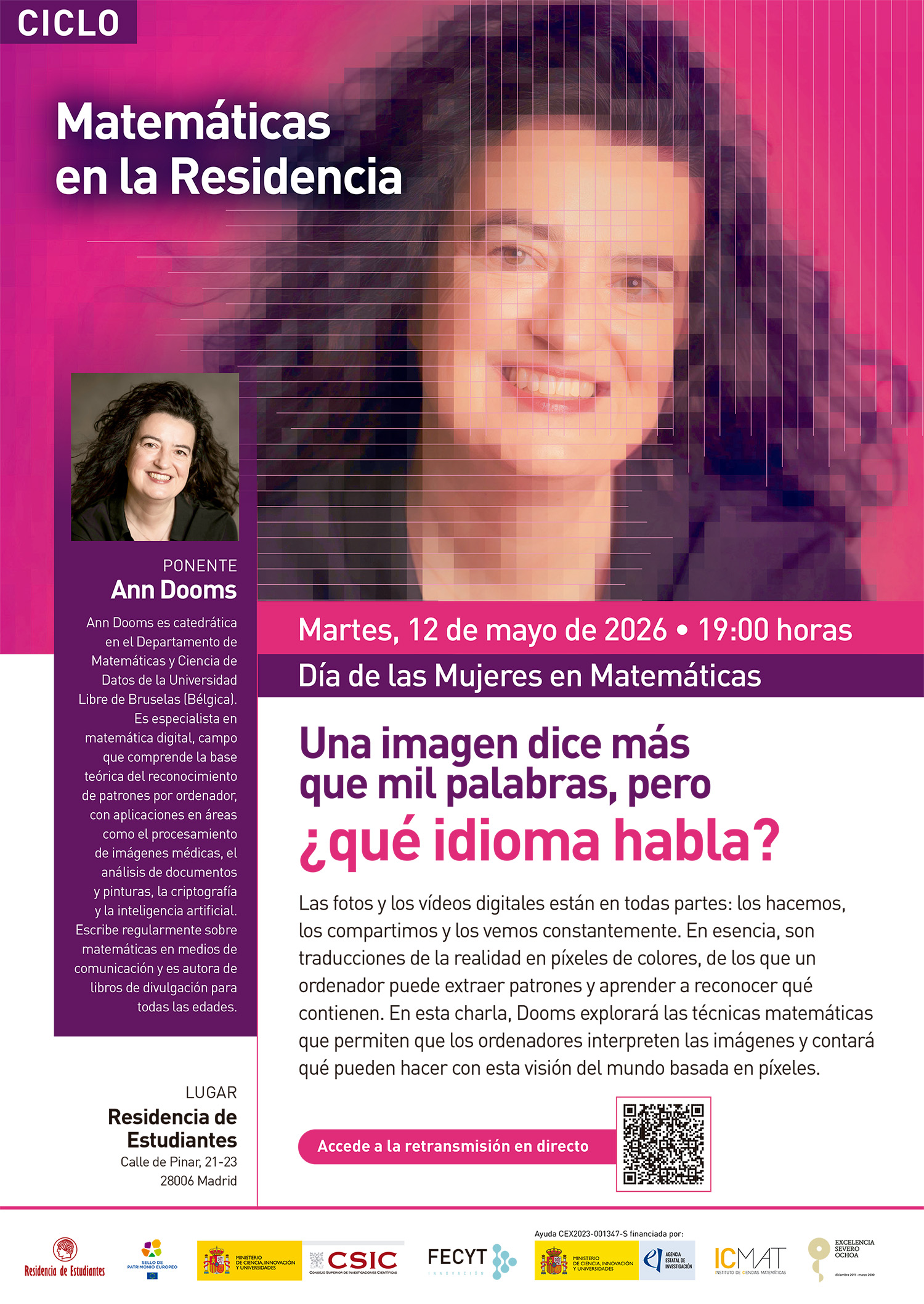
Ann Dooms
Ann Dooms is professor in the Department of Mathematics and Data Science at the Vrije Universiteit Brussel (VUB), Belgium, where she currently leads the Mathematics & Data Science (MADS) research group. Dooms specialises in digital mathematics, a field that provides the theoretical basis for computer pattern recognition and has applications in areas such as medical image processing, the analysis of documents and paintings, cryptography and artificial intelligence.
Dooms is currently Chair of the Education Committee of the European Mathematical Society (EMS) and Chair of the Scientific Council of the Belgian Defence. She also regularly writes about mathematics in the media and is the author of popular science books aimed at readers of all ages. She has received numerous awards for her work in research, teaching and science communication.
12 May, Women in Mathematics Day
On 12 May 1977, Maryam Mirzakhani was born in Tehran. She was the first woman to receive the Fields Medal, the highest distinction in mathematics. Following her untimely death on 14 July 2017, the Women’s Committee of the Iranian Mathematical Society proposed, at the World Meeting for Women in Mathematics held in Rio de Janeiro in July 2018, that 12 May should be recognised as Women in Mathematics Day. Since then, numerous initiatives have taken place annually around the world highlighting the work of women in mathematics. In 2025, more than 210 events were organised worldwide. The ICMAT has joined this commemoration since its first edition.
Mathematics at the Residencia
Mathematics at the Residencia is a public outreach lecture series organised by ICMAT in collaboration with the CSIC’s Deputy Vice-Presidency for Scientific Culture and Citizen Science (VACC) and the Residencia de Estudiantes.
Since the programme was created in 2009, it has featured prominent international communicators of mathematics such as Marcus du Sautoy, Jesús María Sanz-Serna, Pierre Cartier, Guillermo Martínez, Edward Frenkel, Christiane Rousseau, Mickaël Launay, John Allen Paulos, Marta Macho-Stadler, Jin Akiyama, Eduardo Sáenz de Cabezón, Sylvia Nasar, Raúl Ibáñez and Harald Helfgott.
—
This text is an automatic translation from the original Spanish version.