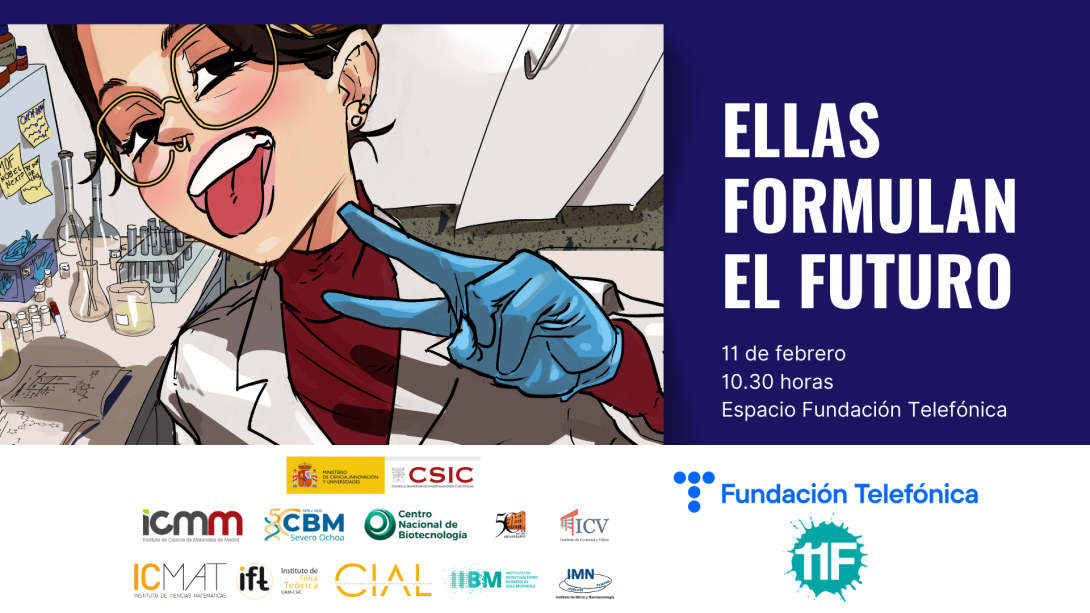
Illustration by Alejandro Silva Ybarnegaray (ICMM-CSIC)
The centres of the Spanish National Research Council (CSIC) located on the Cantoblanco Campus join Espacio Fundación Telefónica in Madrid to offer students in upper secondary education and sixth-form college scientific demonstrations on topics ranging from physics, mathematics and biology to curiosities such as why we like certain foods and not others
Date: 11 February 2026, from 10:30 to 13:00
Venue: Auditorium of Espacio Fundación Telefónica, Madrid (Calle de Fuencarral, 3, Centro, 28004 Madrid)
Fully booked
The programme consists of six scientific demonstrations led by women researchers
WORKSHOP 1. CIAL. Why do you like (or dislike) certain foods?
Have you ever wondered why there are foods you love and others you cannot even stand the smell of? Or why you start to like something, or stop liking it, over time? In this talk we will explore the main factors: physiological, genetic, psychological, biological, cultural and social, that shape the way we perceive, accept or reject certain foods
In addition, we will focus on understanding how our senses help us decide whether something seems pleasant to us or not, and we will explain some of the techniques used in research to study how we perceive food and why we eat what we eat
WORKSHOP 2. ICP. Catalysis: the invisible chemistry that moves the world
In this science outreach workshop we will explore what catalysis is and why it is one of the key ideas of modern chemistry. Through experimental demonstrations, we will show how catalysts make it possible to speed up chemical reactions, control their behaviour and direct the way energy is released in a chemical process
The session will begin with simple examples inspired by everyday life and will continue with more striking catalysed reactions, including processes in which chemical energy is directly transformed into light, as occurs in chemiluminescence reactions used in real applications
The aim is to present catalysis in an accessible and visual way, highlighting its fundamental role in understanding energy, matter and many current technologies
WORKSHOP 3. CNB. Plants: green allies of biotechnology
Would you like to know which plants are the Top Models of the laboratory? Come and meet them! In this activity, you will be introduced to the plant species most commonly used to study biological processes in a more efficient and simple way
You will discover the “laboratory mouse” of the plant world for the study of genes and cells. You will also learn which small plant can absorb toxic compounds, a true superhero in the cleaning of polluted water and the environment. And what about tobacco? In this workshop you will discover that the tobacco plant is key to the production of vaccines and other medicines
WORKSHOP 4. ICMAT. Mathematics in motion: a look into the world of fluids
In this workshop, phenomena related to fluids will be shown in an experimental and surprising way. In addition, the physical and mathematical laws underlying these phenomena will be explained, how mathematics makes it possible to describe surprising phenomena in the physical world, basic concepts of fluid modelling will be introduced and laws that determine the behaviour of fluids will be presented. Speaker: Mencía Reborido (ICMAT predoctoral researcher)
WORKSHOP 5. CBM. Visualisation of tissue tension using a bright-field microscope
We will bring a microscope connected to a laptop to observe live how the cellular structures of the samples we bring are stained (onion skin to observe plant cells, and/or a buccal swab from a volunteer in the audience to observe animal cells). We will explain microscopy techniques and what they are used for (observation of cellular structures and localisation of proteins and DNA in healthy and diseased/mutated cells and tissues). We will need to connect the laptop to the room screen so that the entire audience can “look” through the microscope and see the staining live
WORKSHOP 6. ICMM. Superconductivity: a fascinating phenomenon
Superconductors are materials that, at low temperatures, lose their resistance to the flow of electric current and can therefore conduct it without energy loss. Thanks to this property, superconductors have enormous potential for energy saving in our society. In addition, superconductors expel magnetic fields, giving rise to spectacular demonstrations of levitation. All these remarkable properties are explained by quantum physics. In this activity, staff from the Institute of Materials Science of Madrid explain superconductivity and demonstrate levitation, an effect that can not only be seen but also felt. Come and feel the force
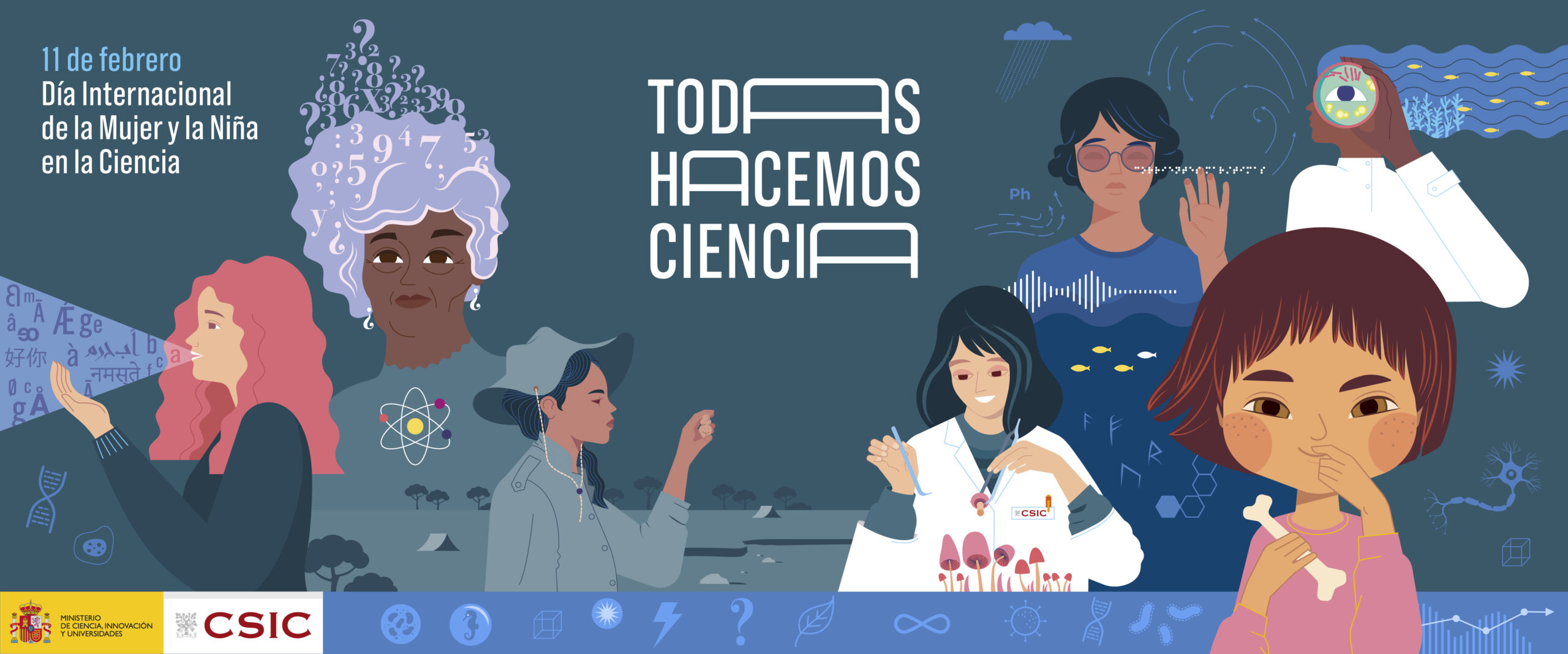
CSIC centres on the Cantoblanco Campus
The CSIC centres in Cantoblanco are the Institute of Materials Science of Madrid (ICMM, as organiser), the Institute of Ceramics and Glass (ICV), the Institute of Catalysis and Petrochemistry (ICP), the National Centre for Biotechnology (CNB), the Centre for Molecular Biology “Severo Ochoa” (CBM-SO), the Institute of Food Science (CIAL), the Institute of Theoretical Physics (IFT), the Institute of Mathematical Sciences (ICMAT), the Institute of Nano- and Microelectronics (IMN) and the Sols-Morreale Biomedical Research Institute (IIBM)