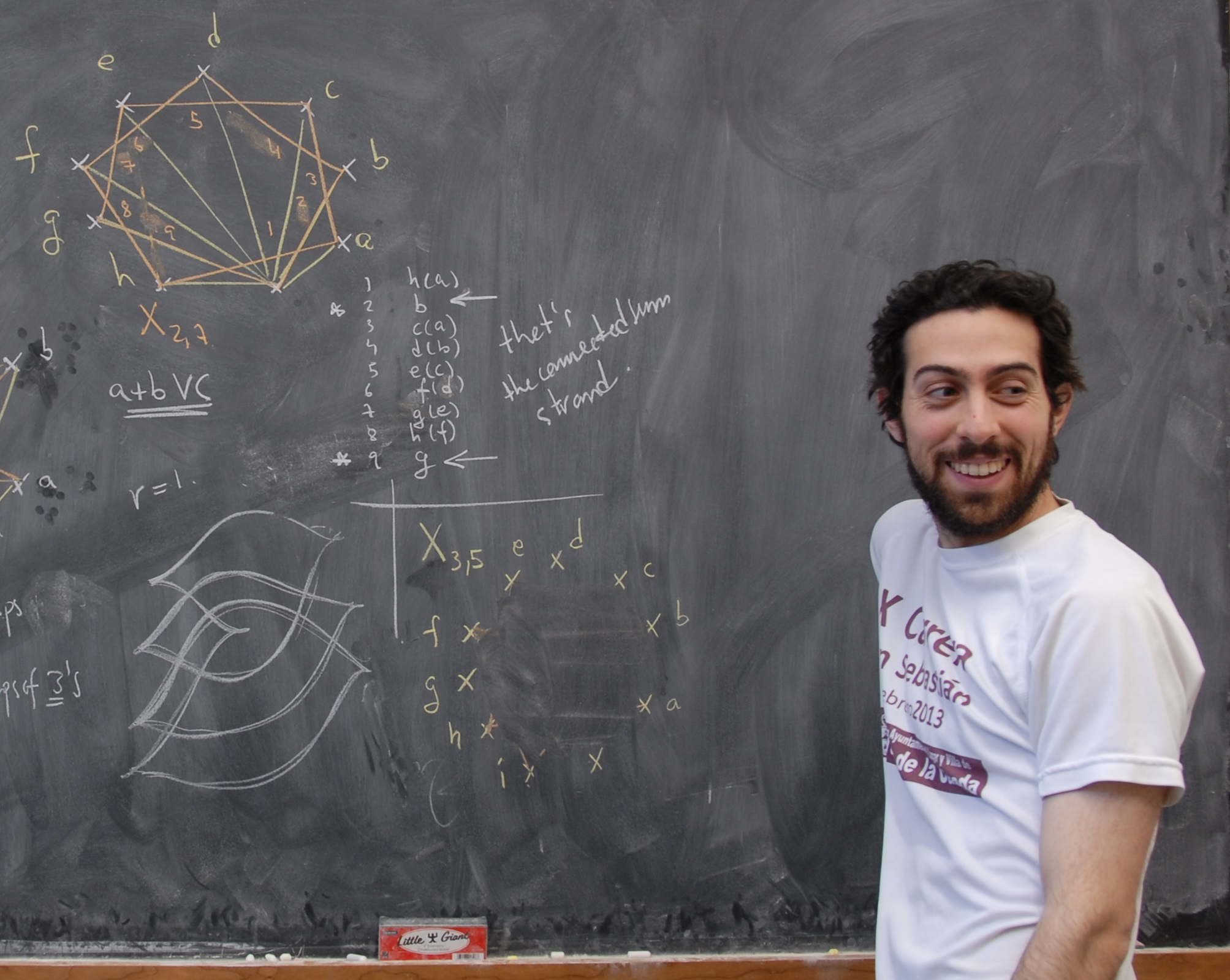
Roger Casals is an expert in symplectic and contact topology. Image courtesy of Roger Casals.
Roger Casals (1988, Barcelona)
Current position (as of October 2025): Professor of Mathematics at UC Davis (USA)
Research area: Symplectic and contact topology.
PhD at ICMAT: “Contact Fibrations over the 2-disk”, supervised by Francisco Presas Mata (ICMAT-CSIC). Defense: April 2015
Ágata Timón García-Longoria (ICMAT/CSIC)
Academic career
Roger Casals obtained his Bachelor’s degree in Mathematics from the Universitat Politècnica de Catalunya (2006–2011) and a Master’s degree in Mathematics from the Universidad Complutense de Madrid (2011–2012) through a La Caixa Foundation fellowship. In 2015, he earned his PhD in Mathematics at ICMAT and the Universidad Autónoma de Madrid, and then moved to the Massachusetts Institute of Technology (MIT) in the United States as a postdoctoral researcher. After spending a year at University College London (UK), Casals joined the University of California, Davis (USA) in 2018, where he has been a full professor since 2023. His research focuses on geometry and topology, particularly symplectic and contact topology. His contributions have been recognized with the José Luis Rubio de Francia Award from the Spanish Royal Mathematical Society, the Vicent Caselles Award from the RSME and the BBVA Foundation, the NSF CAREER Award from the National Science Foundation, the Sloan Fellowship from the Alfred P. Sloan Foundation, and most recently the MCA 2025 Award from the Mathematical Council of the Americas.
Doctoral stage at ICMAT
“The impact of ICMAT is evident in my working style: always striving for top-level standards and open to all kinds of mathematics”
“The impact of ICMAT on my development has been very positive, and it remains evident in my working style to this day: always striving for top-level standards and open to all kinds of mathematics,” says Casals. “My doctoral stage at the center was very rich intellectually, culturally, and personally. The scientific environment inspired me to raise my own working standards—to understand and do mathematics with more depth and seek connections with other areas. The stimulating activity—with seminars, the JAE Summer School—and the different visitors enriched my experience, resulting in highly productive years.”
Among the visitors, he recalls his first face-to-face encounter with a Fields Medalist. “Suddenly, we had to go pick up Simon Donaldson [then director of one of the ICMAT Laboratories] at the airport. Even in a rush, we had to go through the car wash first—I had never cleaned a car so thoroughly! Both he and his wife were delightful throughout the visit. For me, being so young, it was a very positive experience to spend time with top-level mathematicians beyond the office—during meals, dinners, and drives around Madrid,” he recalls.
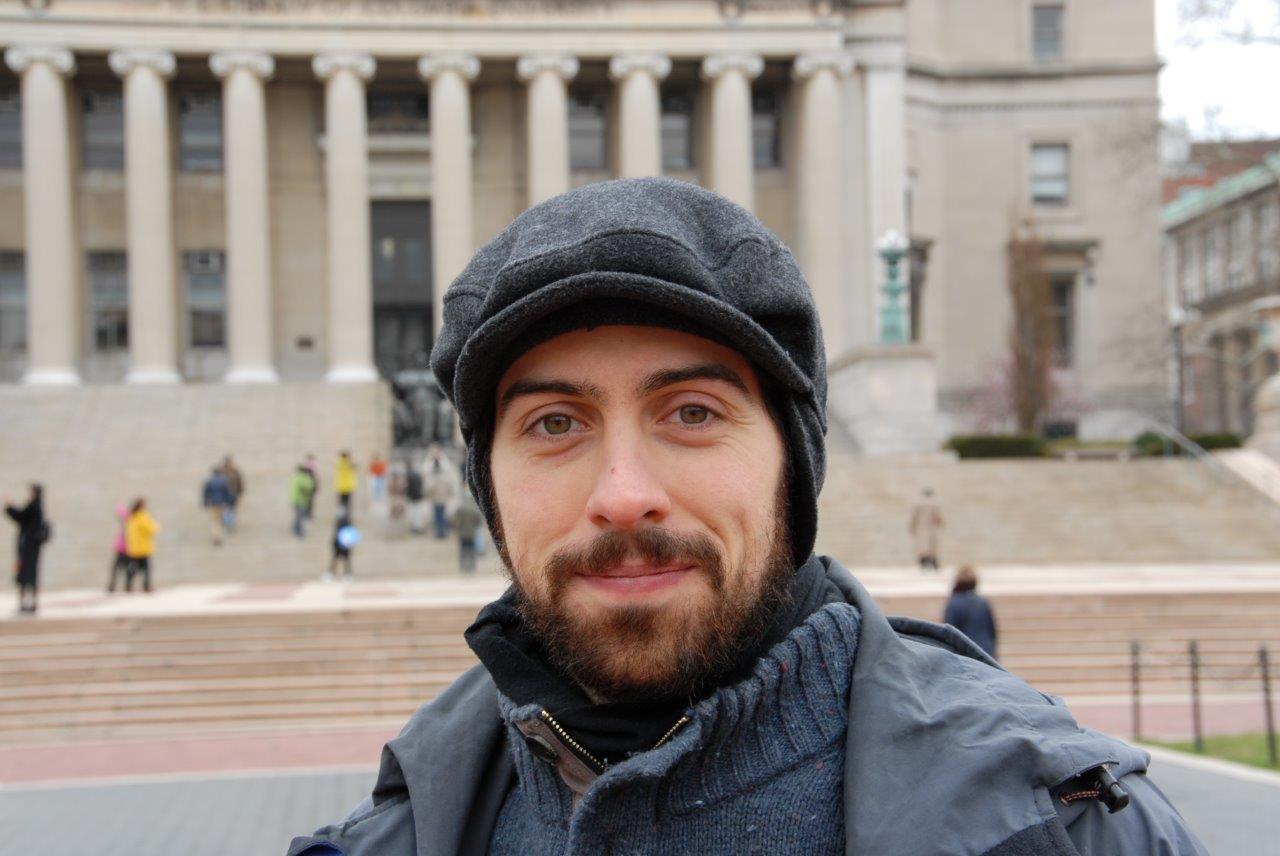
After his postdoctoral stays at MIT and University College London, Casals joined UC Davis, where he is now a full professor. Image courtesy of the researcher.
Enter the Matrix
Before starting his PhD, Casals held two JAE Intro fellowships at ICMAT, in two consecutive years: the first with Vicente Muñoz and Tomás Luis Gómez de Quiroga, and the second with Francisco Presas, who later supervised his thesis. “During that time, I learned what it truly means to understand something in depth. Those two summers were unforgettable. It was like going from riding a bicycle to driving a Formula 1 car. Suddenly, instead of solving undergraduate problems, we were reading research books in a matter of weeks and working on open problems. I still don’t know how we learned so much in so little time—it was an incredible experience. The JAE courses were also extremely helpful; I still fondly remember all I learned and the tools I still use today. Thanks to ICMAT’s top-level mathematicians and the time they devoted to my training, it was a bit like in the movie Matrix, when Neo has the programs installed directly into his brain and says, ‘I know Kung Fu.’”
Studying equations through geometry
Now, Roger Casals is a full professor at the University of California, Davis, in the United States. He studies equations from a geometric point of view—in other words, he uses geometric tools to understand the space of solutions to certain equations. “For example, I analyze whether solutions exist or not—that is, whether the solution space is empty or not—and if they do exist, what geometric shape this space has: does it resemble a sphere, a torus, or a more general space?” explains Casals. In particular, he studies equations that are algebraic—with polynomials or rational expressions—or analytic—with exponentials. “The motivation to understand these solution spaces comes from other branches of science, such as physics, chemistry, or biology. The geometry of these spaces is mathematically rich and often has an underlying dynamical component, for instance, describing the evolution of a system over time,” he adds.
Symplectic and contact topology—his areas of specialization—have interactions and implications in various branches of physics and engineering, such as thermodynamics, geometric optics, control theory—which allows machines to be controlled—or the study of periodic orbits in dynamical systems. “Part of symplectic topology was born from studying the stability of the solar system,” Casals notes. “Symplectic and contact topology can be applied in many situations where standard calculus has serious shortcomings. Often, a singularity is actually a smooth object in higher dimensions if projected singularly. This allows us to reach correct answers that otherwise we wouldn’t know how to obtain,” he explains.
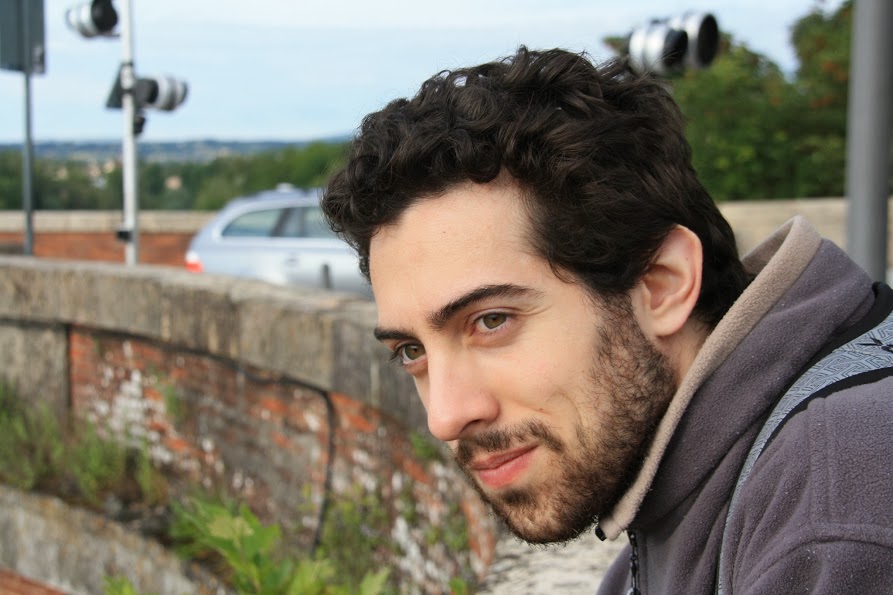
Before starting his PhD, Casals received two JAE Intro fellowships at ICMAT, which introduced him to mathematical research. Image courtesy of the researcher.
Creator of new techniques to solve open conjectures
“I am passionate about working on problems for which no existing technique is available. This forces me to be creative and develop new theories from scratch.”
In his research, Casals develops new methods to understand and manipulate solution spaces. “Sometimes this requires introducing a new kind of calculus, such as the manipulation of Stein handlebodies and Legendrian surgeries that I developed at MIT, or the diagrammatic calculus of weaves, which I introduced during the pandemic and which has solved several open conjectures in both topology and commutative algebra,” he says.
“I am passionate about working on problems for which no existing technique is available. This forces me to be creative and develop new theories from scratch—with new methods, new concepts, and new types of results. When this is built solidly and in detail, it almost automatically leads to answers to open questions. It’s an intimate process of creation that happens day by day in the silence of the office and the intensity of thought, where part of you and part of mathematics intertwine intrinsically. And then, it’s beautiful when other mathematicians get excited and start using the methods you’ve developed. That’s the moment when I move on to think about the next question, starting from zero,” he describes.
Geometries indistinguishable by algebra
Casals is interested in geometric spaces that cannot be distinguished using algebraic tools. “In basic situations, algebra can determine when two geometric spaces are different—for example, if they have different kinds of holes. However, if from an algebraic viewpoint two spaces look the same, are they really the same?” reflects Casals. “Often, algebra cannot detect all the geometry, but there are important results—such as h-cobordisms or h-principles—that surprisingly show that sometimes it can,” he says. “I have very good memories of the first time I learned such a result: it was with Tomás Luis Gómez de Quiroga [ICMAT-CSIC] at ICMAT, and with Vicente Muñoz [Universidad Complutense de Madrid],” he adds.
“These situations, where nobody knows how algebraic tools might help, are the ones that attract me the most. They force me to do geometry: often the best way to solve the problem is to develop a completely different approach,” says Casals. To tackle a problem, he believes it is best “to keep the door open to any tool, even if it seems a remote possibility and learning how it works is a challenge.”
A research field yet to be explored
“It’s like living in an amusement park, except you never know which ride you’re on”
This creative approach is ideal for his research field, in which “almost all the basic questions remain completely open.” “For example, we have no idea whether the symplectic symmetry group of a standard 6-dimensional ball has more than one connected component. I could list 100 such questions that a first-year PhD student could come up with. We don’t know the answers, nor even how to begin to approach them,” he explains. The unexplored nature of the field makes it especially exciting for Casals. “It’s like living in a mathematical amusement park, except you never know which ride you’re on, or how—or when—it ends,” he describes.
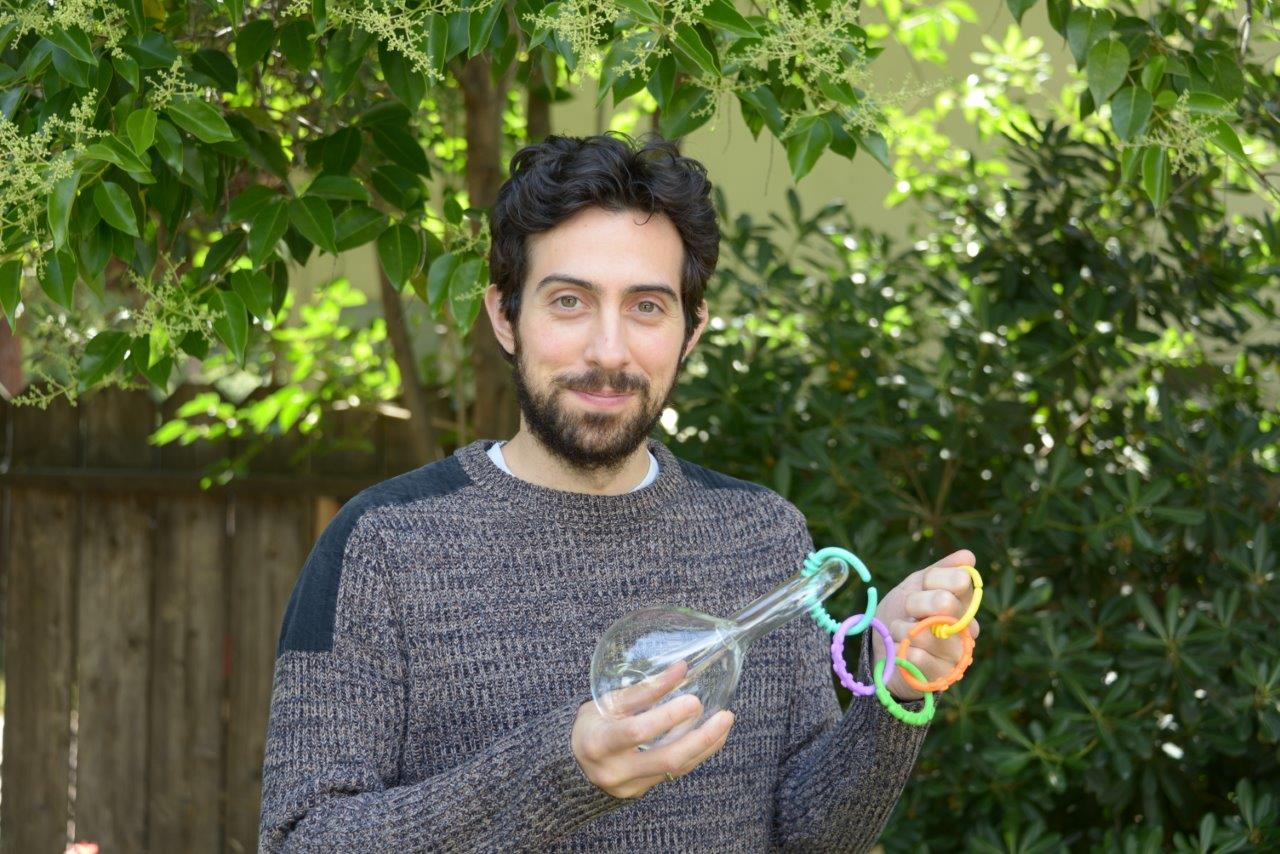
Beyond mathematics, Casals enjoys spending time with his family—at home, at the park, cycling around town, or swimming. Image courtesy of the researcher.
ICMAT Alumni
ICMAT Alumni features profiles of researchers who completed their PhD theses at ICMAT and who currently have recognized academic careers.
If you would like to start a PhD at ICMAT, you can check our job opportunities page, where calls for predoctoral contracts are regularly published.
Note: This is an automatic translation. Some nuances may differ from the original Spanish version.