Interview with Mario García Fernández (ICMAT-CSIC), winner of the CSIC’s 2026 María Moliner Award for Early-Career Doctoral Supervision

Mario García giving a short course as part of GAAG (2025) at the Instituto de Matemática Pura e Aplicada (IMPA, Brazil).
One of the four María Moliner Awards of the Spanish National Research Council (CSIC), which recognise the best early-career supervision of doctoral theses within the organisation, went this year to Mario García Fernández, a CSIC tenured scientist at the Instituto de Ciencias Matemáticas (ICMAT). The prize, worth €6,000 and now in its third edition, honours those who show an exceptional commitment to training new researchers.
This is certainly true of García Fernández, an expert in differential and algebraic geometry with deep connections to geometric analysis and mathematical physics, who has no hesitation in placing the training of new researchers at the heart of his scientific work — both for its human and its professional value. He currently supervises two theses at ICMAT and two more at institutions in Brazil and France. He also acts as a tutor on the Mathematics Intensive Programme and other ICMAT initiatives introducing young people to research.
What role does thesis supervision play in your day-to-day work?
I spend several hours a week in meetings with each of my doctoral students, giving them both the technical support they need for their research and mentoring for their research careers. The problems I work on require very demanding training in different areas of mathematics, such as differential geometry, geometric analysis, algebraic geometry or algebra. What’s more, my line of research interacts very closely with theoretical physics, so students sometimes need a basic grounding in certain mathematical aspects of field theories. This makes the first years of the doctorate very tough, and close supervision essential.
“The final year of a thesis is usually very exciting: you see [the students] take part in discussions as fellow professionals, as equals”
And what does it bring you?
It’s very rewarding work, watching people who are just starting out in mathematical research evolve — from the early days, when they have only the basic knowledge from their degree or master’s, to the final year of the thesis, by which point they have become experts in a cutting-edge research topic. The last year is usually very exciting; you see them contributing ideas, taking part in conversations as fellow professionals, as equals, with tremendous enthusiasm. Beyond this more human side, supervising doctoral theses also brings me a great deal scientifically. In the early stages of the doctorate I assign each student a basic problem, which helps guide and direct their studies across different topics, and which usually becomes the seed of their thesis problem. I try to propose problems that help trainees find their own space, according to their interests, with a view to their future scientific independence. In this process, new ideas or new approaches often emerge to problems I had previously worked on alone — sometimes contributed by the students themselves.
What advice would you share about supervising doctoral theses? Something nobody told you, that you had to learn from experience.
I think people underestimate the time and effort involved in supervising a doctoral thesis. It’s a job that takes several hours a week, sometimes spent in face-to-face meetings, other times on individual work by the supervisor, to gauge future difficulties and properly calibrate how hard the proposed problem should be. You also need to have confidence in your students’ potential and abilities. It’s important to be generous with the problems you offer, proposing interesting questions that a senior researcher could probably solve in far less time.
“You have to be generous with the problems: offer interesting questions that a senior researcher could solve in far less time”
A senior researcher, or… artificial intelligence (AI)? What impact do you think these models could have on training new researchers in mathematics?
This is undoubtedly another major issue in training research staff. The use of artificial intelligence is gradually changing the way we do mathematics. Indeed, the mechanical problems that used to be set for a student to get them started on certain techniques, and which could take months to bear fruit, can now be done by a well-trained AI in a single morning. A few weeks ago, together with two collaborators in Hamburg and London and one of my former students, Andoni de Arriba, we carried out some algebraic calculations with the help of Gemini [Google’s family of AI models] that took us one afternoon, and which could have been a first-year doctoral student’s task.
But I don’t think we should dismiss the impact that the process of obtaining results — whether positive or not — has on a person’s development. Our minds learn through this process, and if we don’t put them through it, we are limiting the ability of new generations to do science. I think we should embrace AI as a powerful and valid tool, while at the same time making sure that new generations of researchers are able to check the veracity of the results the machine produces. And that can only be achieved by working hard, unaided, on problems.
How do you think this new scenario can be approached?
Perhaps one compromise is to keep doing calculations meticulously by hand in relatively simple cases — what we usually call “toy models” — to build intuition and ideas, while leaving the more sophisticated examples, which could take a person years to work out, to the machine. Students should use AI, but they need to learn to do so with judgement.
“One of the biggest problems is the gender gap: very few women go on to do a doctorate in geometry”
Beyond that, what do you think are the most important challenges facing mathematical research training today?
I would say that one of the biggest problems is the gender gap, at least in the field of geometry. Very few women pursue doctoral studies in this area. We need to change certain dynamics to increase the number of female doctoral students in our field. Another very important problem is inclusion for people with disabilities. We are encountering a great many institutional obstacles preventing one of our students, who has a disability, from making research trips to conferences on equal terms with other young people in our group.
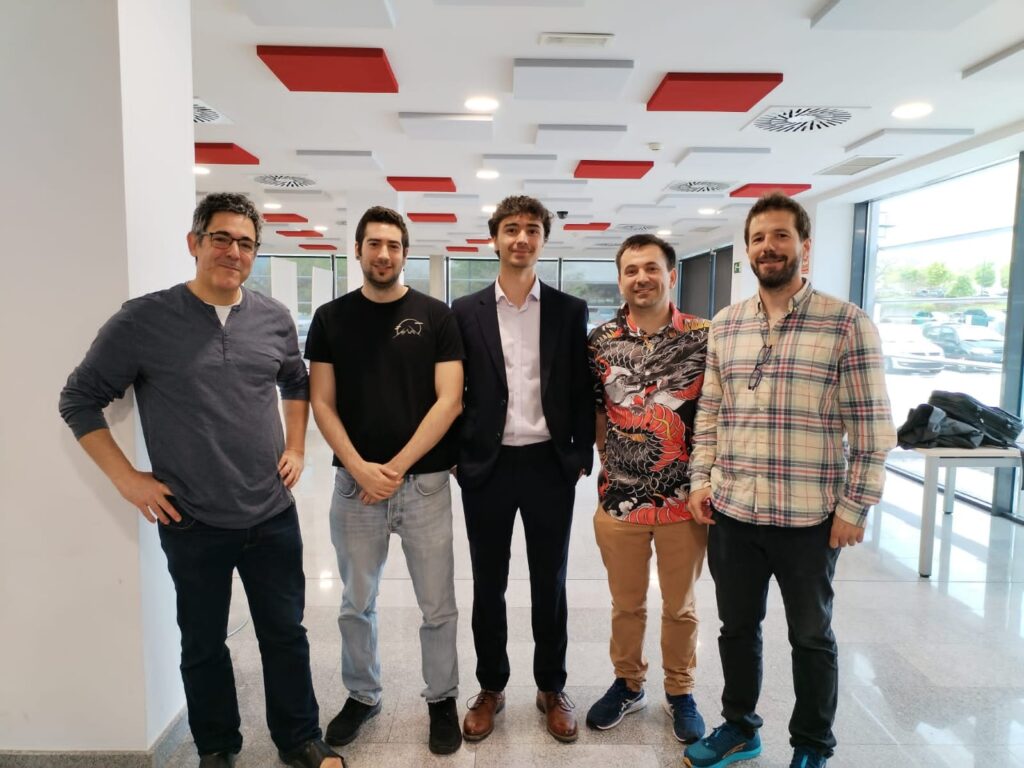
In the photo, taken after Roberto Téllez’s thesis defense (from left to right): Luis Álvarez Cónsul, Raúl González Molina, Roberto Téllez Domínguez, Andoni De Arriba De la Hera, and Mario García Fernández. Credit: Photo courtesy of the researcher.
How many theses have you supervised or are you currently supervising?
To date I have completed the supervision of three doctoral theses: that of Andoni De Arriba De la Hera (who defended his work at the Universidad Complutense de Madrid in 2023), on mathematical aspects of two-dimensional conformal field theories; that of Raúl González Molina (who received the Special Doctoral Award at the Universidad Autónoma de Madrid, UAM, in 2024), which addressed existence results for supersymmetry equations in string theory; and that of Roberto Téllez Domínguez (at UAM in 2025), who studied a new approach to the complex geometry of the solution space of those equations. The first and third were co-supervised with my colleague Luis Álvarez Cónsul (ICMAT-CSIC). I am very proud of all three, both for their achievements during the thesis and for their current research careers at various universities.
I am currently also supervising two further doctoral theses at ICMAT, by Alfredo Llosa Lazo and Néstor Blázquez Hernán-Gómez; another at Unicamp (Campinas, São Paulo), by Agnaldo da Silva, co-supervised with Henrique Sa Earp; and I have recently begun supervising another at ENS Lyon, by Jean Chessa, co-supervised with Eveline Legendre.
What gave you the most “respect” when you started supervising theses?
Without doubt, starting to supervise Raúl González: he was my second student and the first I supervised on my own. I spent a great deal of time thinking about his thesis problem, so that it would be well balanced in terms of difficulty and interest while also suiting his mathematical skills and tastes. I’m very pleased it turned out to be a success, resulting in a publication in the Journal für die reine und angewandte Mathematik in 2025.
Mario García Fernández has been a CSIC tenured scientist at ICMAT since January 2024. His research focuses on differential and algebraic geometry, with close links to geometric analysis and mathematical physics. His main lines of work cover special metrics and connections in Kähler and non-Kähler complex geometry, spin geometry, generalised geometry, and the theory of moduli spaces. He has published articles in journals such as the Journal of the European Mathematical Society, Journal of Differential Geometry, Crelle’s Journal, Journal de Mathématiques Pures et Appliquées, Advances in Mathematics, Geometry and Topology, Proceedings of the London Mathematical Society and Communications in Mathematical Physics. Before joining CSIC as a civil servant, he was a Ramón y Cajal researcher (2020–2023) and a lecturer at the Universidad Autónoma de Madrid (2017–2019), the institution where he received his doctorate in 2009. Prior to that, he was a Marie Sklodowska-Curie Individual Fellow at ICMAT (2015–2017) and a postdoctoral researcher in ICMAT’s Nigel Hitchin Laboratory (2014–2015), at the École Polytechnique Fédérale de Lausanne (2013–2014) and at the Centre for Quantum Geometry of Moduli Spaces in Aarhus (2010–2012). He has also held research stays at the Max Planck Institute for Mathematics (Bonn), Humboldt University (Berlin) and the Hausdorff Institute for Mathematics (Bonn).
This text is an automatic translation from the original Spanish version.