
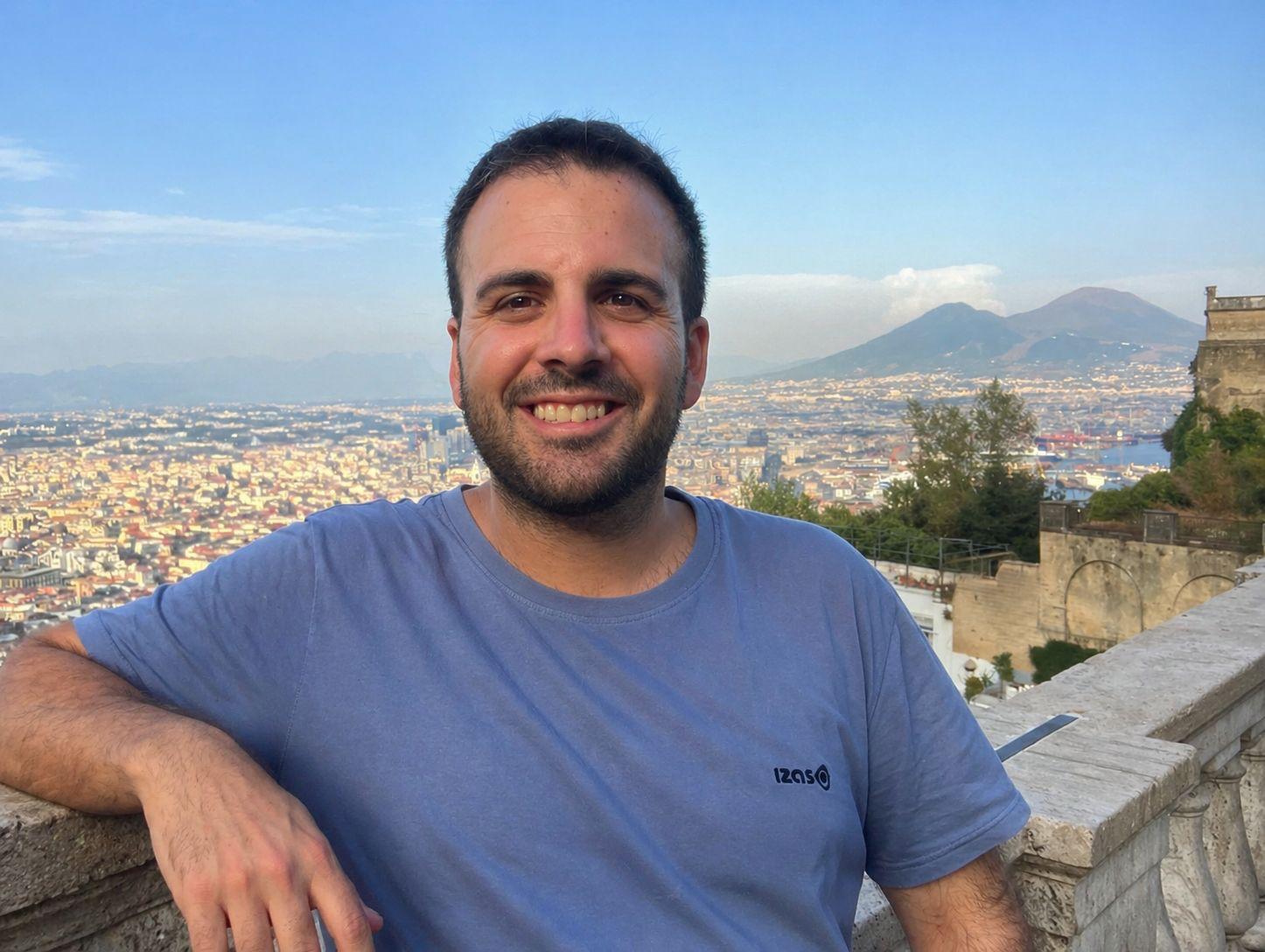
[caption] Antonio J. Fernández is an expert in partial differential equations. Image courtesy of the researcher.
Ágata Timón (ICMAT-CSIC)
At the end of April, Antonio J. Fernández, a Ramón y Cajal researcher at the Autonomous University of Madrid and a member of ICMAT, received unexpected news. The Spanish Society for Applied Mathematics had decided to award him the 29th SeMA “Antonio Valle” Young Researcher Prize (2026). “I had never received recognition of this kind before and it has been a great joy. It is a great honour that the scientific community appreciates my work,” he says.
The committee of the award, one of the most prestigious distinctions for young mathematicians in Spain, highlighted that “Antonio J. Fernández possesses the merits that this prize seeks to recognise: excellence in original mathematical work with an applied component, clearly identifiable personal contributions, and scientific creativity developed independently after the doctoral thesis. His profile combines quality, maturity, leadership and internationalisation.”
Fernández is an expert in partial differential equations. He has worked on a variety of problems in fluid mechanics, which he studies using tools from analysis and differential geometry. After earning his PhD in Mathematics in France, through a joint programme of the University of Franche-Comté and the Polytechnic University of Hauts-de-France, he carried out postdoctoral stays at the University of Bath (United Kingdom) and at ICMAT, experiences that the award committee highlighted as a key factor in the development of his independence as a researcher.
“Scientific creativity developed independently after the doctoral thesis” is one of the reasons cited by the jury when awarding you the 2026 SeMA Antonio Valle Young Researcher Prize. Was there a specific moment when you felt you were finding your own path as a researcher?
The line of research I am currently developing began to take shape during my first postdoctoral stay at the University of Bath. By the end of my PhD, I had a firm objective: to find a line of research of my own, independent from that of my PhD supervisors.
And where did that objective lead you?
A common pattern in the most recent projects I have worked on is that in all of them, solutions are constructed “by hand”, and therefore their behaviour is well understood. I am not only interested in proving the existence of solutions for certain equations, which is mainly what I did during my PhD, but also in understanding their shape and behaviour.
After working in Bath, you joined ICMAT. You speak of that stage as a turning point. What exactly changed?
My postdoctoral stay at ICMAT, with Alberto Enciso (ICMAT-CSIC), changed both the topics I study and the type of problems I tackle, as well as the way I approach them. I believe it represented a major leap forward in my scientific career. I continue to collaborate with many people at the institute, not only with Alberto, but also with Ángel Castro (ICMAT-CSIC), David Meyer (now at the Max Planck Institute for Mathematics in the Sciences in Leipzig, Germany), and Daniel Peralta (ICMAT-CSIC).
What area does your research belong to?
Broadly speaking, my research falls within the analysis of partial differential equations. In the words of Xavier Ros-Otón, “the equations that move the world”, since they model a vast number of physical and natural phenomena. I am particularly attracted to equations arising from fluid mechanics, such as the Euler equations, and also to equations that originate in geometric problems, such as the Yamabe equation.
Is there a problem that currently fascinates you?
The problem that interests me most today is whether Schiffer’s conjecture is true or false. I find it fascinating that a problem with such a simple formulation—one that a second-year mathematics undergraduate can understand—can be so difficult to solve. It is also a problem that somehow lives at the intersection of analysis and geometry, two areas that greatly interest me.
It is also closely related to Pompeiu’s problem, an inverse problem that, in addition to its purely mathematical interest, has many applications in tomography and image reconstruction. Again, this problem has a very simple formulation, yet we know very little about how to solve it, even though it was proposed almost one hundred years ago.
What is the current status of Schiffer’s conjecture? Do you think we will see a complete solution in our generation?
I think that, within the mathematical community, perceptions regarding Schiffer’s conjecture have changed in recent years. While in the 1980s and 1990s there were many partial results suggesting it was true, recently several results have pointed towards the conjecture being false. In addition, a major technical obstacle to constructing counterexamples has been overcome. I would like to think that within the next ten or twenty years we may see one.
You already hold a Ramón y Cajal fellowship and lead a national research project as principal investigator, which is no small achievement at your age. What would you say to someone beginning a PhD in mathematics and wondering whether pursuing a research career is worthwhile?
For me, it has undoubtedly been worthwhile. Of course, it has its good sides and its bad sides, but I am very happy with this choice.
You completed your PhD in France and your first postdoc in England. You spent many years abroad before returning to Spain. What would you say to a young Spanish researcher wondering whether to leave or stay?
The five years I spent abroad were crucial to my development, but I believe mathematical research in Spain is improving significantly and very rapidly. Today there are several world-leading researchers who have chosen to establish themselves here, and developing a scientific career in Spain is a very good option. In my opinion, combining a period abroad with building a scientific career in Spain is the ideal path.
This is an automatic translation of the original Spanish text. In case of any discrepancy, the Spanish version shall prevail.