
New research shows that certain geometric rigidity breaks down when considering domains with two boundaries. By studying a relaxed version of Schiffer’s famous conjecture, Alberto Enciso (ICMAT-CSIC), Antonio J. Fernández (Autonomous University of Madrid), David Ruiz (University of Granada), and Pieralberto Sicbaldi (University of Granada) have discovered new spectral solutions in ring-shaped domains, revealing unexpected connections with the existence of steady fluid flows without radial symmetry.
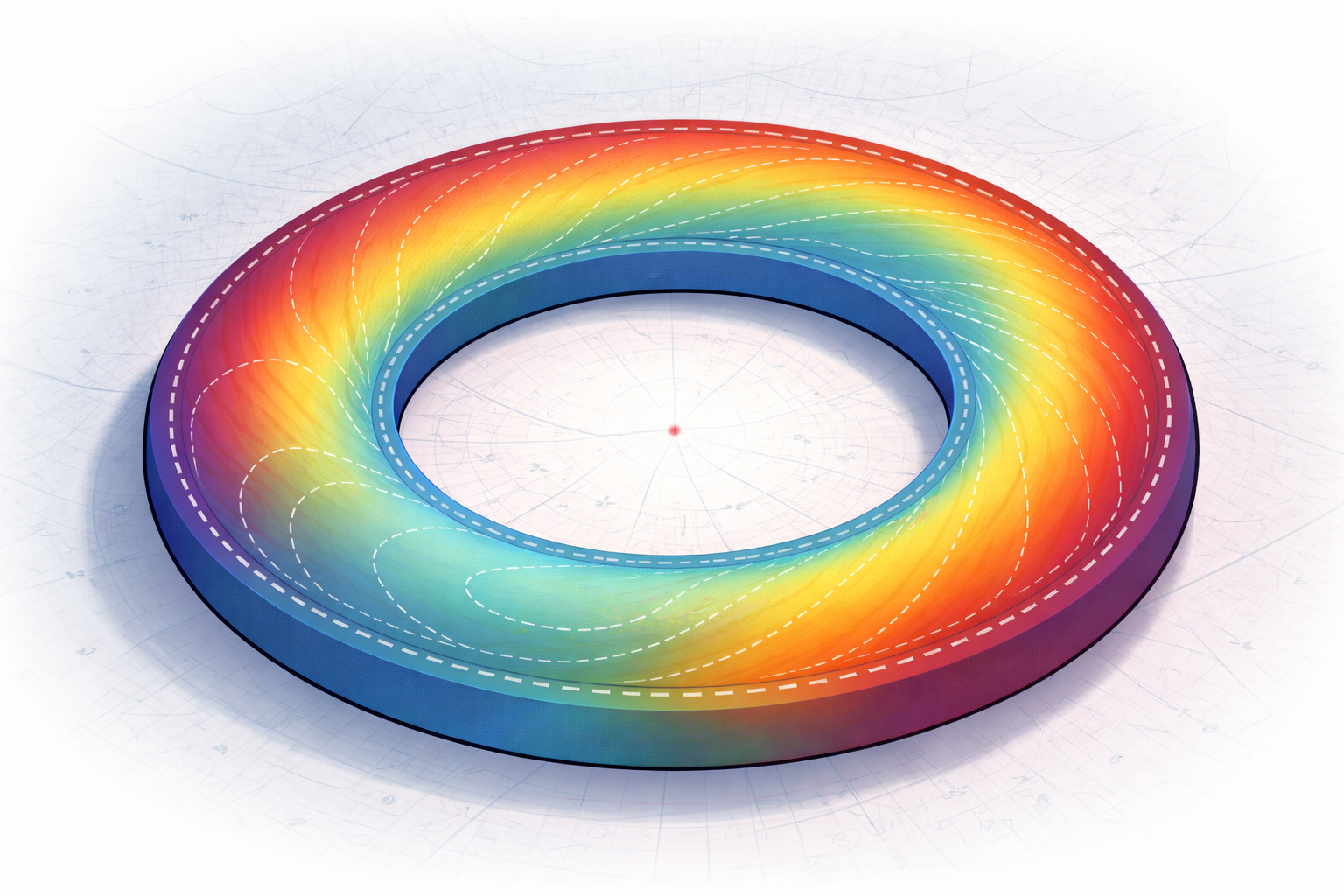
A new result studies a relaxed version of Schiffer’s problem in flat domains with two boundary components, such as rings. Image generated with AI.
The shape of the region of space where a problem arises (the domain) profoundly influences the physical and mathematical phenomena that can occur. The precise way in which this happens is studied by spectral geometry, an area of mathematics that analyses how the topology or geometry of an object influences the operators defined on it. This allows us to understand, for example, how the shape of a drum affects the sound it produces.
The shape of the domain can also determine the movement of a fluid inside it. For example, whether or not the flow has symmetries, whether it is confined to a specific region, or whether it can have more complex structures. One of the best-known problems in this field is Schiffer’s conjecture, formulated in the 1950s, which predicts strong geometric rigidity: if a flat domain admits eigenfunctions of the Laplace operator that are constant on the boundary, then that domain must necessarily be a disc. This result, confirmed in numerous contexts, suggests that imposing seemingly simple spectral conditions can very strictly determine the geometry of the domain.
Now, in ‘A Schiffer-type problem for annuli with applications to stationary planar Euler flows’, Alberto Enciso (ICMAT-CSIC), Antonio J. Fernández (Autonomous University of Madrid), David Ruiz (University of Granada) and Pieralberto Sicbaldi (University of Granada) question this rigidity by studying a relaxed version of Schiffer’s problem in flat domains with two boundary components, such as rings. In this new approach, eigenfunctions are sought that are constant in each component of the boundary, although not necessarily with the same value.
The main result demonstrates the existence of non-trivial solutions in doubly connected domains, which implies that, by allowing a second boundary and slightly relaxing the conditions, domains other than the disc appear that admit this type of eigenfunctions.
This finding shows that Schiffer’s phenomenon does not literally extend to rings. Surprisingly, the breakdown of rigidity is not total: the problem still exhibits very strong rigidity properties, of the same type as in the original conjecture. That is, although new examples exist, they are strongly restricted by the geometry of the domain.
Beyond its theoretical interest, the result has direct applications in fluid mechanics. In particular, it allows us to construct stationary flows of the plane that satisfy Euler’s equations, are continuous in the Lipschitz sense, have compact support, and do not exhibit radial symmetry. These types of solutions provide new explicit examples of stationary flows with complex geometries, expanding the known repertoire and reinforcing the link between spectral geometry and fluid dynamics.
Reference
Alberto Enciso, Antonio J. Fernández, David Ruiz, Pieralberto Sicbaldi “A Schiffer-type problem for annuli with applications to stationary planar Euler flows,” Duke Mathematical Journal 174(6), 1151-1208, (15 April 2025)