
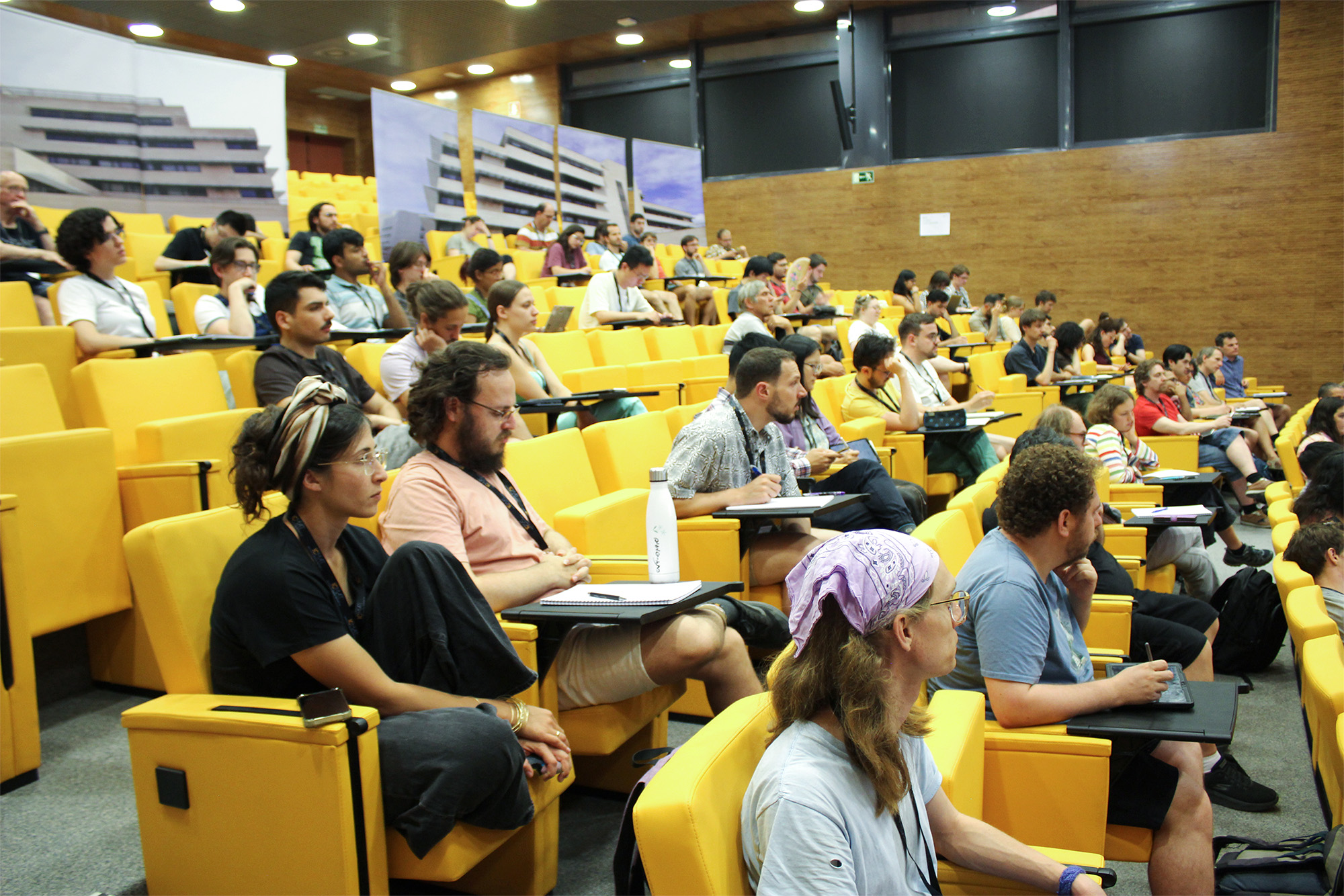
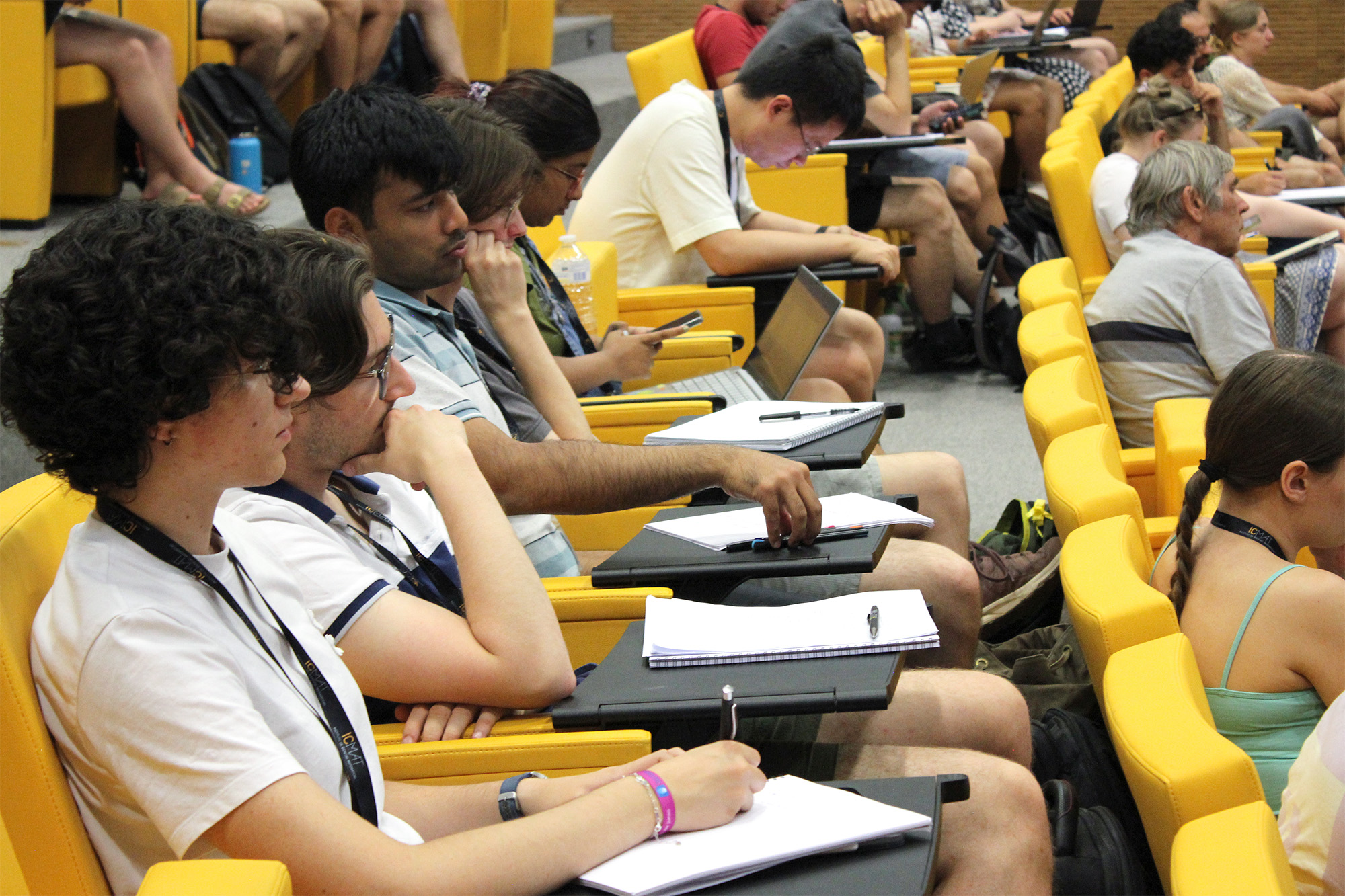
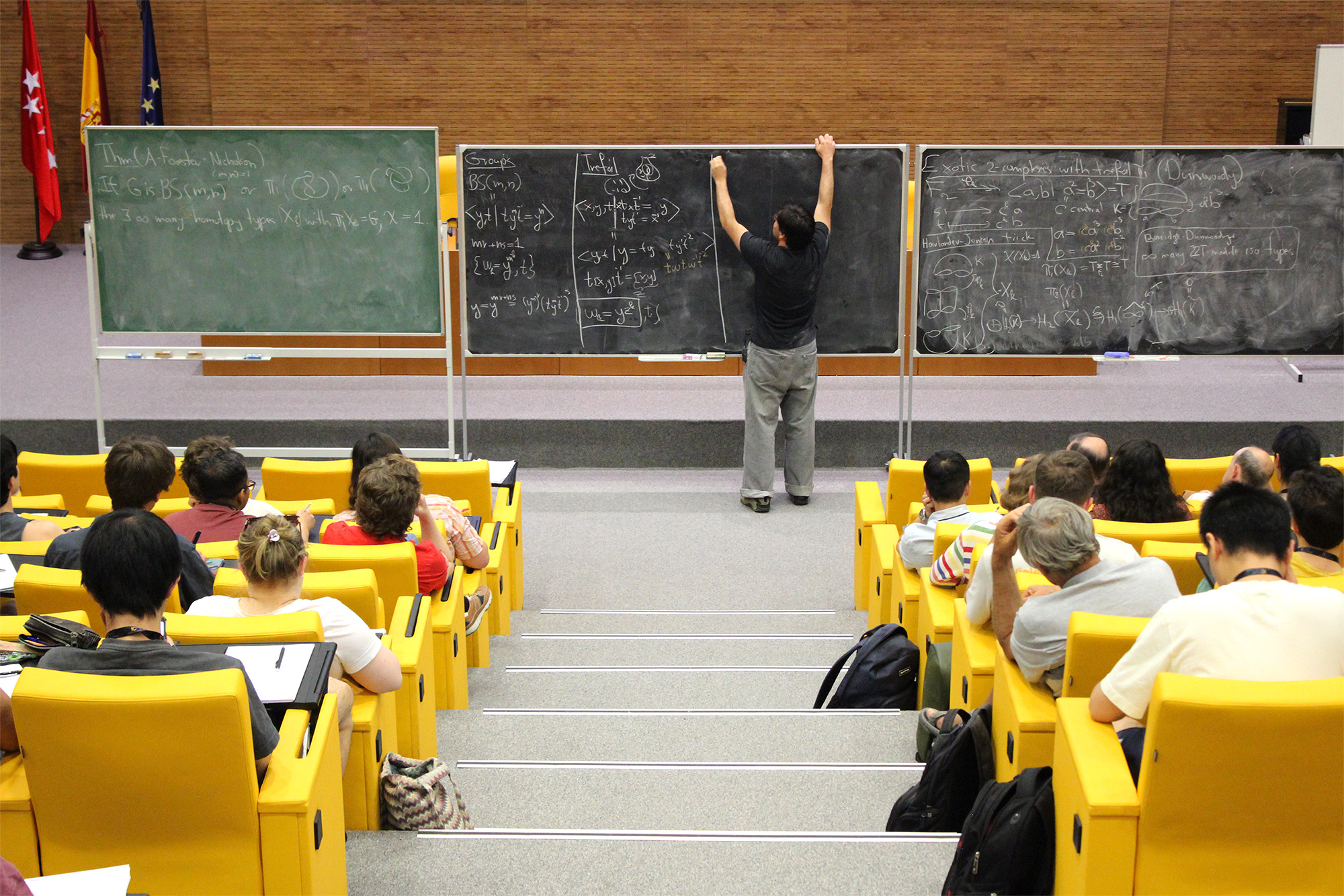
The advanced school Aspherical 2-complexes and their fundamental groups: past, present, and future is part of the ICMAT’s Bridson-Reid Laboratory. Images: Laura M Iraola/ ICMAT.
Ágata Timón (ICMAT-CSIC)
From 22 to 26 June, the Institute of Mathematical Sciences (ICMAT) is hosting the advanced school Aspherical 2-complexes and their fundamental groups: past, present, and future, an event bringing together some of the most prominent researchers in geometric group theory to address one of the most widely studied objects in the field: aspherical 2-dimensional complexes.
The school, organised as part of the ICMAT’s Bridson-Reid Laboratory, combines a series of introductory lectures by Jim Howie (Heriot-Watt University), Marco Linton (ICMAT) and Henry Wilton (University of Cambridge), designed to lay the groundwork for both classical results and recent developments, alongside a programme of research talks given by specialists in the field.
What is an aspherical 2-dimensional complex?
In topology, a complex is a way of constructing spaces by gluing together simple pieces (such as points, line segments, triangles or polygons, for example). When these pieces have at most two dimensions (points, lines and flat faces, with no “volumes”), this is known as a 2-dimensional complex.
Being aspherical relates to the absence of certain types of “holes”. This property is important because, when it holds, the complex is determined by its so-called fundamental group: two aspherical complexes with the same fundamental group are, in essence, “the same”. This turns aspherical 2-complexes into a bridge between algebra (the study of groups) and geometry and topology, which is precisely the territory of geometric group theory.
Over recent decades, researchers in this field have studied these objects intensively. Which groups can arise as the fundamental group of an aspherical 2-complex? How can this property be recognised from the algebraic presentation of a group? Or, what relationship does it bear to classical problems such as the word problem?
The ICMAT’s Bridson-Reid Laboratory
The school forms part of the Bridson-Reid Laboratory, one of the projects within the ICMAT’s Severo Ochoa programme, coordinated by Andrei Jaikin, research professor at the Spanish National Research Council (CSIC) at the ICMAT.
The laboratory is led by Martin Bridson, Professor at the University of Oxford and Director of the Clay Mathematics Institute, and Alan Reid, Professor and Chair, since 2008, of the Department of Mathematics at Rice University (USA).
The Laboratory aims to make progress on fundamental mathematical problems such as the word problem, profinite rigidity (linked to the Remeslennikov conjecture, formulated more than 50 years ago), and the classification of groups with specific geometric properties.
⚠️ This is an automatic translation. For the original version, please see the Spanish text.