- Javier Parcet (ICMAT-CSIC) receives an ERC Advanced Grant from the European Research Council, one of the most competitive and prestigious awards in European research.
- The project will address the elusive Connes rigidity conjecture, which involves classifying complex mathematical structures arising from quantum mechanics that make it possible to model systems with numerous variables and symmetries.
- Parcet will also be an invited speaker at the International Congress of Mathematicians 2026, to be held in July in Philadelphia (USA).
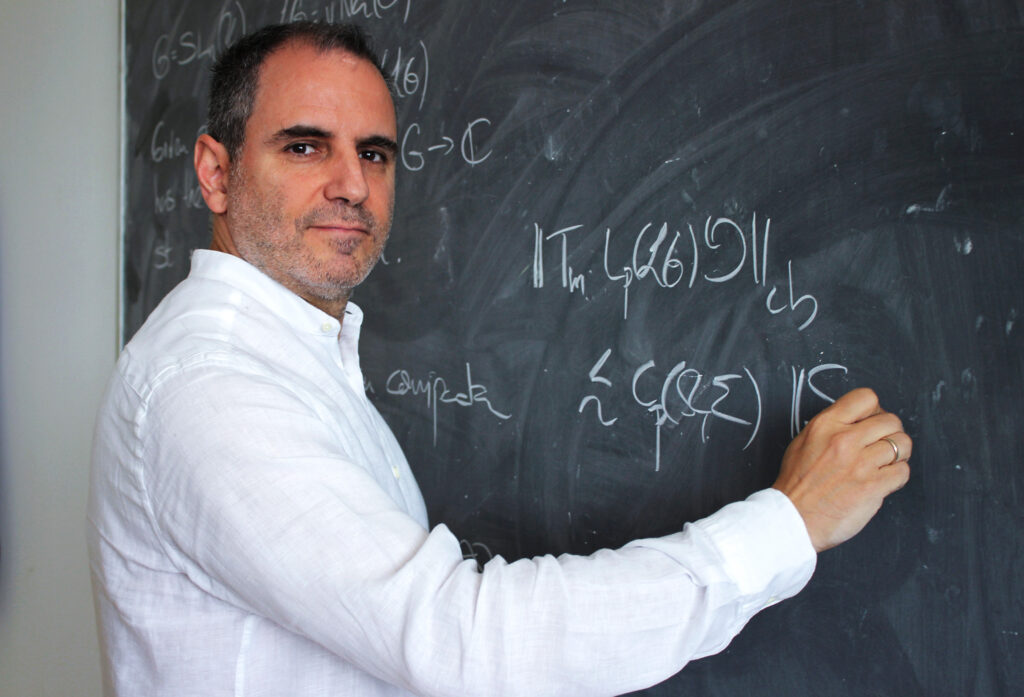
Javier Parcet is a CSIC research professor at ICMAT. Image: Laura M Iraola/ICMAT.
Ágata Timón (ICMAT-CSIC). Quantum mechanics has transformed not only physics but also mathematics. In the 1920s, Werner Heisenberg showed that the subatomic world could not be described using only the ordinary functions of classical physics. What was needed were matrices and more general transformations with a disconcerting property: they do not always commute. In other words, order matters: applying A first and then B does not necessarily give the same result as applying B first and then A. To give mathematical rigor to this new physics, the mathematician John von Neumann introduced in the 1930s the structures that today bear his name: von Neumann algebras. They can be thought of as large mathematical architectures capable of modeling systems with many variables and symmetries, not only in quantum mechanics but also in analysis, geometry, or group theory.
Since then, one of the great ambitions of this field has been to classify them: to know when two of these structures are essentially the same and when they are truly different. As with the chemical elements in the periodic table, the challenge is to find the properties that allow ordering a vast universe of objects and recognizing them by their fundamental traits. Now, the European Research Council (ERC) has awarded an ERC Advanced Grant to the SMARP project (Schur Multipliers and Rigidity Phenomena) led by Javier Parcet, research professor of the Spanish National Research Council (CSIC) at the Institute of Mathematical Sciences (ICMAT), to advance this problem. It is one of the most competitive and prestigious funding schemes in European science, endowed with more than 1.8 million euros over five years. This was one of nine projects selected in this call within the mathematics field, the only one in Spain.
The project aims to shed light on the famous Connes rigidity conjecture, one of the great open problems in the field, which seeks to complete a very important region of that periodic table. Parcet’s central idea is as profound as it is suggestive: to distinguish certain highly relevant von Neumann algebras by showing that each one possesses, in a certain sense, its own “spectrum of tones.” If that spectrum could be heard and shown to change from one algebra to another, a way to recognize them would have been found. It is a quantum form of a classic mathematical question: can you hear the shape of a drum?
“The ERC Advanced Grant boosts the momentum we are experiencing and will allow me to strengthen the team, with talented students and top-level postdocs. We will be able to channel a great deal of energy into the rigidity conjecture and related questions,” explains Parcet.
The researcher’s strategy differs radically from other previous approaches to this conjecture. “It took me many years to see my intuition reflected in actual papers, for those papers to crystallize into a solid strategy for tackling the Connes rigidity conjecture, and for that strategy to gain some traction. Now it is indeed understood as a possible line of attack,” states Parcet, who has been invited to speak about these advances at the International Congress of Mathematicians (ICM), the largest gathering in the discipline, in Philadelphia (USA) from July 23 to 30. The ICM, held every four years, is the most important forum in mathematics and the event at which the Fields Medals, considered the highest honor in mathematics, are announced.
A starting paradox and a conjecture
To understand this conjecture, it is useful to start with one of the most famous paradoxes in mathematics: the Banach-Tarski paradox. This states that, under certain mathematical rules, it is possible to divide a solid sphere (an orange, for example) into a finite number of pieces and, through rotations and translations, reassemble them to obtain two spheres identical to the original. It is a surprising result that reveals profound differences between the mathematical structures that describe symmetries: groups.
John von Neumann introduced amenable groups to identify the mathematical structures in which a paradox of this kind cannot occur. Decades later, in 1976, Alain Connes proved that the von Neumann algebras generated by amenable groups cannot be distinguished from one another: when the algebra is constructed, the information about the original group is erased. For this work, Connes was awarded the Fields Medal.
In 1980, Connes posed the opposite question for certain groups in which the Banach-Tarski paradox does occur. More specifically, he conjectured that the von Neumann algebras of strongly non-amenable groups are distinguishable. The most important family of this type is that of the groups SLₙ(Z), formed by square matrices of size n x n with integer entries and determinant 1.
His conjecture is simple to state, though extremely difficult to prove: the von Neumann algebras associated with SL₃(Z), SL₄(Z), SL₅(Z), and so on, are all distinct. For more than four decades, mathematicians around the world have tried to prove it.
Javier Parcet is one of the invited speakers at the 2026 International Congress of Mathematicians (ICM). Image: Laura M Iraola/ICMAT.
Hearing the shape of a drum
Thirty-five years after Connes posed the question, Parcet began developing a new strategy to address it. His proposal connects the theory of von Neumann algebras with harmonic analysis, the area of mathematics that studies how to decompose complex objects into frequencies, oscillations, or tones (through the famous Fourier series) in a way similar to how a sound can be broken down into its notes.
The approach did not come out of nowhere. In 2008, Parcet had introduced harmonic analysis techniques to study von Neumann algebras, opening a line of research known as noncommutative Calderón-Zygmund theory, developed during his first ERC [Starting] Grant between 2010 and 2015. And in 2011, he read a paper by Laurent Lafforgue and Mikael de la Salle [who now co-directs the “Pisier – de la Salle” Laboratory at ICMAT] that would change the course of his research. That paper showed certain pathologies of Fourier series over SLₙ(Z) in certain spaces. Those anomalies suggested that groups could leave a detectable trace in their associated algebras, which might make it possible to distinguish them.
“Lafforgue and de la Salle’s work was a turning point that rescued and revived Uffe Haagerup’s earlier contributions around the conjecture, which had been forgotten for years as a line of attack. However, they could not establish whether the observed pathologies occur in different ranges for different values of n, something that would imply the Connes conjecture but which raised too many doubts at the time,” explains Parcet.
“When I read the paper, I sensed for the first time that there could be a connection between those pathologies and very deep aspects of classical harmonic analysis, such as Bochner-Riesz and Kakeya-type phenomena. That intuition had a major impact on my work and has guided my scientific interests ever since. I needed to understand how that form of harmonic analysis manifests itself in the von Neumann algebras of the groups considered by Connes,” says the mathematician.
If his intuition is correct, the pathologies would appear in different ranges for SL₃(Z), SL₄(Z), SL₅(Z), and other groups in the family. The ranges would then function as a kind of fingerprint: an internal feature that would make it possible to distinguish the associated algebras and, with it, resolve the Connes conjecture.
The strategy consists of investigating whether each of these algebras vibrates in a different way, whether it possesses its own harmonic signature. “Every von Neumann algebra admits, in a certain sense, a determined range of tones, in the same way that the sound of a drum gives us clues about its shape. We aim to clarify these ranges using elements of harmonic analysis (Fourier and Schur multipliers) in order to listen. This would allow us to conclude that these are not equivalent structures and to prove the rigidity conjecture, or at least to shed light in that direction,” explains Parcet.
Since 2015, growing evidence has emerged supporting Parcet’s original intuition. This includes, moreover, unprecedented connections between aspects of the Connes rigidity conjecture and the famous Kakeya conjecture in works by Parcet (2021) and de la Salle (2026).
ERC Grants
ERC Grants, named after the European Research Council, are the most competitive and prestigious individual research funding in the European Union. They are awarded annually and there are three categories depending on the researcher’s career stage: Starting Grants, of up to 1.5 million euros, for early-career researchers; Consolidator Grants, of up to 2 million, for researchers in the consolidation phase; and Advanced Grants, of up to 2.5 million, for researchers with an established track record and ambitious frontier projects.
“The new projects funded through the Advanced Grants demonstrate the creativity, ambition, and intellectual daring that frontier research demands. The ERC’s mission is to support those who ask complex scientific questions and wish to venture into unexplored territories in search of new knowledge,” says Maria Leptin, President of the European Research Council (ERC).
In this call, 319 ERC Advanced Grants were awarded, 29 of them to researchers at Spanish institutions. In total, nine ERC Advanced Grants were awarded to mathematics projects, and among them, Parcet’s is the only one in Spain.
Selection is carried out by international panels of experts following a single criterion: the scientific excellence of the researcher and the project. There are no geographic, institutional, or thematic quotas. Obtaining an ERC Grant, and an Advanced Grant in particular, is one of the most demanding scientific recognitions in the European research area. This year’s success rate for the ERC Advanced Grants call stands below 10%.
Since the call began, in 2007, ICMAT has received thirteen of these prestigious European Research Council awards across the Starting, Consolidator, and Advanced categories, representing more than half of all awards granted in the field of mathematics across Spain as a whole.
Automatic translation from the original Spanish text.