
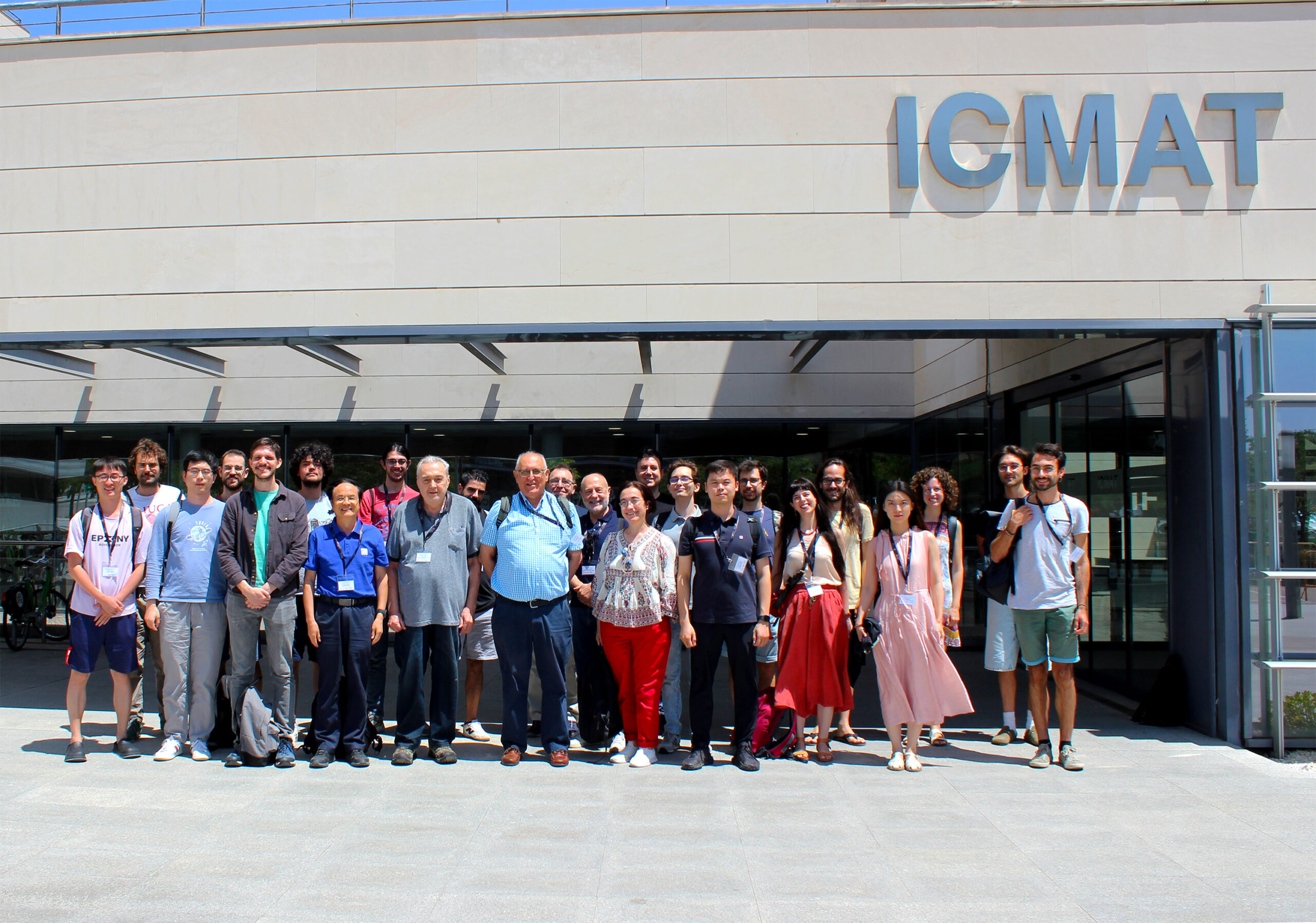
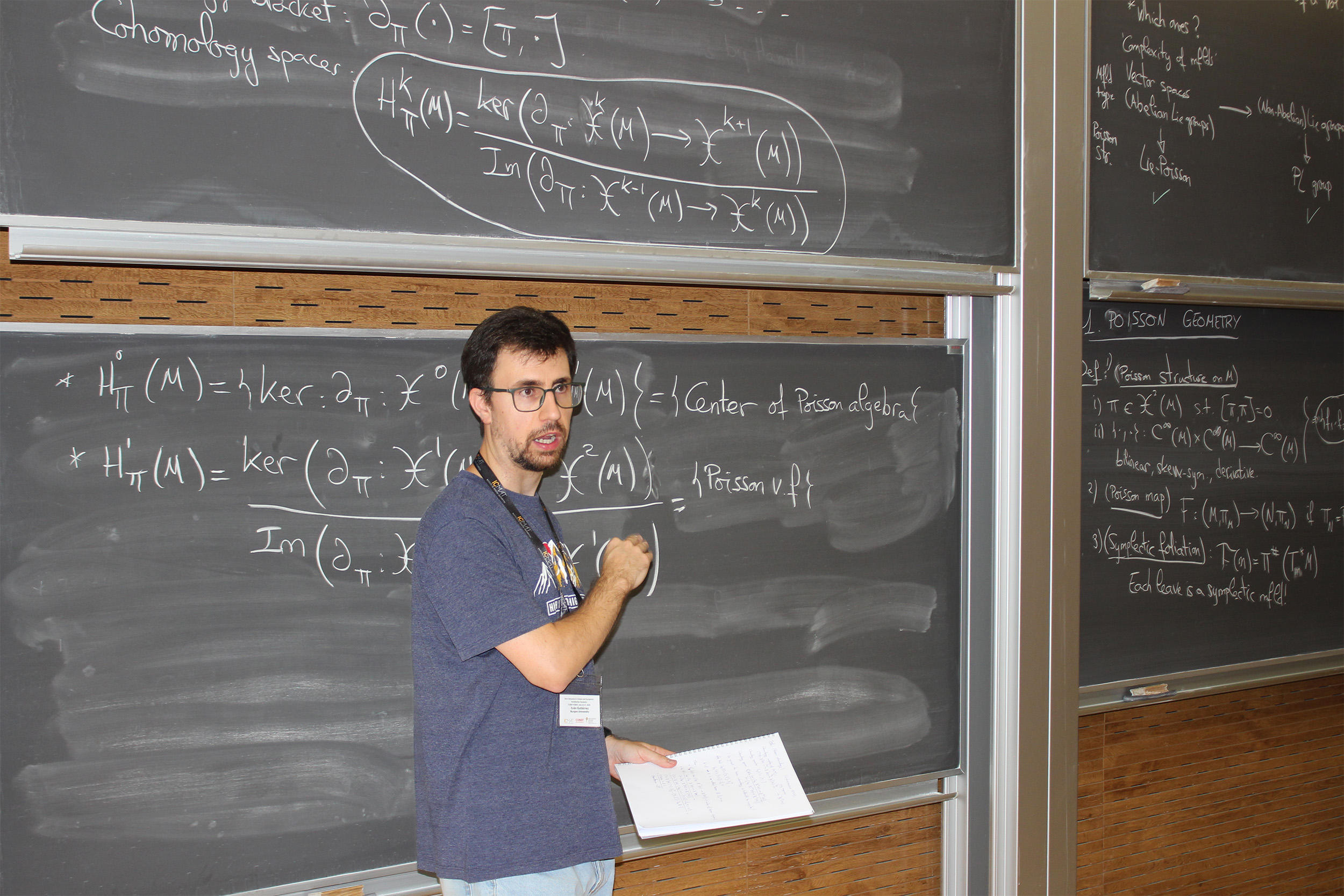
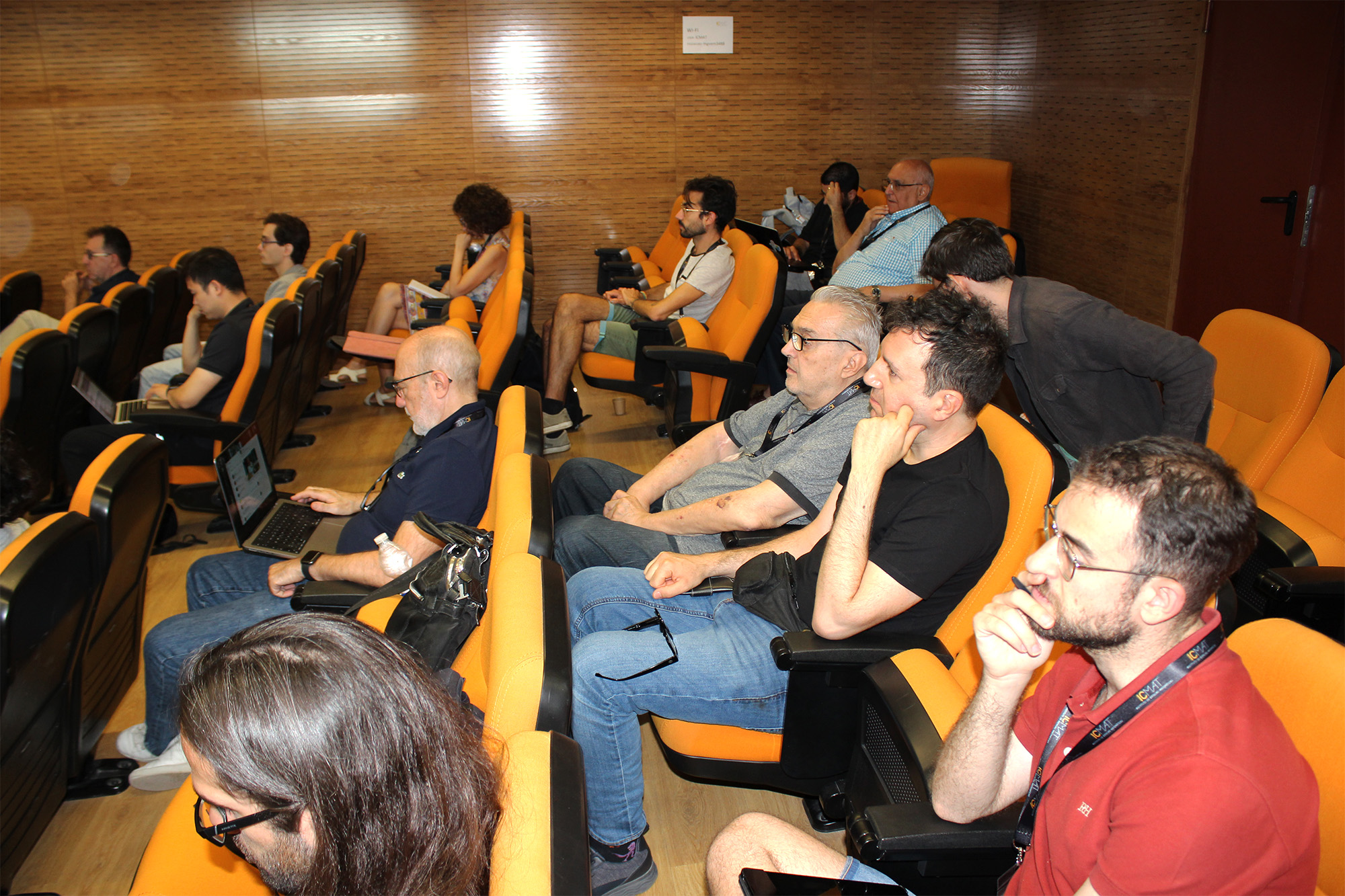
Group photo and some of the sessions of the conference held at ICMAT. Images: Laura M Iraola/ ICMAT.
From July 13 to 17, 2026, CUNEF University and ICMAT hosted in Madrid the 2nd International Workshop “New Advances in Contact and Symplectic Hamiltonian Dynamics”, a meeting that brought together researchers from Spain, China, and Singapore specializing in geometric mechanics and related areas. The workshop’s aim was to explore in depth the formal aspects of symplectic and contact Hamiltonian systems, as well as the associated stochastic processes and their applications.
Hamiltonian dynamics is the mathematical language that, for more than two centuries, has been used to describe how physical systems evolve over time: from the motion of planets to the behavior of a subatomic particle. Its symplectic and contact versions are two geometric frameworks that make it possible to formalize this evolution with precision, also incorporating phenomena with a component of randomness (so-called stochastic processes), present in systems where chance or noise plays a role.
This common framework makes it possible to tackle problems that, at first glance, seem to belong to entirely different worlds. Among them, control theory, which deals with how to steer a system’s behavior toward a given goal; neural networks, which inspire much of today’s artificial intelligence; quantum systems, in which the laws of physics behave radically differently from what we observe at everyday scales; and cosmology, which studies the origin and evolution of the universe.
Various experts in this field and its applications took part in the conference. Among them, “Jinqiao Duan, head of the Mathematics Department at Great Bay University and of the Laboratory of Mathematical and Neural Dynamical Systems, focused on predicting and treating neurodegenerative diseases through artificial intelligence tools and stochastic dynamical systems,” explained Manuel de León, a CSIC researcher at ICMAT and co-organizer of the event. He also highlighted the work of Juan Pablo Ortega, who “leads a research group in Singapore with various applications of neural networks and machine learning.” Meanwhile, Verónica Errasti Díez and Jordi Gaset Rifà (CUNEF) apply differential geometry to the study of new cosmological theories, including black holes and gravitational waves.
Spanish-Asian collaboration
This second edition builds on the one held at Great Bay University in Dongguan (China) in November 2024, further consolidating a scientific collaboration between Spanish and Asian research groups working on geometry and Hamiltonian dynamics.
As is often the case in this kind of collaboration, the connection with Chinese and Singaporean researchers began through personal contacts that later grew into an institutional relationship. “In this case, the relationship was formalized with the signing of a memorandum of understanding (MoU) between the institutions involved. For this second edition, we added colleagues from Singapore to the collaboration between Great Bay University and ICMAT, with whom we’ve kept in touch for many years,” adds De León. Looking ahead, he is confident the relationship will keep growing: “We hope to continue working on this collaboration, which involves mutual visits, student exchanges, and joint international projects.”
In addition to those already mentioned, the program featured specialists such as Fernando Barbero (Instituto de Estructura de la Materia), Alberto Ibort (Universidad Carlos III de Madrid), Álvaro Pelayo (Universidad Complutense de Madrid), Tudor Ratiu (École Polytechnique Fédérale de Lausanne), Jinqiao Duan (Great Bay University, China), and Jianyu Hu (Nanyang Technological University, Singapore), among other researchers from Spanish, Chinese, and Singaporean institutions.
The organizing committee was made up of Manuel de León and David Martín de Diego, both from ICMAT-CSIC, together with Saskia Demulder, Verónica Errasti Díez, Jordi Gaset Rifà, and Manuel Lainz, from CUNEF University, the institution that co-organized the event with ICMAT.
Automatic translation.