Horizons of Mathematics, with Eleonora di Nezza (Universidad de Roma Tor Vergata, Italia)
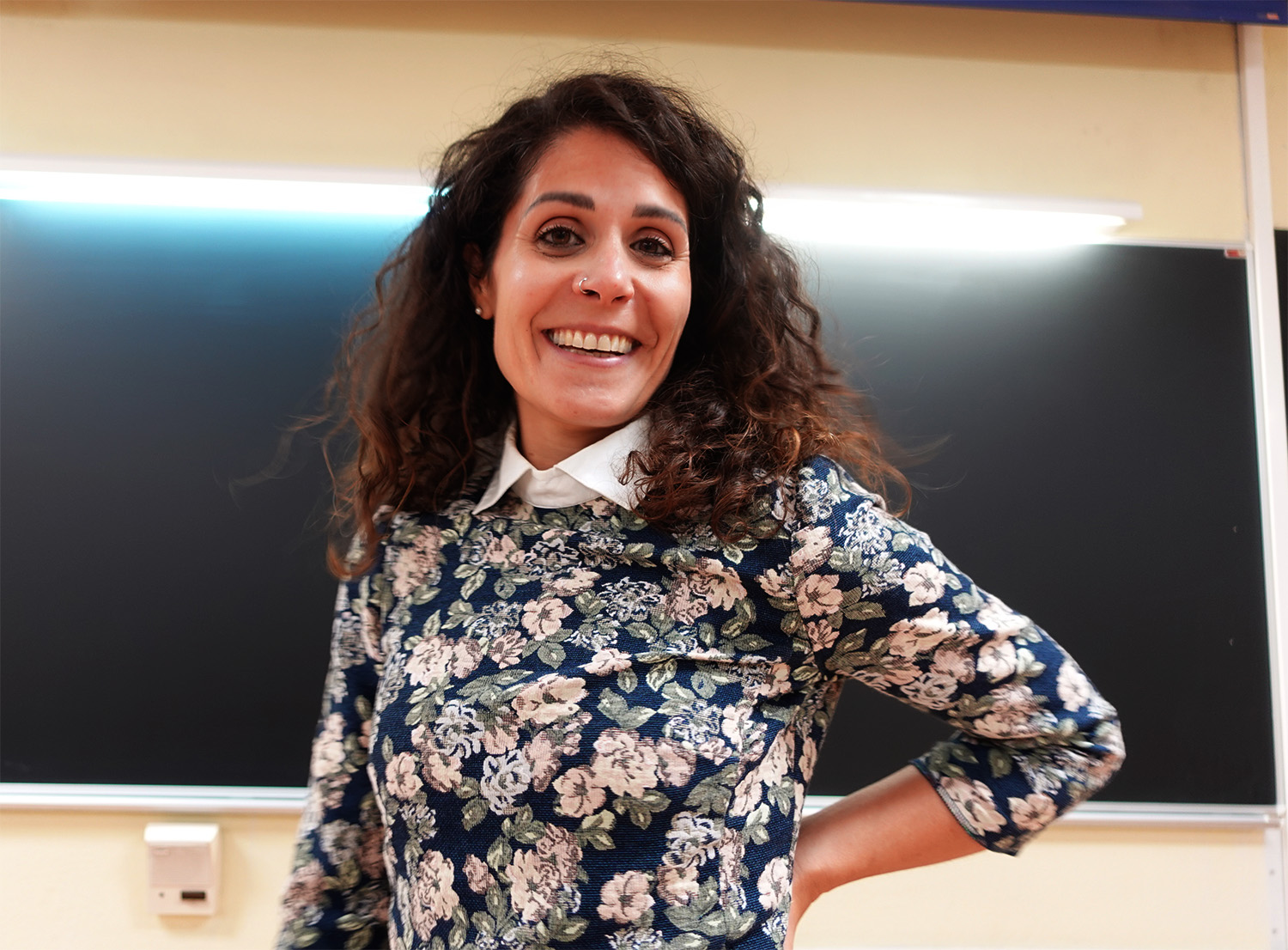
Eleonora di Nezza is a professor at the University of Rome Tor Vergata (Italy). Image: Elisa Ramírez García
Kähler geometry studies spaces endowed with an exceptionally rich structure, arising from the intersection of three distinct geometries. This versatility makes it possible to tackle difficult problems concerning the metrics, that determine the curvature of these spaces, some of them connected to theoretical physics, and gathered in a list arranged by difficulty following the Calabi Program. At the Joint ICMAT–UAM–UCM–UC3M Mathematics Colloquium, on November 7, Eleonora Di Nezza, Professor at the University of Rome Tor Vergata, presented the techniques developed over the past two decades for studying special metrics on Kähler manifolds.
Elisa Ramírez García (CSIC-FBBVA Scientific Communication Grant 2024)
Just as it would make no sense to use a metro map to find one’s bearings in the mountains, in order to solve a specific mathematical problem, it is possible to choose among different existing geometries, using in each case the one that is most suitable or facilitates the work. Geometry provides precisely a way of describing the space in which the problem is set: it provides the language and the tools to analyse the shapes and structures that arise.
For example, classical mechanics, the branch of physics describing the motion of everyday bodies, such as a ball, a pendulum or a spinning top, is formulated on a geometry called symplectic geometry. By contrast, when addressing problems within the framework of general relativity, developed by Einstein in 1915 to describe the behaviour of very massive bodies such as planets or stars, one uses Riemannian geometry, a higher-dimensional generalisation of ancient Euclidean geometry, the geometry of plane figures.
Each geometry has its own potential and characteristic tools. Among them, there is one that is particularly interesting because it compatibly integrates the properties of several distinct geometries: Kähler geometry. Lying at the intersection of three worlds, the symplectic, the Riemannian and the complex, this geometry studies spaces endowed with a very rich structure called Kähler manifolds, introduced by the German mathematician Erich Kähler in 1933.

Calabi-Yau manifold, a famous example of a Kähler manifold/ Imagen: Lunch (Wikimedia commons)
The mathematical structure that defines Kähler manifolds helps, in certain problems, to provide more information and grants them great versatility: “A Kähler manifold possesses a lot of structure, coming from different geometries, but they all work well together. Many difficult problems become more manageable because one can use all those structures at once. It’s almost magic,” notes Eleonora Di Nezza, Professor at the University of Rome Tor Vergata and speaker at the Joint ICMAT–UAM–UCM–UC3M Mathematics Colloquium and at the course “The space of Kähler potentials”, held this November at the ICMAT.
Because it is a complex manifold, one can define on it functions that take and return complex values. And because it is Riemannian, it has a metric allowing distances to be measured and curvatures computed. Its symplectic nature arises naturally and serves as a bridge between the other two structures.
Kähler metrics that solve Einstein’s equations
Kähler manifolds offer a great advantage when tackling a mathematical problem derived from Einstein’s equations of general relativity. These equations describe how a massive object deforms the space-time around it (modelled as a Riemannian manifold), generating what is perceived as gravity. The question, geometric in nature, is to identify the metric–the mathematical way of measuring distances– that determines how this manifold curves, something described via curvature measures such as the Ricci curvature.

Einstein Field Equations. is the metric, the Ricci curvature and R the scalar cuvature.
In the simplest case, the vacuum, where no matter is present, the problem translates geometrically into finding a metric whose Ricci curvature is constant. Solving this in full generality is extremely difficult and remains an open challenge in Riemannian geometry. However, in the setting of Kähler geometry, Di Nezza affirms that the situation changes completely: “In Riemannian manifolds, which is where the problem is defined in general, it has been solved in low dimensions, up to four, and in cases with symmetries we understand well; but in arbitrary dimension it remains unsolved. On a Kähler manifold, by contrast, thanks to its additional structure, the problem does have an answer in any dimension.”
The Calabi Program: the to-do list for Kähler geometers
In the particular case where the Ricci curvature is zero, its solution is a Kähler metric that gives rise to specific Kähler manifolds known as Calabi–Yau manifolds, in honour of two great mathematicians. Eugenio Calabi, an American mathematician, conjectured their existence in 1957, and Shing-Tung Yau, a Chinese-American mathematician, proved the conjecture and received the Fields Medal in 1982 for the achievement. These manifolds turned out to be enormously relevant in theoretical physics, especially in string theory, where they are used to describe additional dimensions of the Universe.

Two-dimensional section of a six-dimensional Calabi-Yau manifold, a particular case of a Kähler manifold / Image: Andrew J. Hanson
The study of other Kähler metrics with special curvature properties was also initiated by Eugenio Calabi. After Yau proved one of his conjectures, Kähler geometers began to develop and expand Calabi’s original ideas, which gradually crystalised into a sequence of increasingly restrictive problems. This set of questions eventually came to be known as the Calabi Program, named in his honour, although its formulation as a systematic program emerged only later.
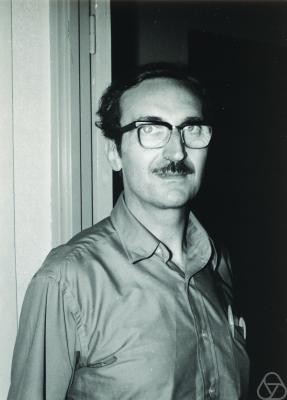
Eugenio Calabi /Image: Konrad Jacobs, Erlangen
This program may be understood as a list of problems organised according to the type of curvature constraints imposed on the metric, in increasing order of difficulty. The first goal on the list, finding metrics with constant Ricci curvature, is completely solved –in Kähler geometry, in the original Riemannian formulation it remains open, as mentioned earlier–. The next challenge is to determine whether there exist Kähler manifolds admitting a metric with constant scalar curvature, another fundamental measure of the curvature of space. According to Di Nezza: “The second line of the list is almost complete. It has been solved in the smooth case, without singularities, and substantial progress has also been made in the singular case.”
Di Nezza has contributed significantly to the first challenge of the Calabi Program, studying the singularities of the equation to which the problem of finding Kähler metrics with constant Ricci curvature reduces: the Monge–Ampère equation. To this end, she applied analytic techniques from pluripotential theory, an advanced framework of complex analysis.
Her most recent contribution consists of proving an existence theorem in a general framework that, in a sense, encompasses all the results obtained over the past six years in the study of the second challenge of the Calabi Program.
“It is crucial to have a global vision of the problem, but then one must face the technical and computational work with care and honesty. Sometimes one thinks: ‘Ah, this is going to work this way’, but the devil is in the details,” says Di Nezza.
Eleonora Di Nezza

Di Nezza during her colloquium. Image: Elisa Ramírez García
Since September 2025, Eleonora Di Nezza has been a Professor at the University of Rome Tor Vergata (Italy), and since 2023 she leads the project “SiGMA” (Singular Monge–Ampère Equations), funded by a Consolidator Grant from the European Research Council (ERC). Until 2025, she worked in France, holding positions at the Sorbonne, the École Polytechnique and the École Normale Supérieure in Paris.
She carried out her doctoral research between the University of Rome Tor Vergata and the Paul Sabatier University in Toulouse (France), focusing on the geometry of complex Monge–Ampère equations on compact Kähler manifolds.
After receiving her PhD, she undertook a postdoctoral stay at Imperial College London (United Kingdom) with a Marie Curie Fellowship, during which she joined the Mathematical Sciences Research Institute in Berkeley (United States). In 2017, she moved to France to join the Institut des Hautes Études Scientifiques (IHÉS).
She has received several awards in recent years: the Bronze Medal of the French National Centre for Scientific Research (CNRS) in 2021, the Reine-Elizabeth Prize of the Pierre Le Conte Foundation of the French Academy of Sciences in 2023, and the Bartolozzi Prize of the Italian Mathematical Union (ex aequo with Cristiana De Filippis) in 2023.
Joint Colloquium: “Special metrics in Kähler geometry”, Eleonora Di Nezza, Università degli studi di Roma. 7 November 2025, Aula Miguel de Guzmán, Facultad de Matemáticas, Universidad Complutense de Madrid
Abstract: Over the past two decades, a powerful variational framework has emerged for studying special metrics on Kähler manifolds, including Kähler-Einstein and constant scalar curvature Kähler metrics. In this talk, I will introduce the central ideas of this approach, highlight the key players in the theory, and discuss some of the most recent advances in the field.
—
Note: This is an automatic translation. Some nuances may differ from the original Spanish version.