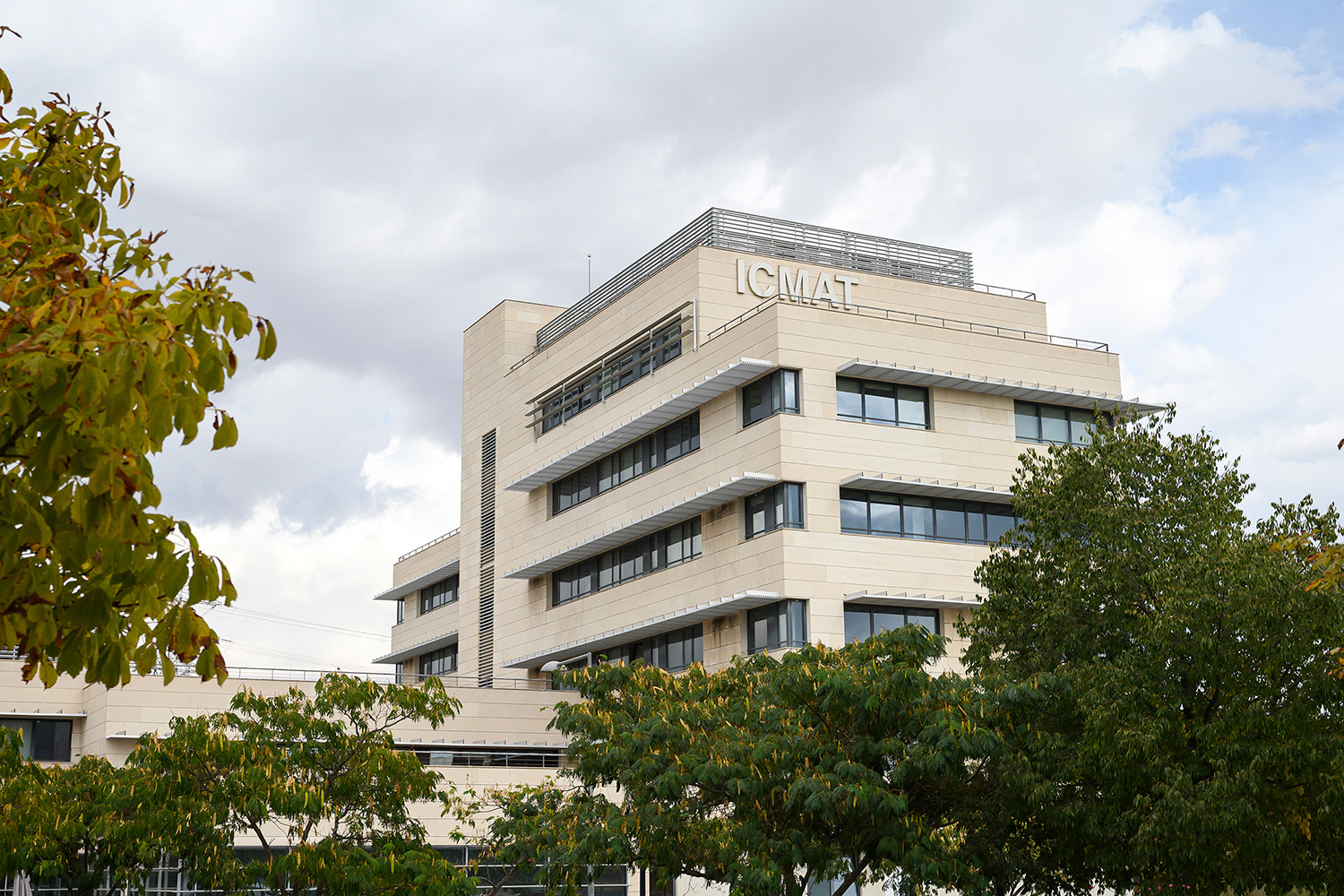
Image: ICMAT/Álvaro Minguito
Laura Moreno Iraola (ICMAT)
The Institute of Mathematical Sciences (ICMAT) is hosting the Workshop on Potential Theory and Geometric Function Theory in Metric Spaces from 18 to 22 May, focusing on the fields of potential theory and geometric function theory in metric spaces, a setting in which the classical geometric structure of Euclidean space is not available. “The development of analytical tools at this level of generality is particularly powerful, since it allows applications in numerous environments, including graph theory, networks, fractals and highly irregular spaces, without any differentiable structure a priori,” explain Estibalitz Durand Cartagena (UNED) and Jesús Jaramillo (ICMAT, Complutense University of Madrid), co-organisers of the event. “For example, we study problems such as the famous isoperimetric problem, which seeks to minimise the surface area of the boundary under a constraint on the enclosed volume, or Plateau’s problem, in which the area of a surface bounded by a fixed curve is minimised,” they continue.
On the one hand, potential theory is the branch of mathematical analysis that adapts ideas from physics, especially from electromagnetic theory, to the study of partial differential equations. On the other hand, geometric function theory studies transformations of geometric spaces with controlled bounds on distortion, including generalisations of conformal mappings. The conference will also address the calculus of variations, which studies minimisation problems within certain classes of geometric objects.
The conference also recognises the pioneering work of Nagaswari Shanmugalingam (University of Cincinnati) in the analysis of metric measure spaces as an independent field of research since the late 1990s. “One of the most widely studied and versatile functional space concepts in this context is the class of Newton–Sobolev functions, introduced by Shanmugalingam in her doctoral thesis,” comment Durand Cartagena and Jaramillo. “In her work, she has studied various connections with potential theory, Dirichlet forms and geometric function theory. The theory of Newton–Sobolev functions is today a highly active and continuously expanding area, central to modern analysis in metric spaces,” they note.
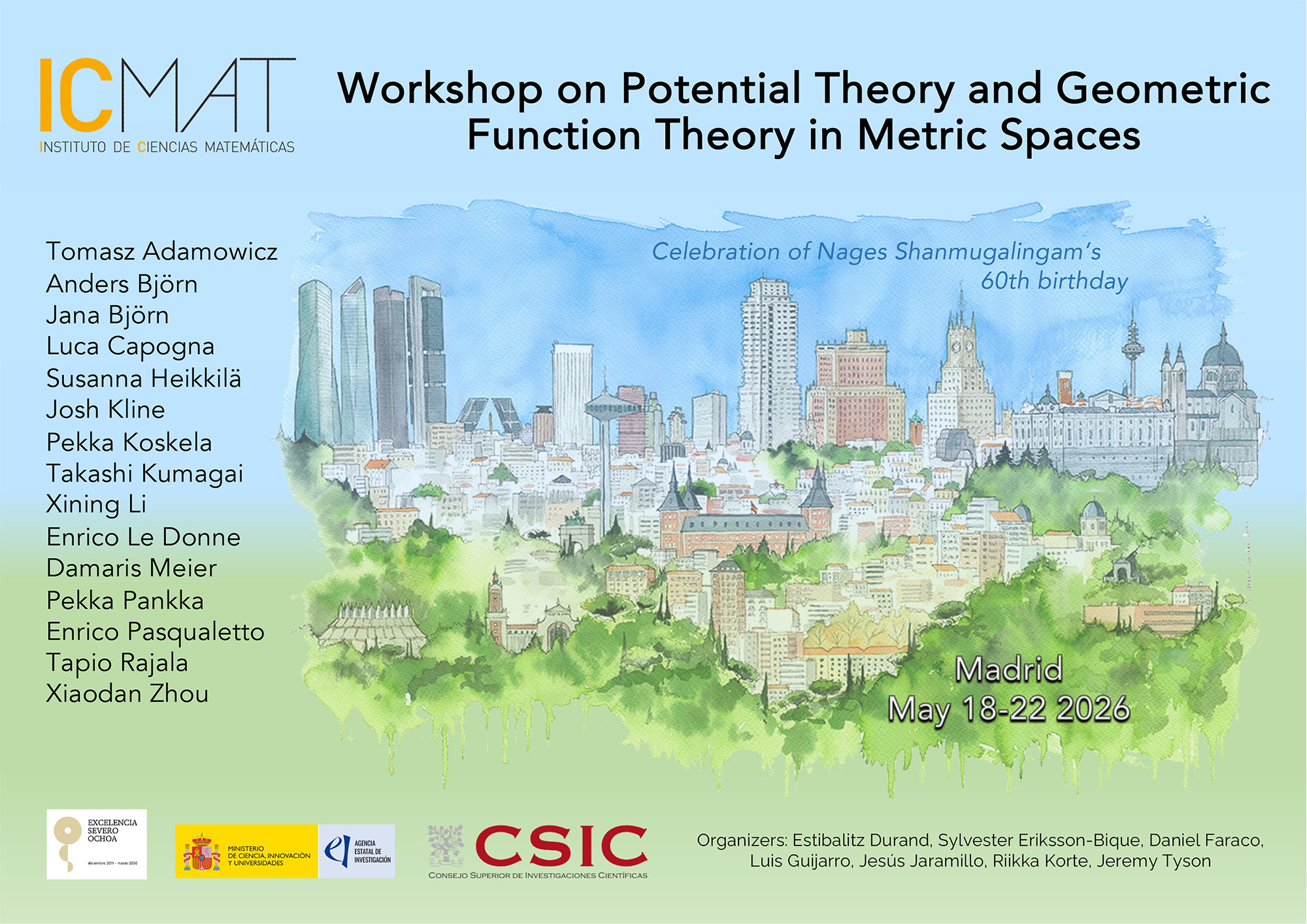
Throughout the week, around 80 international specialists in these areas will gather to share the latest advances and explore new research directions. The programme consists of 15 plenary lectures, short talks and other additional sessions such as poster presentations. The event also aims to encourage exchange between established and early-career researchers and to strengthen international collaborations.
In addition to Durand Cartagena and Jaramillo, the meeting is organised by Sylvester Eriksson-Bique (University of Jyväskylä), Daniel Faraco (UAM-ICMAT), Luis Guijarro (UAM-ICMAT), Riikka Korte (Aalto University) and Jeremy T. Tyson (University of Illinois at Urbana–Champaign).
—
This text is an automatic translation from the original Spanish version.