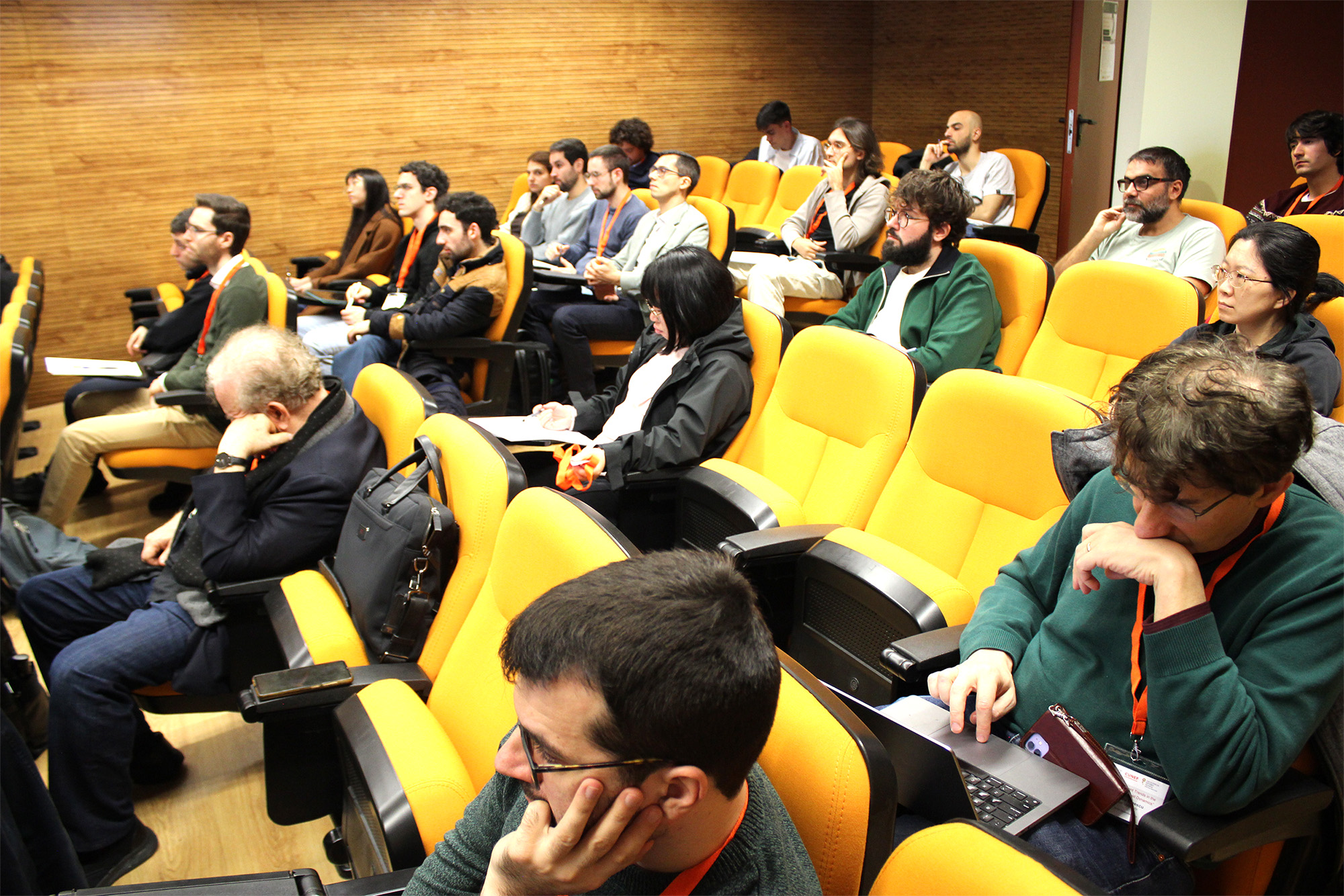
The meeting is being held at ICMAT, except on Wednesday, when it takes place at CUNEF University. Image: Laura Moreno Iraola / ICMAT
From yesterday until Friday, world’s leading experts in the field of fluid equations, one of the hottest areas of current research, are gathering at ICMAT and CUNEF University. They are presenting their latest results on the study of the Euler and Navier–Stokes equations at the conference Recent Trends in Mathematical Fluid Dynamics.
“The Euler and Navier–Stokes equations describe the behavior of fluids and have countless applications, from aerodynamics to oceanography,” explains Diego Córdoba (ICMAT-CSIC), co-organizer of the event together with Óscar Domínguez (CUNEF University) and Fan Zheng (ICMAT-CSIC). “However, their theoretical analysis poses one of the greatest challenges in mathematics (selected as one of the seven Millennium Problems by the Clay Mathematics Institute): the existence of singularities in their solutions,” adds Córdoba.
“A singularity occurs when certain quantities, such as the fluid velocity or its gradient, become infinite in finite time,” he explains. At present, the scientific community is focusing its efforts on finding a singularity in fluid flows. “Of particular interest are singularities that form in the interior of the fluid, without the intervention of the boundary,” the mathematician notes. To tackle this problem, several innovative strategies have been proposed, whose latest advances will be presented at the event.
The conference talks cover the theory of partial differential equations applied to the Euler and Navier–Stokes equations, not only in relation to the possible appearance of finite-time singularities, but also concerning well-posedness, regularity of solutions, and the analysis of weak or measure-valued solutions. Issues related to boundary layers and free boundaries, transport and mixing phenomena, stability and long-term dynamics are also addressed, along with modern analytical techniques such as convex integration, compensated compactness, and spectral or semigroup methods.
The aim of the conference is “to present new techniques and open problems, foster a dynamic exchange among specialists in mathematical analysis at all stages of their research careers, and outline the key questions driving current research in mathematical fluid dynamics,” according to the organizers.
Warning: This text is an automatic translation from the original Spanish version.