
Horizons of mathematics, with Julia Wolf (University of Cambridge, UK)
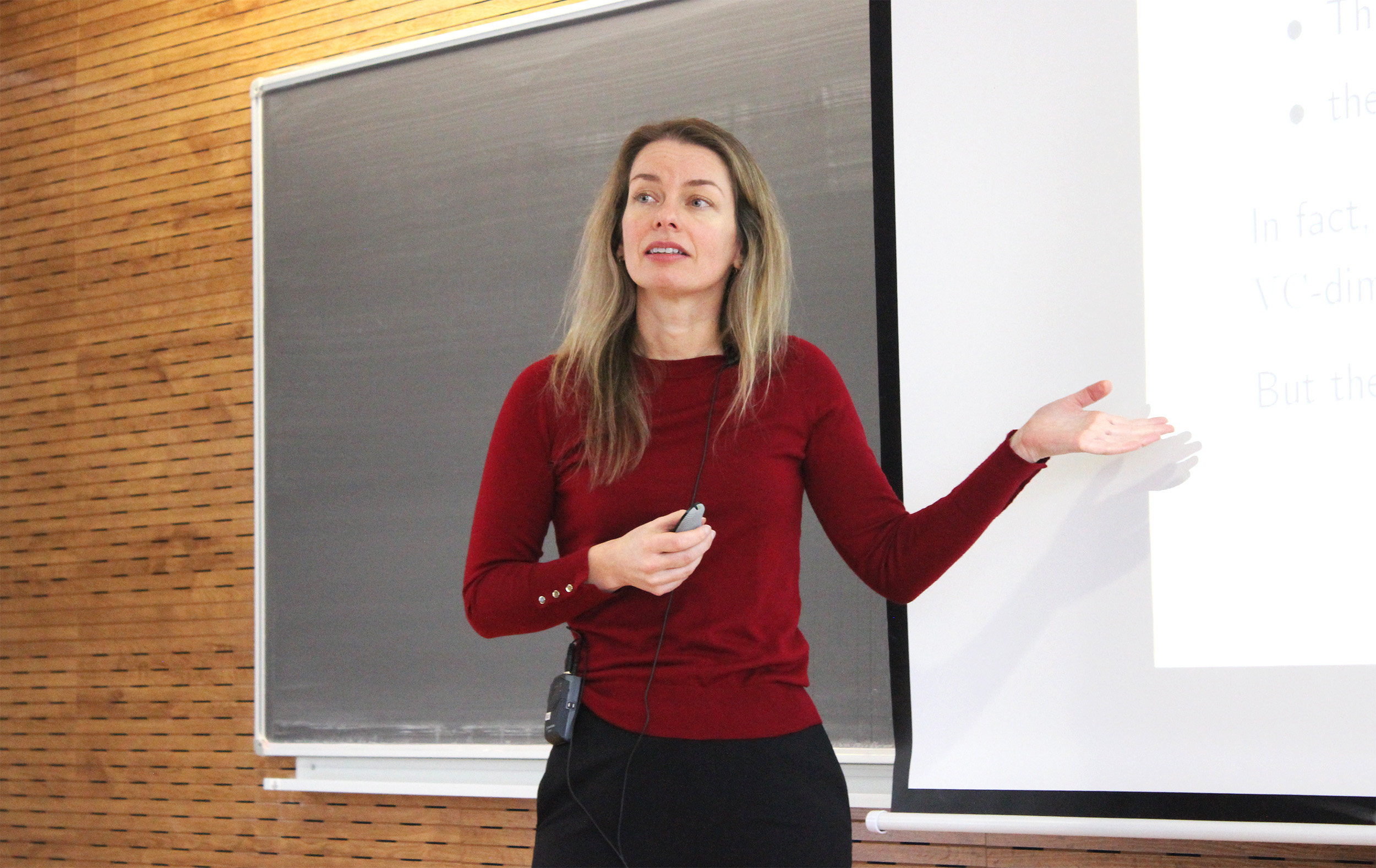
Julia Wolf, professor at the University of Cambridge, was the speaker at the latest ICMAT-UAM-UCM-UC3M Joint Mathematics Colloquium. Image: Laura Moreno Iraola/ICMAT.
Model theory provides a logical framework for distinguishing between mathematical structures with predictable behaviour and others of extreme complexity. Through concepts such as stability and VC-dimension, this discipline connects logic with areas as diverse as combinatorics, algebra and machine learning, opening up new ways of understanding what makes a mathematical structure controllable—or not. On 6 February, Julia Wolf (University of Cambridge) presented her recent contributions to this topic, which have aimed at extending these notions so that they apply to mathematical structures described by formulas in more than two variables, which constitute the majority. The talk took place at the Joint Mathematics Colloquium ICMAT–UAM–UCM–UC3M under the title “Where do you draw the (dividing) line?”.
Model theory occupies a central place in contemporary mathematical research, as it provides both a language and a set of tools to analyse the internal structure of mathematical objects from a logical perspective. It studies how the formal properties of a system of axioms relate to the behaviour of the structures that satisfy them, thus acting as a bridge between logic and areas such as algebra, geometry or analysis. In particular, model theory offers precise criteria for distinguishing between “well-behaved” mathematical contexts and others of great complexity, which is key to understanding which phenomena can be systematically classified, described or predicted. It is within this framework that the distinction between tame and wild structures arises.
“In logic, a structure is said to be tame if the logical formulas describing it have well-behaved properties—for instance, they give rise to only few possible types,” explains Julia Wolf, Professor at the University of Cambridge and speaker at the latest Joint Mathematics Colloquium ICMAT–UAM–UCM–UC3M. This means that, within such a structure, logical formulas allow only a limited number of essentially different behaviours: although there may be many elements, they fall into well-defined classes that display clear and controllable patterns. “Wild structures, on the other hand, are characterised by formulas that allow uncontrolled complexity. These formal properties are reflected in the concrete behaviour of the mathematical structure itself,” she adds.
“For instance, any infinite field whose first-order theory is very tame in the sense of logic (specifically, ‘superstable’) is algebraically closed, meaning that every polynomial equation with coefficients from the field has a solution in the field itself. By contrast, the random graph is wild: its formulas can encode all finite graphs, leading to maximal combinatorial complexity,” Wolf notes.
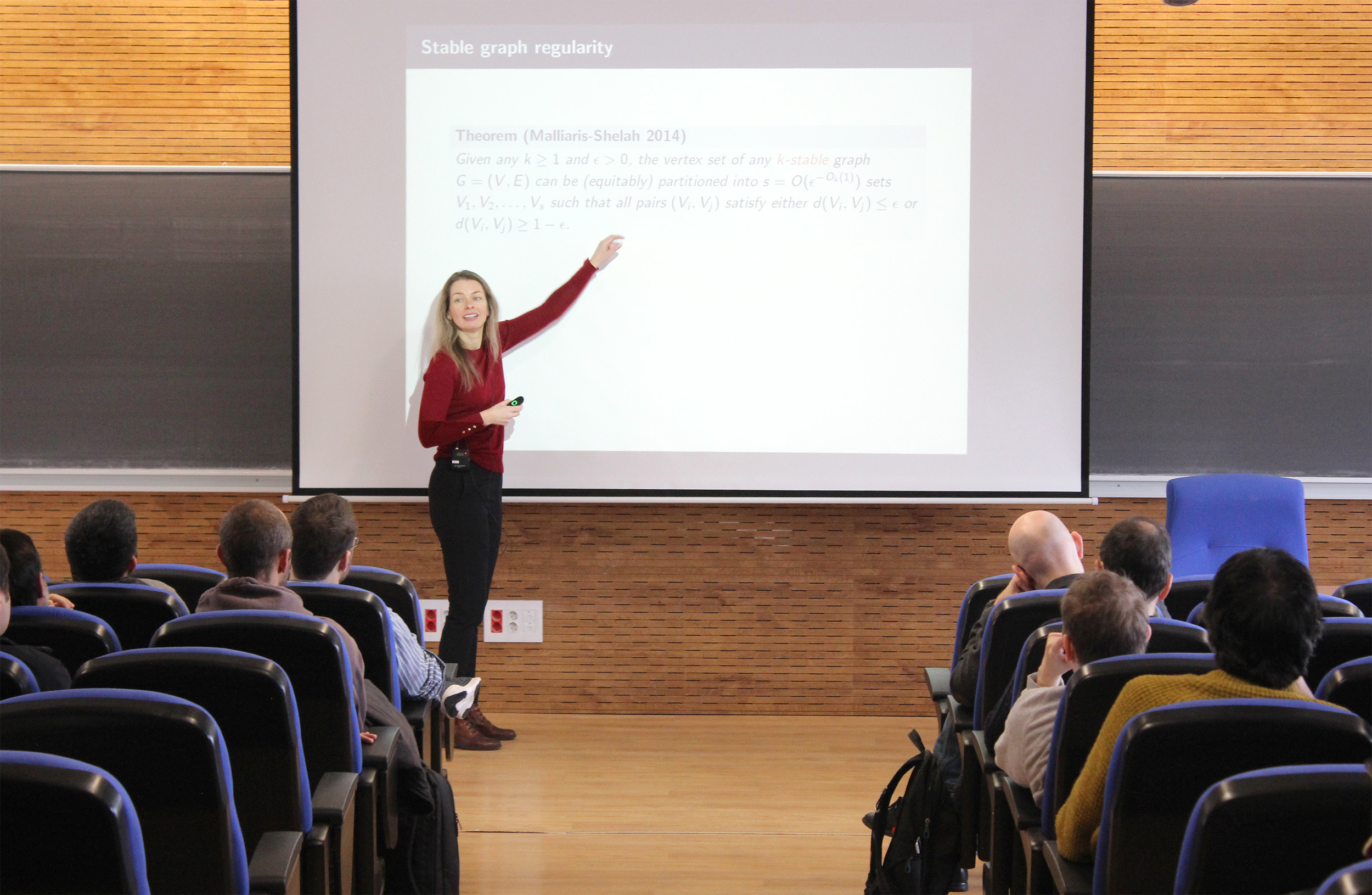
Wolf’s research focuses on combinatorics and number theory. Image: Laura Moreno Iraola/ICMAT.
This makes it particularly interesting to identify properties that separate one class of structures from the other. “One way to separate tame from wild structures is via VC-dimension, which measures how complicated the families of sets defined by formulas can be: low VC-dimension indicates structurally simple behaviour, while infinite VC-dimension signals the ability to encode arbitrary patterns. An even stronger dividing line is stability,” she explains.
VC-dimension also plays a foundational role in statistical learning theory. “VC-dimension precisely characterises which classes of hypotheses are learnable from finite data in a popular learning framework known as ‘PAC’. More recently, ideas from model-theoretic stability have entered learning theory as well: stability has been shown to be essentially equivalent to learnability under differential privacy constraints,” says Wolf.
However, these notions also have significant limitations. “They apply most naturally to binary formulas (in two variables), while many mathematical structures are inherently described by formulas in more than two variables. My recent work focuses on extending the notion and applications of VC-dimension and stability to these settings,” she explains.
Some of the key ideas behind this approach come from a rather different area, namely additive combinatorics, in which Wolf was originally trained. “It studies concrete objects such as sets of integers and their additive properties,” she says. “This subject has its own, quite different, hierarchy of complexity, organised by the order of Fourier analysis needed to count solutions to various systems of linear equations. The algebraic structure that appears in higher-order Fourier analysis has turned out to be instrumental in identifying a suitable higher-order generalisation of stability. It has also provided a fertile testing ground for this new notion, whilst at the same time allowing us to refine our technical understanding of higher-order Fourier analysis itself,” she concludes.
Julia Wolf, a Key Figure in Contemporary Combinatorics
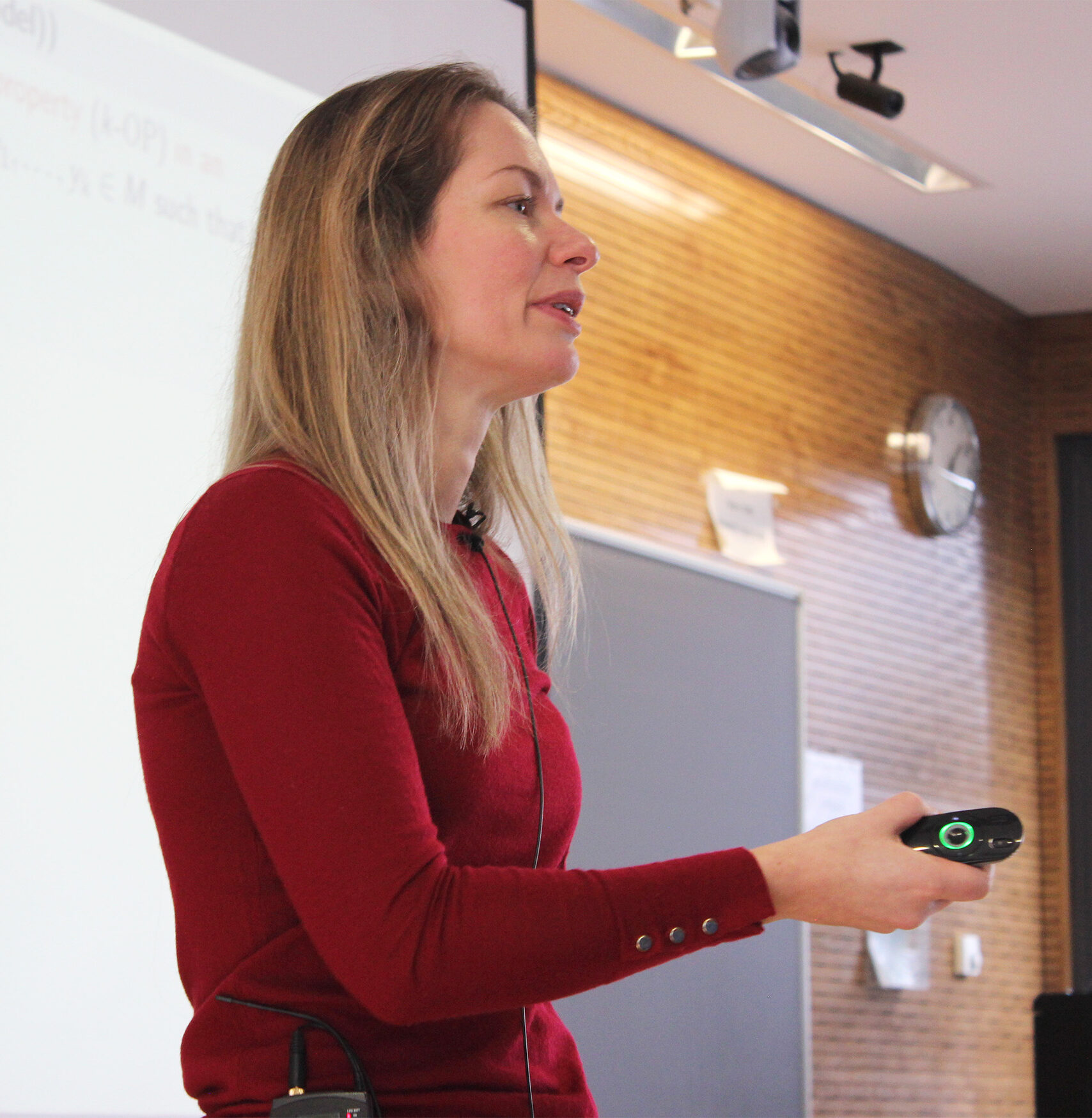
Julia Wolf is Professor of Pure Mathematics at the University of Cambridge. Her research focuses on combinatorics and number theory, particularly additive combinatorics, pseudorandomness and the interactions between combinatorics and model theory.
She earned her PhD from the University of Cambridge under the supervision of Timothy Gowers and has held positions at institutions such as École Polytechnique in Paris, the University of Bristol (UK), Rutgers University (USA) and the Institute for Advanced Study in Princeton (USA).
Throughout her career she has received numerous distinctions, including the Anne Bennett Prize and an Atiyah Fellowship from the London Mathematical Society, and, most recently, the Pilkington Prize from the University of Cambridge. Her research is currently supported by a fellowship from the Engineering and Physical Sciences Research Council.
Wolf combines her research activity with an extensive teaching and doctoral supervision role, as well as a strong commitment to mathematical outreach, advanced training and the promotion of women’s participation in mathematics. She has also played a prominent role in organising international conferences, editorial work and institutional responsibilities within the mathematical community.
Joint Mathematics Colloquium ICMAT–UAM–UCM–UC3M: Where do you draw the (dividing) line?
Julia Wolf (Cambridge University). 06/02/2026
Abstract: A longstanding classification programme in model theory aims to determine when a mathematical structure exhibits tame, structurally simple—as opposed to wild, intractable—behaviour. A key role is played by so-called dividing lines, i.e. properties of logical formulas (or theories) that separate these regimes. In this talk, we will illustrate recent progress using examples of graphs and groups, and use the lens of combinatorics to gain new insight into higher-order dividing lines. We will also explain how this perspective has led to advances in higher-order Fourier analysis, exchangeability, and statistical learning.