Ágata Timón García-Longoria (ICMAT-CSIC)
Javier Gómez Serrano is a researcher at Brown University (USA) and a specialist in partial differential equations. He completed his PhD at the ICMAT under the supervision of Diego Córdoba (ICMAT-CSIC) and, like his former supervisor, focuses his research on the study of the formation of singularities in the Euler and Navier–Stokes equations, one of the Clay Mathematics Institute’s Millennium Prize Problems and the subject of intense international scientific competition. Through an innovative combination of analytical techniques and neural networks, Gómez Serrano has achieved significant advances in this field. In recognition of his work, he has been invited to deliver the lecture devoted to the Navier–Stokes problem within the Millennium Prize Problem Lecture Series, organised by Harvard University (USA). Last year, he received two international awards: one of the MCA Awards (Mathematical Congress of the Americas), from the Mathematical Council of the Americas, and the R. E. Moore Award.

The mathematician Javier Gómez Serrano is an expert in the use of AI for mathematical research. Image: Alex Onciu/ El País.
According to Javier Gómez Serrano, professor at Brown University (USA), it was a paper he wrote during his PhD that “launched” his career. The article Finite time singularities for the free boundary incompressible Euler equations, co-authored with Ángel Castro (ICMAT-CSIC), Diego Córdoba (ICMAT-CSIC), Gómez Serrano’s PhD supervisor, Charles Fefferman (Princeton University, USA, and director of one of the ICMAT Laboratories) and Francisco Gancedo (University of Seville), studies when and how solutions of the incompressible Euler equations with free boundary lose regularity. “That result first translated into a postdoctoral contract at Princeton with Fefferman, with whom I still work. Afterwards, it led to other papers and projects. Moreover, I am convinced that it played a decisive role in the European Research Council (ERC) awarding me a Starting Grant. I am very grateful to Diego for giving me this great opportunity and launching my career,” Gómez Serrano states.
Nowadays, Gómez Serrano is one of the leading figures in the study of fluid equations. In particular, the Navier–Stokes and Euler equations, which model the motion of an incompressible fluid with and without viscosity, respectively, as well as the surface quasi-geostrophic equation. “The central questions in this area of mathematics ask whether, either for every initial condition there exists a global solution for all time, or whether there exists an initial condition that produces a singularity, that is, where particle velocities or their derivatives become infinite in finite time,” explains the mathematician. “In particular, solving this enigma in the case of the Navier–Stokes equations is rewarded with one million dollars (and immortal fame) by the Clay Institute,” he adds.
Twenty-five years after the list was proposed, Harvard University has organised a programme of lectures, the “Millennium Prize Problem Lecture Series”, between September 2025 and April 2026. Gómez Serrano is responsible for speaking about the Navier–Stokes problem, alongside other experts (including two Fields medallists, a Nevanlinna Prize laureate and a Wolf Prize recipient), who will present the most recent advances on the remaining Millennium Problems.
Gómez Serrano works on this problem using highly novel methods that combine approaches from classical analysis with the computational power of computers. “I have obtained good results using techniques at the boundary between traditional mathematics and computational tools,” he states. “Specifically, I have used computer-assisted proofs to study partial differential equations,” he explains.
This was another major step during his doctoral training. “I learned the technique when it was still not very developed and, with effort, I managed to become one of the leading figures in this direction. I have been fortunate that many years later this type of technique has become much more popular, and all that investment of time has paid off handsomely,” he says.
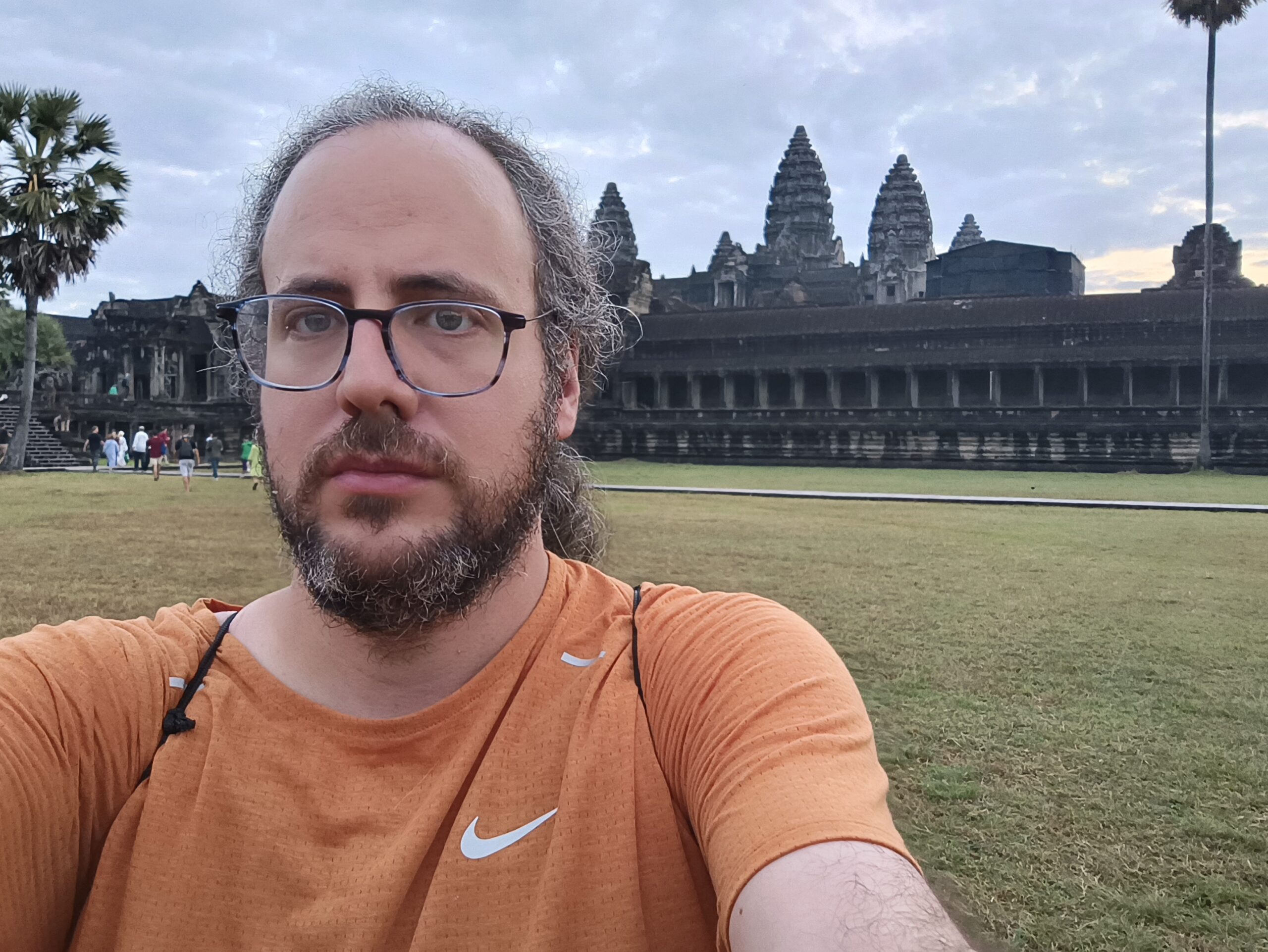
Last year, Gómez Serrano received one of the MCA Awards (Mathematical Congress of the Americas), from the Mathematical Council of the Americas, as well as the R. E. Moore Award.
Artificial intelligence to tackle the Millennium Problem (and other open problems)
In addition, in addressing the Navier–Stokes problem, Gómez Serrano has been a pioneer in successfully incorporating machine learning and artificial intelligence (AI) tools to numerically locate singularities in the equations. In 2023, together with a group of mathematicians and geophysicists, he found self-similar solutions for several types of fluid equations, even in unstable situations—something impossible using traditional numerical methods. “This new method makes it possible to understand where and how the singularity is created and the shape of the solution at any time before the blow-up, even an instant before,” the mathematician explained in an article published in El País.
“In the coming years, we expect that a combination of this type of modern techniques will make it possible to solve the Millennium Problem by discovering a numerical candidate for the singularity,” Gómez Serrano assures.
The scientist is a leading expert in the interaction between AI and mathematics. In particular, he has collaborated with a Google DeepMind team—together with Fields medallist Terence Tao—to develop AlphaEvolve, an AI system capable of improving results in dozens of open problems across a wide range of areas. “The idea is to find and refine mathematical constructions through code: large language models generate candidate programmes that are evaluated and successively improved through a process inspired by natural selection, thus combining human intuition with computational exploration,” he explains.
“One of the most stimulating aspects of this new modern mathematics is that it is still not clear how far its full potential and versatility can go, and because of this many goals that once seemed very distant may now be within reach. On the other hand, one must be very tolerant of failure—but that makes it even more exciting!” he admits.
It is expected that the popularity of this approach will grow in the coming years. “Although it will not replace classical methods, its strength will lie in combining both perspectives, due to their complementary nature: machine learning is extraordinarily powerful, but mathematical rigour is needed to be able to understand and analyse the results,” he predicts.
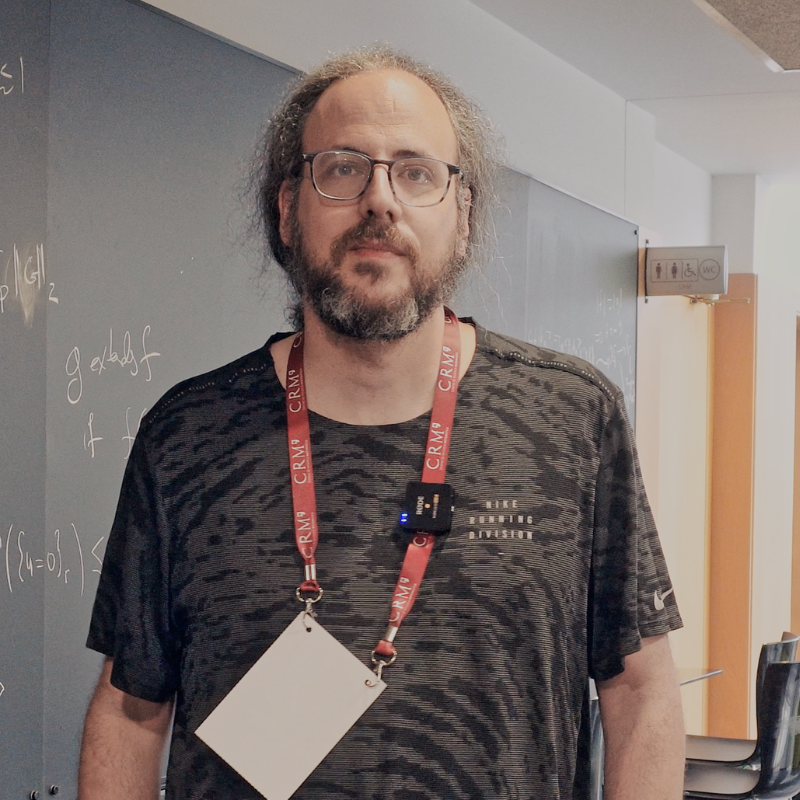
Gómez Serrano completed his PhD at the ICMAT under the supervision of Diego Córdoba (ICMAT-CSIC), on fluid equations. Image: Pau Varela.
Javier Gómez Serrano
Gómez Serrano holds a degree in Mathematics and a degree in Telecommunications Engineering from the Polytechnic University of Catalonia. In the summer of 2007, he had his first contact with research through a CSIC JAE Intro grant, which allowed him to collaborate for two months with Diego Córdoba. “I liked the group atmosphere and the type of mathematics they were doing so much that, among the various offers I had received to pursue a PhD, both from within and outside Spain, I decided to do it at the ICMAT, with Diego,” he says.
“My time at the ICMAT was absolutely fundamental to my development as a researcher. During my PhD, the ICMAT provided me with a top-level scientific environment, vibrant and full of stimuli. The constant interaction with world-class researchers, both visitors and permanent staff, allowed me not only to deepen my expertise in my area but also to broaden my vision of mathematics,” he explains.
After completing his PhD in 2013, he moved to Princeton University (USA), where he worked as an Instructor until 2016. From 2016 to 2020 he was Assistant Professor and Director of Graduate Studies at the same university. Between 2020 and 2022 he was a Distinguished Researcher at the University of Barcelona and, simultaneously, a Visiting Professor at Brown University (USA). He is currently a Full Professor at Brown University.
His research is funded by the National Science Foundation. Previously, he received a Starting Grant from the European Research Council (ERC) and an NSF CAREER award. In addition, he is one of the two principal investigators of the research project for centres “Mathematical Sciences Institutes” at the Institute for Computational and Experimental Research in Mathematics (ICERM). He has delivered more than 150 invited talks at conferences and seminars at the most prestigious mathematical institutions worldwide.
Last July, he received the MCA Award at the Mathematical Congress of the Americas (MCA) 2025, a meeting that brings together students, institutions and mathematical societies from across the Americas. This year he has also received the R. E. Moore Award 2025 for his article “Smooth imploding solutions for 3D compressible fluids”, published in Forum of Mathematics, Pi. This award recognises research in which interval analysis has a decisive impact.
These distinctions add to other achievements such as the Antonio Ambrosetti Medal (2023), the SeMA Antonio Valle Award (2018), the FBBVA Vicent Caselles Award (2017) and the Princeton Junior Faculty Teaching Award (2015), as well as the Aisenstadt Chair and Lectures (2024)—which has been held by numerous Fields medallists—and a plenary lecture at the Riviere–Fabes Symposium (2025).
ICMAT Alumni
The ICMAT Alumni section features profiles of researchers who completed their PhD at the ICMAT and who currently have a recognised academic career.
If you would like to start a PhD at the ICMAT, you can consult our job opportunities webpage, where calls for predoctoral contracts are regularly published.