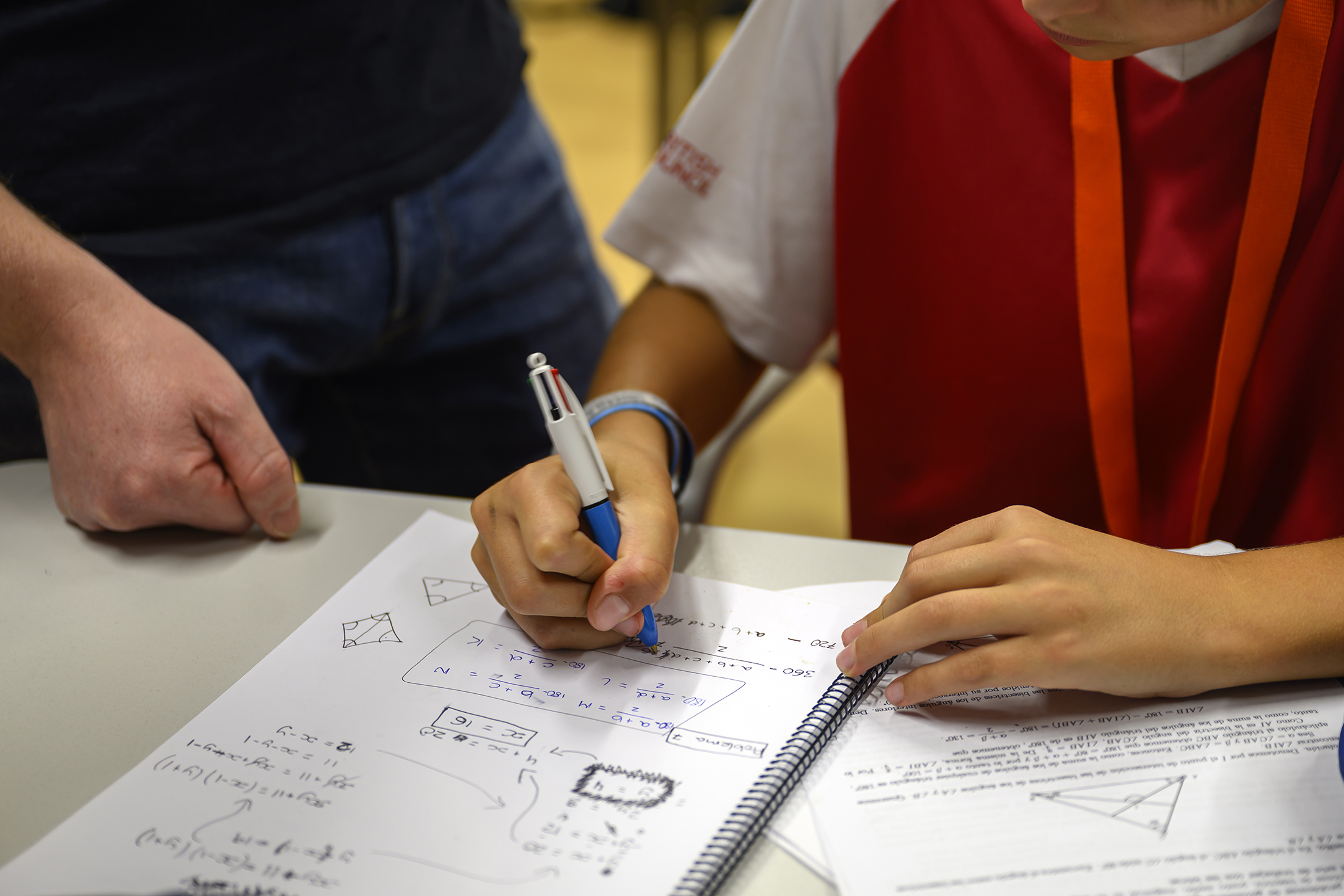
The MIP begins its second edition. Image: Álvaro Minguito/ICMAT
- Four new Mathematics students from the Complutense University of Madrid, all from state schools, are joining the Mathematics Intensive Program (MIP), adding to the four students from the first cohort.
- As a new feature, the programme is introducing supervised working groups, in which participants will work together on advanced mathematical problems throughout the academic year.
- The MIP courses introducing students to mathematical topics remain open, upon prior registration, to all interested undergraduate students. The first, “Ideas on the Distribution of Prime Numbers”, taught by Fernando Chamizo (ICMAT-UAM), begins this Friday, 2 October, at 4:00 pm at ICMAT.
73 is the twenty-first prime number, and 21 is the product of its digits: 7 × 3. Reversing its digits gives 37, which is the twelfth prime, while 12 is in turn 21 reversed. Sheldon Cooper, the character from the popular series The Big Bang Theory, proclaimed it “the best number” and, in 2019, two mathematicians demonstrated that it is the only prime number with both properties. “I find it incredible that things like this can be proved,” says Leo Meriläinen, who this month began a joint degree in Mathematics and Physics at the Complutense University of Madrid (UCM).
Meriläinen is one of the four students who have just joined the Mathematics Intensive Program (MIP) at the Institute of Mathematical Sciences (ICMAT), the first intensive training programme for university mathematics students in Spain. The programme is free for students and, upon completing their degree, those who complete it will receive a specific certificate issued by the Spanish National Research Council (CSIC). It is inspired by institutions such as the École Normale Supérieure in Paris and the Scuola Normale Superiore in Pisa, which have produced some of the world’s most outstanding mathematicians and several Fields Medal winners.
This is the MIP’s second academic year, and it now has two cohorts: a total of eight students who, throughout their four-year degree, will work with ICMAT researchers, attend advanced courses and begin their training in mathematical research. The new participants were selected through a two-stage process, which attracted 40 applications. All four are studying at the UCM and come from state schools in different parts of Spain. All of them have experience in programmes promoting mathematical talent and in competitions.
Héctor Hidalgo, from IES María Guerrero in Collado Villalba, has been taking part since 2023 in the Small Institute of Mathematics (PIM), ICMAT’s programme to promote interest in mathematics among students from the first year of secondary school to the final year of upper secondary education, and won the individual event of the 24th “Joaquín Hernández” Inter-School Mathematics Competition of the Community of Madrid in 2026. He is particularly interested in number theory, because of the variety of results that can be obtained “just by knowing the remainder that a number gives when divided by another”. Meriläinen, from IES Diego Velázquez in Torrelodones, also comes from the PIM. He came first in the same Inter-School Competition, won a silver medal in the Madrid regional round of the Mathematical Olympiad and a silver medal in the national round of the Physics Olympiad.
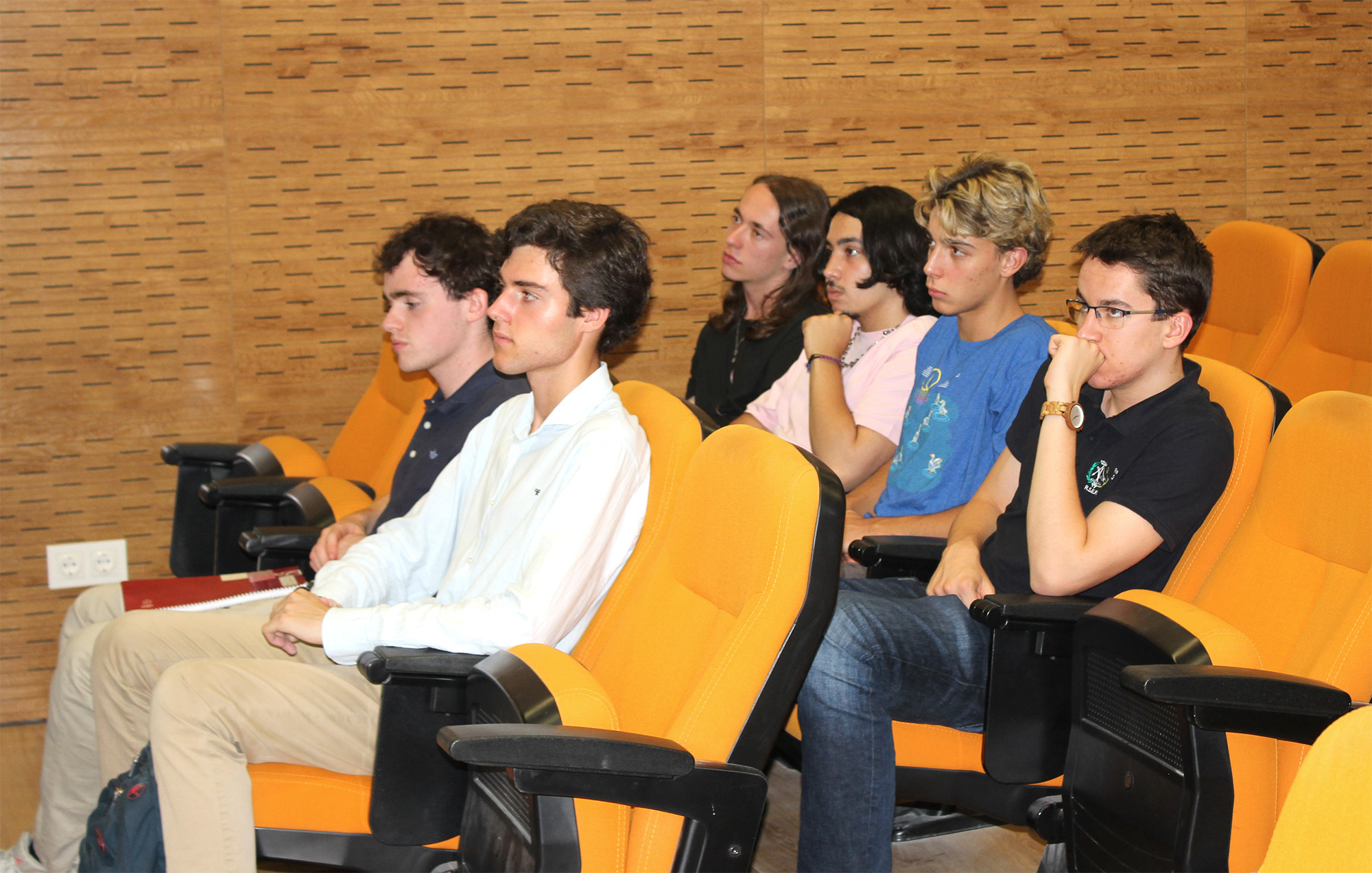
The MIP now has eight students. In the front row, Gonzalo San Vicente and Iván López from the first cohort, together with Leo Meriläinen, Héctor Hidalgo, Pablo París and Alejandro Zuate, the MIP’s new students. Image: Laura M. Iraola/ICMAT
The other two students come from the Mathematical Talent Development Programme (Estalmat). Pablo París joins the programme from IES Rosalía de Castro in Santiago de Compostela. He won a bronze medal in the Galician Mathematical Olympiad and the award for best mathematics project in the Stephen Hawking Young Researchers Awards, with a monograph on how to draw closed curves in the complex plane using Fourier series. Alejandro Zuate, from IES Ciudad de los Poetas in Madrid, won a bronze medal at the International Mathematical Olympiad, a silver medal at the Ibero-American Mathematical Olympiad and a gold medal at the Spanish Mathematical Olympiad. He is fascinated by projective geometry.
They join the first cohort, which is now beginning its second year and comprises Gonzalo San Vicente, Iván López Navarro, Justo Juan Salcedo Otero and Sofía Paz Chacón.
Mentoring and group work
Each participant is assigned an ICMAT mentor, who will support them throughout their degree. They meet regularly and work on readings and topics tailored to their interests. “The mentor is a point of reference who advises them throughout their training on scientific and academic matters, including recommending other researchers they can talk to or work with in the areas that most interest them,” explain María Ángeles García Ferrero (ICMAT-CSIC) and David Martín de Diego (ICMAT-CSIC), the programme’s coordinators.
This year, Pedro Tradacete (ICMAT-CSIC), Ángel Castro (ICMAT-CSIC), Davide Barbieri (ICMAT-Autonomous University of Madrid) and Tomás Gómez (ICMAT-CSIC) are joining the programme as mentors. Diego Córdoba (ICMAT-CSIC), Mario García Fernández (ICMAT-CSIC), Andrei Jaikin (ICMAT-CSIC) and Martín de Diego will continue in their roles.
The main new feature this year is the supervised working groups. “Last year’s participants themselves said that they preferred working in small groups rather than individually,” the coordinators explain. In these groups, an ICMAT researcher coordinates the work and sets research problems for the students to work on together throughout the academic year, although they may move from one group to another depending on their interests. The initiative aims to familiarise students with the collaborative dimension of mathematical research.
Four groups have been created for this academic year: one on fluid mechanics, in which students will be introduced to the physical and mathematical concepts underlying fluids, as well as their numerical simulation, coordinated by Ángel Castro; another on vector calculus and an introduction to differentiable manifolds, coordinated by Mario García; and two others — one on algebraic groups acting on trees and another covering a range of topics — coordinated by Jaikin, who also directs the Small Institute of Mathematics (PIM).
Advanced courses open to all undergraduate students
The MIP continues to offer its courses introducing advanced mathematical topics, which are open to any interested undergraduate student. The programme of courses for the second semester, along with the registration form for each course, is available on the ICMAT website. The first course begins on 2 October, with the first of three sessions in which Fernando Chamizo will share ideas on the distribution of prime numbers. He will be followed by Marc Nualart (ICMAT-CSIC), with a three-session series on the mathematics of fluid motion, beginning on 30 October, and Runan He (ICMAT-CSIC), who will speak in December about the modelling and analysis of microelectromechanical systems (MEMS). The sessions take place on Friday afternoons at ICMAT.
With the MIP, ICMAT completes a training pathway that supports mathematical talent at every stage: from the PIM, for young people aged 12 to 18, to the JAE School of Mathematics, for students in the final years of their undergraduate degrees, and the Severo Ochoa scholarships for Master’s and PhD studies.