This week, El Escorial hosts the 12th International Conference on Harmonic Analysis and Partial Differential Equations. The conference, known as “El Escorial Encounters,” has become, in its almost 50-year history, the most prestigious in the world in the field. This edition, which runs since Monday, June 9, gathers more than 200 researchers from at least 20 countries. The program includes ten invited lectures and three mini-courses, aimed at doctoral students who are new to the area. This year, one of these mini-courses is given by mathematician Hong Wang (New York University), co-author of a recent proof of the Kakeya problem in three dimensions.

The meeting brought together more than 200 researchers with expertise in harmonic analysis and partial differential equations. Image: Ágata Timón/ICMAT
Ágata Timón (ICMAT-CSIC)
“The Kakeya problem answers a basic and intriguing question posed more than 50 years ago in harmonic analysis: what is the planar set of minimum area within which a needle can be moved to reverse the respective positions of the eye and the tip?” explained Antonio Córdoba, emeritus professor at the Autonomous University of Madrid (UAM) and ICMAT member in a recent article on the resolution of this problem. A few months ago, a proposed solution to the problem in three dimensions, still awaiting publication, generated considerable interest within the expert community. This week, one of the authors of the proof, mathematician Hong Wang (New York University), is in El Escorial, along with more than 200 expert researchers in harmonic analysis and partial differential equations.

Mathematician Hong Wang will give the mini-course ‘Union of tubes and Kakeya sets’ this week at El Escorial.
Hong has given one of the three mini-courses – “Union of tubes and Kakeya sets,” on her work on the Kakeya problem – included in the 12th International Conference on Harmonic Analysis and Partial Differential Equations, which is held from June 9 to 13 in El Escorial and is organized by ICMAT and UAM. The event, which began in 1974, is considered the most important event in the field of harmonic analysis.

One of the talks at the 12th edition of the congress, which has become the world’s most prestigious in the field. Image: Ágata Timón/ICMAT
This field deals with decomposing functions into simpler components, such as sinusoidal functions. Today, it is one of the hottest areas of research and has also become a fundamental tool in numerous applications, from the compression of digital audio and video files to the design of telecommunication systems. Harmonic analysis originated in the early 19th century with the work of the French mathematician Joseph Fourier on the study of the heat function, a partial differential equation that describes the diffusion of heat in a solid body. His revolutionary idea was to decompose a complex function as a sum of sines and cosines. This technique, known as Fourier series, opened the door to a new way of understanding physical and mathematical phenomena.
An encounter with almost 50 years of history

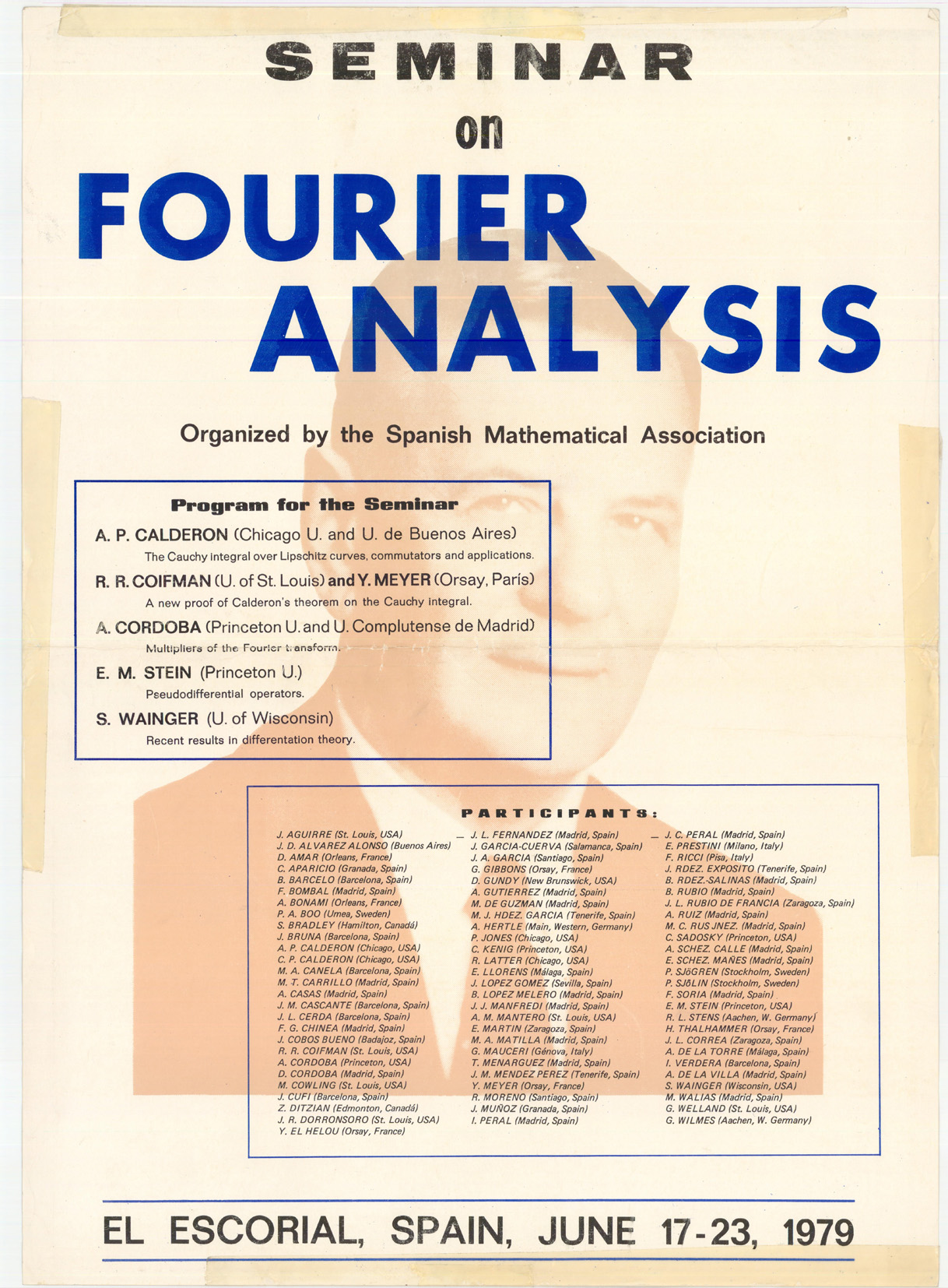
Poster of the first “El Escorial Encounter”, from 1979.
“The format of this conference is somewhat special,” say the organizers. “Three or four very prominent mathematicians are invited to present a deep and current topic in mathematics. Assuming only minimal background from the audience, these mini-courses, primarily intended for young undergraduate and graduate students or mathematicians from other areas who wish to familiarize themselves with the field, reach the frontiers of current research. In addition, the conference features between ten and fifteen more specialized lectures given by invited speakers,” they detail.
Jonathan Hickman – who will talk about geometric maximal functions – and Tuomas Orponen – on radial and restricted projections – are the other two in charge of giving mini-courses. In addition, ten other experts will give more specialized invited lectures, and several short talks and a poster session will accommodate participants who wish to present their own recent results.
The first “El Escorial Encounter” took place in 1979 and featured lectures by Alberto Calderón, Ronald Coifman, Antonio Córdoba, Elias M. Stein, and Stephen Wainger, all of them prestigious analysts, recognized with several national science awards – in the USA and Spain – and international mathematics awards. Since then, ten other editions have been held, approximately every four years.
The organizing committee for the twelfth meeting is made up of Davide Barbieri (ICMAT-UAM), José Conde Alonso (ICMAT-UAM), Daniel Faraco (UAM-ICMAT), Gustavo Garrigós (University of Murcia), Adrián González Pérez (UAM), Eugenio Hernández (UAM), Javier Parcet (ICMAT-CSIC), Javier Ramos (ICMAT-UAM), Guillermo Rey (ICMAT-UAM), Keith Rogers (ICMAT-CSIC), and Ana Vargas (UAM).
Automatic translation notice: This text has been translated automatically.