Interview with Babel Raïssa Guemdjo Kamdem (University of Douala, Cameroon), beneficiary of the Science by Women programme of the Women for Africa Foundation
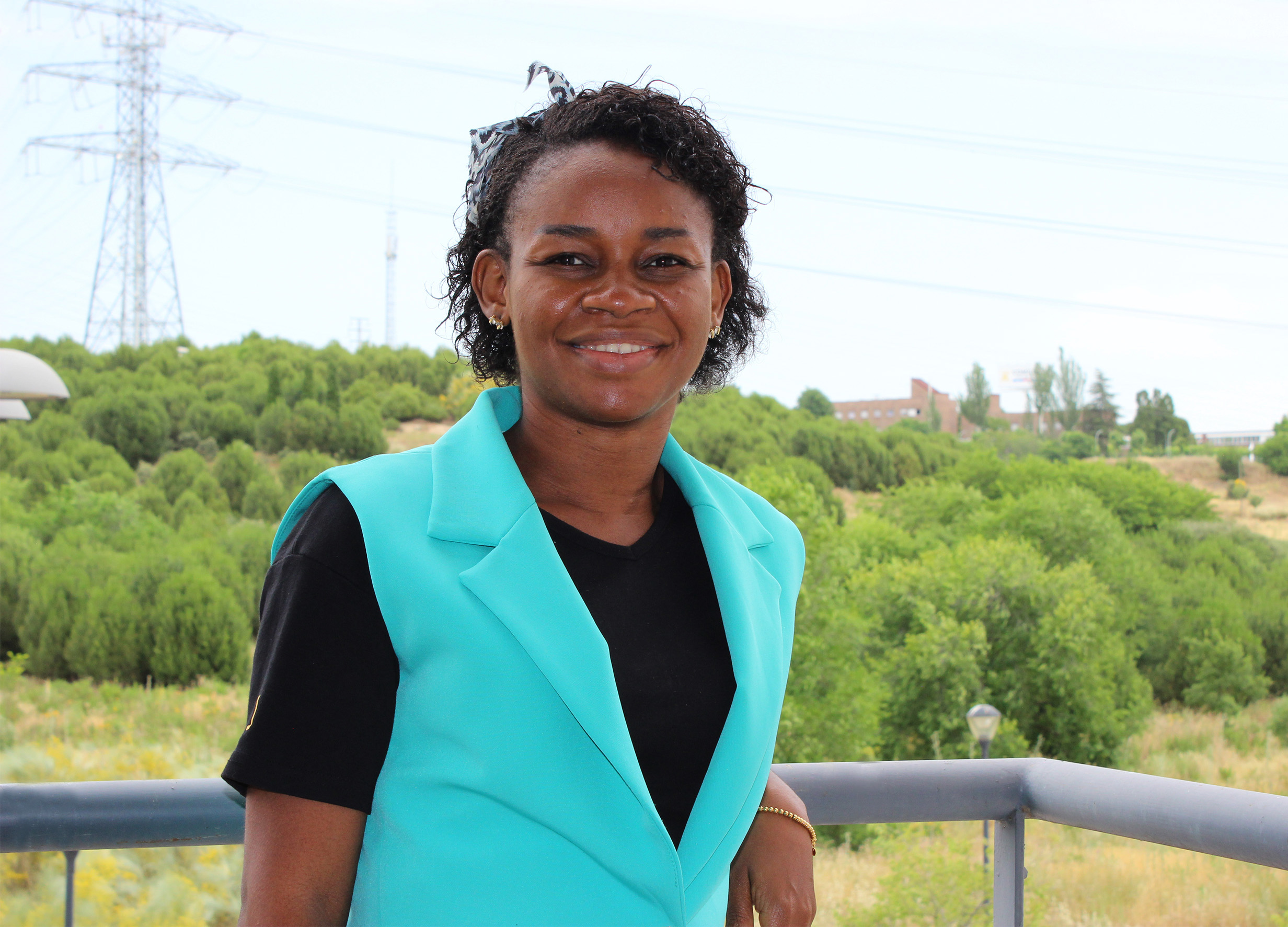
Since May, Babel Raïssa Guemdjo has been undertaking a research stay at the ICMAT thanks to the ‘Science by Women’ programme of the Women for Africa Foundation. Image: Laura M. Iraola/ICMAT
Babel Raïssa Guemdjo Kamdem has been a lecturer and researcher at the Advanced School of Economic and Commercial Sciences of the University of Douala (Cameroon) since 2021. In May 2025, she joined the DataLab group at ICMAT, led by David Ríos (ICMAT-CSIC), through the scientific cooperation programme Science by Women, run by the Women for Africa Foundation, which this year celebrates its 10th edition. Guemdjo will continue her research at the Institute until next October on a project focused on data analysis, machine learning and time series.
Laura M. Iraola (ICMAT)
How has your experience at ICMAT been so far?
So far, it has been very easy because David Ríos and his team, the DataLab group, have welcomed me warmly. I am in a very intellectually stimulating environment, and I am sure my project will be enriched by a wide variety of perspectives thanks to the international and multidisciplinary character of ICMAT.
Which area does your work fall under?
My research area is data analysis, machine learning and time series. Machine learning is a branch of artificial intelligence that allows problems to be solved from data. Current challenges include image recognition –how an artificial intelligence can recognise, for example, a cat in a photo–, understanding human language –one of its uses is training voice assistants–, user predictions and recommendations –targeted advertising or film recommendations–, anomaly detection –to prevent fraud such as banking fraud–, or autonomous driving –identifying roads, traffic signs, pedestrians, etc.– among others.
“I am sure my project will be enriched by a wide variety of perspectives thanks to the international and multidisciplinary character of ICMAT”
What kind of problems are you tackling in collaboration with the DataLab group at ICMAT, led by David Ríos?
Our project focuses on combining adversarial classification and the Kernel Null Foley-Sammon Transform (KNFST) to train machine learning systems to detect unknown objects. For example, if a facial recognition system is trained to identify specific individuals, when a new one appears, under traditional classification, it might incorrectly assign them to an existing category. With our new approach, however, it would be detected as an unknown profile.
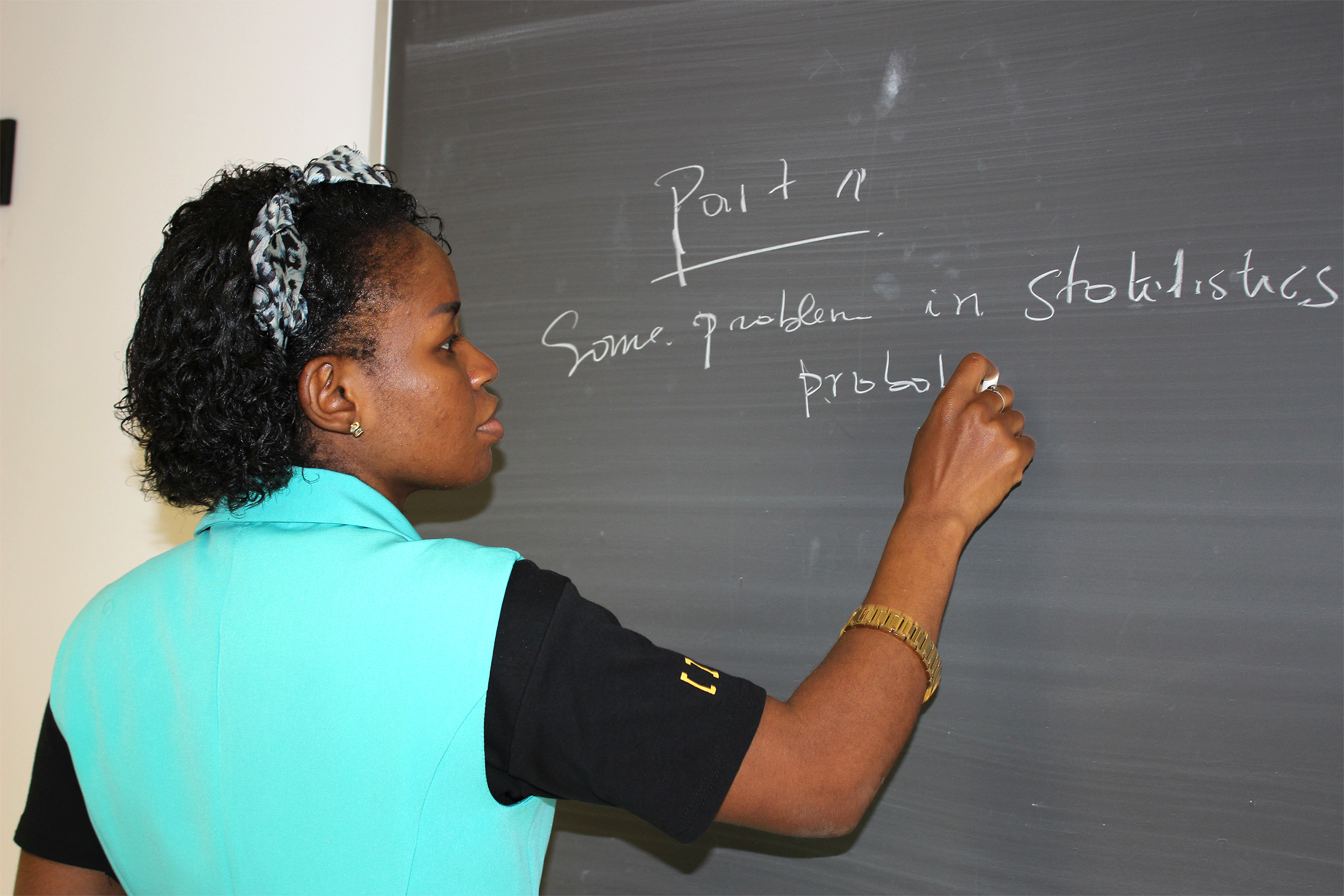
Guemdjo works in the field of data analysis, machine learning and time series. Image: Laura M. Iraola/ICMAT
What mathematical tools do you use to address these problems?
The tools we use are varied and depend on the type of problem, the approach taken and the data available. On the one hand, for exploratory data analysis we use statistics and probabilistic models. On the other hand, from linear algebra we also use the manipulation of matrices and vectors and linear transformations.
Finally, we employ specific machine learning techniques, such as ensemble methods, dimensionality reduction and Bayesian methods.
What do you like most about your research field?
I am fascinated by the predictive power of statistics because it allows us to project into the future on a solid basis. Statistics transform raw datasets into understandable and useful information, enabling us to detect trends, correlations and patterns invisible to the naked eye. For example, understanding how human behaviour evolves, analysing the impact of climate change or following economic trends is possible thanks to statistics.
“I am fascinated by the predictive power of statistics because it allows us to project into the future on a solid basis”
When and how did you become interested in mathematics?
My interest in mathematics arose when I finished my scientific baccalaureate. That is why I decided to enrol at the Faculty of Science of the University of Douala (Cameroon) and choose the branch of Mathematics and Economics within the Department of Mathematics.
Why did you apply for the Science by Women grant from the Women for Africa Foundation?
Because the mission of the programme, to support women scientists and promote their leadership in STEM disciplines, is very inspiring to me, as it aligns with my own values and goals.
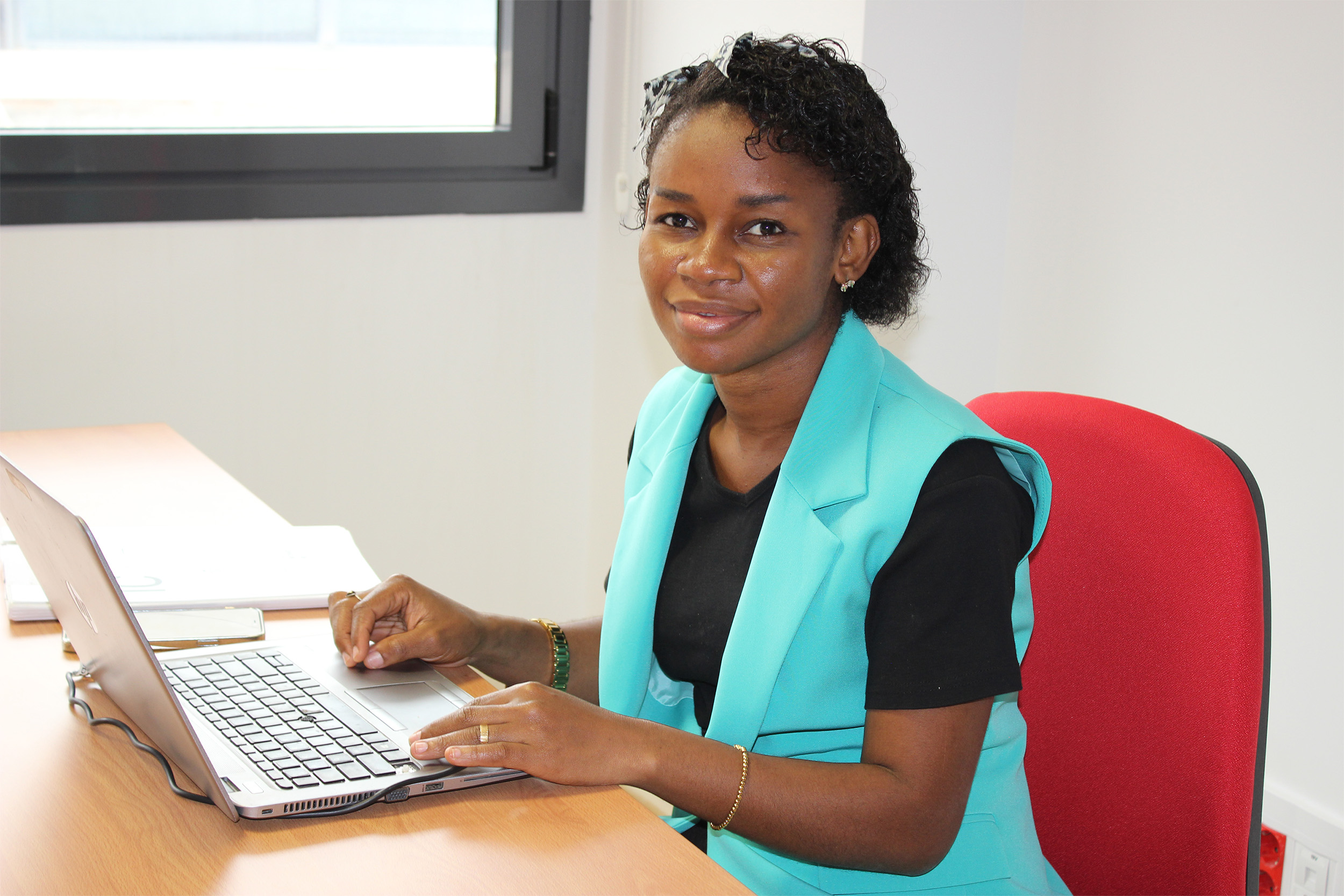
With this stay, Guemdjo hopes to contribute to the development of science in her community. Image: Laura M. Iraola/ICMAT
In what way do you think this stay at ICMAT will influence your career?
I believe the academic excellence and interdisciplinarity of ICMAT provide a unique environment for me to deepen my research and develop innovative solutions with global impact. This stay will also allow me to strengthen my skills, enrich my international scientific network and contribute to the development of science in my community. I hope to serve as an inspiration to other women to get involved in STEM disciplines.
I would also like to build bridges between ICMAT and scientific institutions in my region of Cameroon, Littoral, and launch joint research projects.
“This stay will also allow me to strengthen my skills, enrich my international scientific network and contribute to the development of science in my community”
Apart from your work, what other activities do you enjoy in Madrid?
Madrid offers a complete experience that combines history, culture, nature and gastronomy. I am enjoying the city, broadening my knowledge, discovering its flavours and relaxing in its iconic places. These experiences are an excellent way for me to balance work and personal life while I am here.
Guemdjo is the ninth African scientist to carry out a research stay at ICMAT, as part of Science by Women, an initiative of the Women for Africa Foundation, which this year celebrates its 10th edition. “As a public institution, we have a duty to actively contribute to the development of the scientific careers of people from less privileged backgrounds or from groups traditionally underrepresented in science,” said Javier Aramayona, Director of ICMAT, at the event marking the programme’s tenth anniversary.
—
Note: This is an automatic translation. Some nuances may differ from the original Spanish version.