
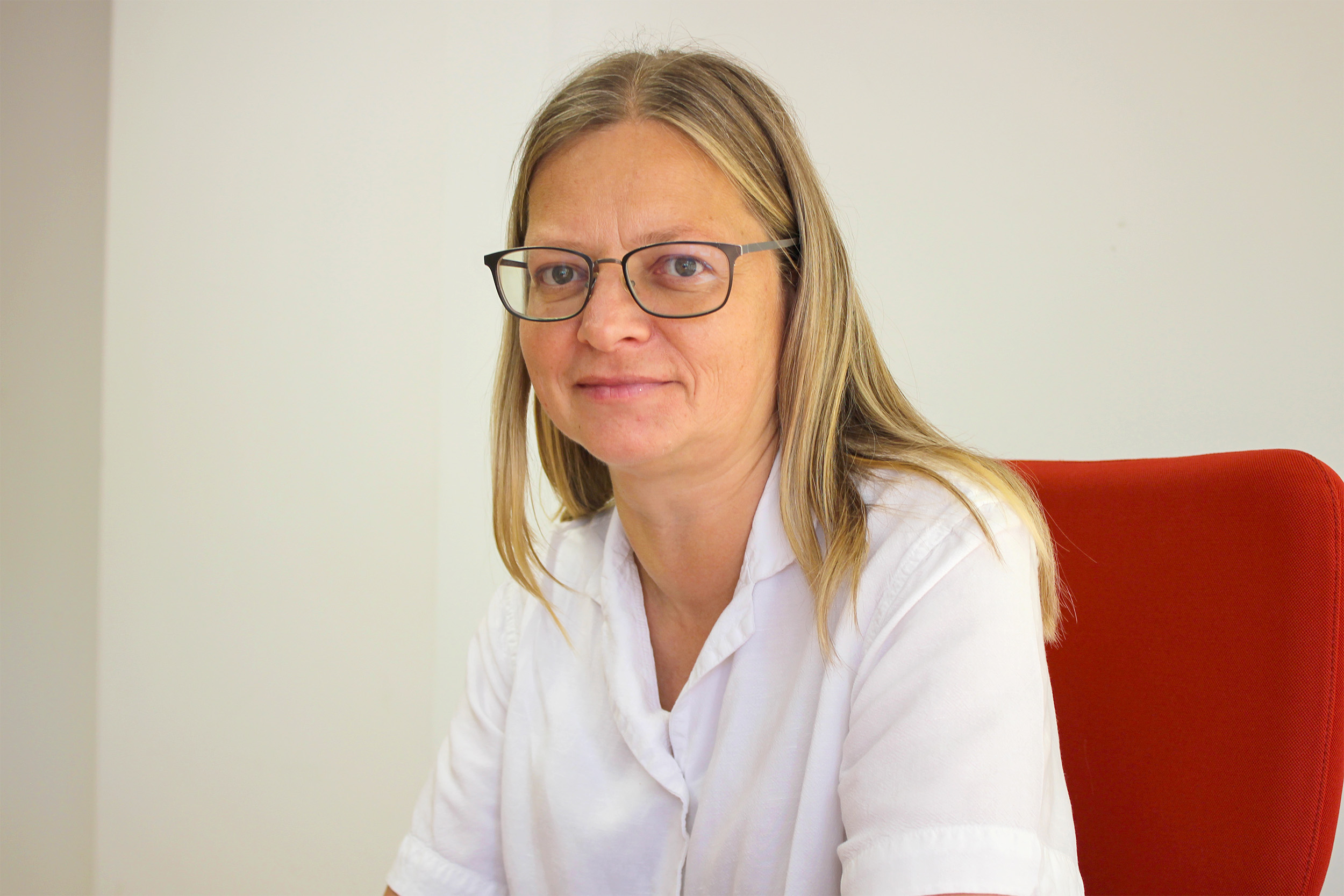
Eugenia Malinnikova, distinguished visiting professor at ICMAT. Image: Laura M. Iraola/ICMAT
She Does Maths
Eugenia Malinnikova has been a Distinguished Visiting Professor at ICMAT since 2024. A professor at Stanford University (USA), her research, which centres on the study of functions and equations, encompasses harmonic analysis, elliptic partial differential equations and potential theory. In June, she visited ICMAT and gave a special colloquium on the Laplace operator on graphs, an object of great interest in mathematics that can, for example, be used to represent and study relationships in a social network.
Laura M. Iraola (ICMAT)
How did you first become interested in mathematical research?
It started when I was a student in St Petersburg, Russia. I had an excellent professor who taught analysis and, in addition to his classes, organised meetings for first-year students where we discussed interesting problems. Thanks to him, I was introduced to potential theory, differential forms and some generalisations of analytic functions to first-order elliptic systems.
Over time, I broadened my interests to include harmonic analysis, but to me all these subjects are deeply connected. Although from the outside they may seem like different areas, they are actually part of the same research into functions, equations and their properties.
What attracts you most to these fields?
I like their concrete nature. I do not work with highly abstract objects, but rather with phenomena that have a clear physical interpretation. Harmonic functions, for example, describe many processes that we encounter in our surroundings. Although my research is highly theoretical and I do not seek immediate applications, I find it stimulating to know that the mathematics I study is connected to such familiar concepts as magnetic and gravitational fields.
What are you currently working on?
I have several projects under way. For several years, I have been working on a problem concerning the size of the critical set of harmonic functions. Together with my collaborators, we are seeking to obtain more precise quantitative estimates in order to gain a better understanding of how many points exhibit certain critical behaviours. It is a problem to which we have devoted a great deal of effort, and we believe we have recently solved it.
Another of my current projects concerns the Laplace operator and its properties on graphs, the subject of the special colloquium I gave during my visit to ICMAT.
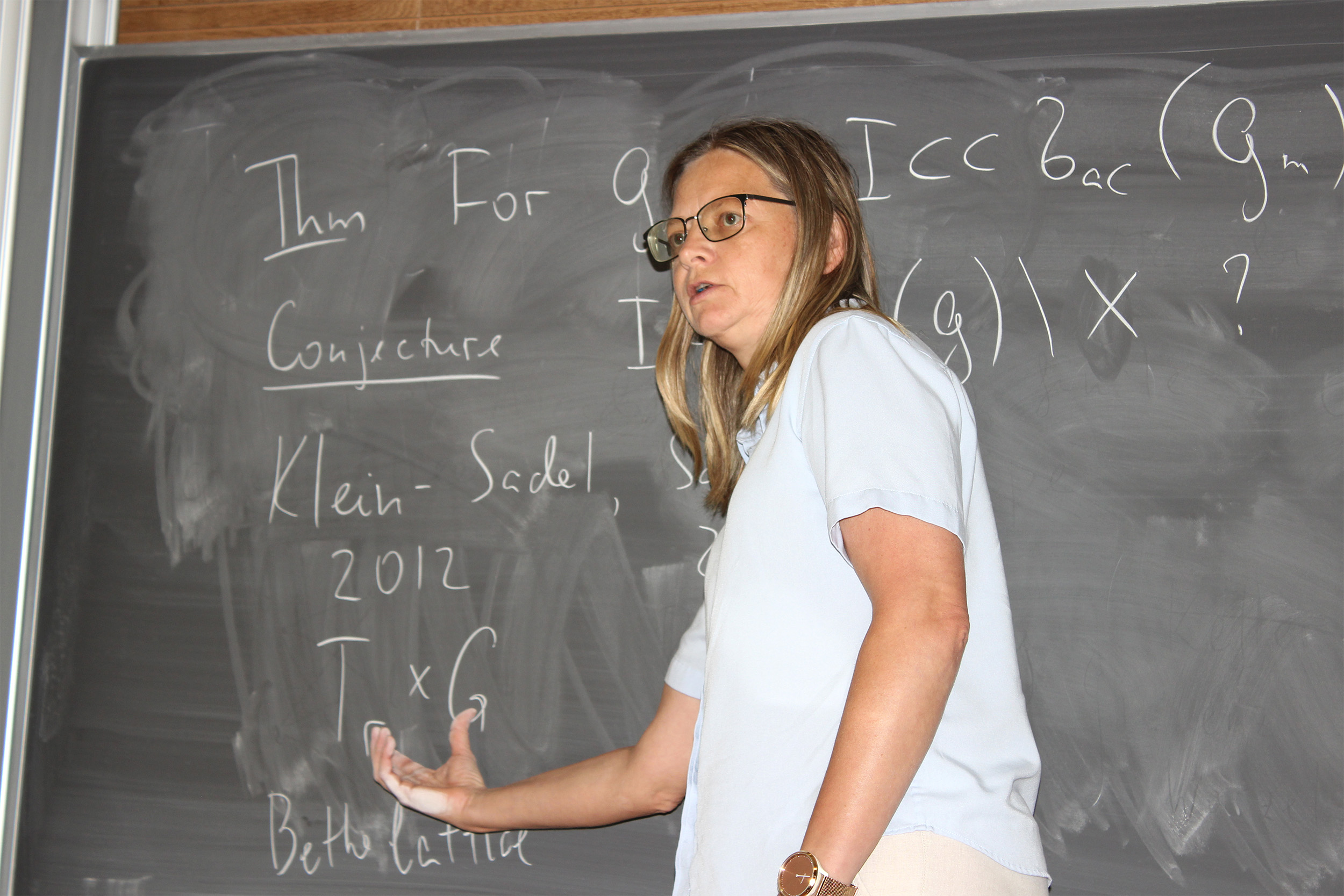
Malinnikova gave a special colloquium at ICMAT in June. Image: Laura M. Iraola/ICMAT
Could you tell us a little more about the implications of this latter research?
In this field, we study the spectrum of the Laplace operator of a graph, that is, its eigenvalues. One simple way of visualising it is to think of a social network. We can represent relationships between people using a graph and use the spectrum of its Laplacian to identify closely connected communities or groups. Beyond its implications for social networks, this field allows us to think about discrete phenomena. And many phenomena in the real world are discrete. We live in a world made up of atoms and molecules, but we do not know to what extent the intuition developed for continuous phenomena remains valid when we work with discrete structures such as graphs.
Looking back, is there a particular result that you are especially proud of?
I do not have one in particular, but I have very fond memories of a project I carried out with Aleksander Logunov, Lev Buhovsky and Mikhail Sodin on harmonic functions on a two-dimensional lattice. Imagine a grid in which the number in each square is equal to the average of the numbers in the four neighbouring squares. That is what we call a harmonic function in this context. We answered some very simple questions about these situations that no one had answered before. It was one of the projects I enjoyed the most.
Internationally recognised research
The International Congress of Mathematicians (ICM) took place in July 2026 in Philadelphia, USA. You were an invited speaker at the ICM in Rio de Janeiro in 2018. You were also a member of the scientific committee for the 2026 edition, which remained confidential until the congress took place. What is the ICM like from the inside?
It was a great honour to be invited to Rio. Before going there, I imagined it would be a huge event where there would hardly be any time to do mathematics. However, I was surprised—it was quite the opposite. I attended excellent lectures and learnt much more than I had expected. It was a very enriching experience.
One of your papers was also recognised in 2017 with the Clay Research Award, which you received jointly with Aleksander Logunov, for “developing a new geometric method to analyse the properties of solutions to elliptic eigenvalue problems”. What did this work involve?
A useful analogy is to think of a drum. Imagine that we do not know its shape and make it sound. As it vibrates, lines appear on the membrane that remain still. One of the questions is to estimate the size of these lines as a function of the vibration frequency. Something similar happens with a violin string: we know how the number of points that remain still depends on the note being played. The higher the note, the higher the frequency, and the more points appear where the string does not move. We study analogous phenomena in much more complicated settings and in higher dimensions.
This work led to a series of geometric and combinatorial tools that Aleksander Logunov subsequently used to tackle Yau’s well-known conjecture concerning the size of the zero sets of certain functions, for which he obtained a partial result.
You have been one of the Distinguished Visiting Professors in ICMAT’s Severo Ochoa programme since 2024. How has this collaboration been?
In this research group, which is locally coordinated by Eva Gallardo [Professor at Complutense University of Madrid and researcher at ICMAT], we are working on a complex project concerning invariant subspaces of certain operators. We start with an operator whose properties we know almost completely and introduce a small perturbation. The surprising thing is that, suddenly, everything changes and we no longer understand what is happening.
What is most interesting to me is that this problem is quite far removed from my usual area of research. I am learning a great deal because it touches on questions that are more directly related to my collaborators’ interests. Sometimes, it is precisely these difficult and uncertain problems that are the most stimulating.
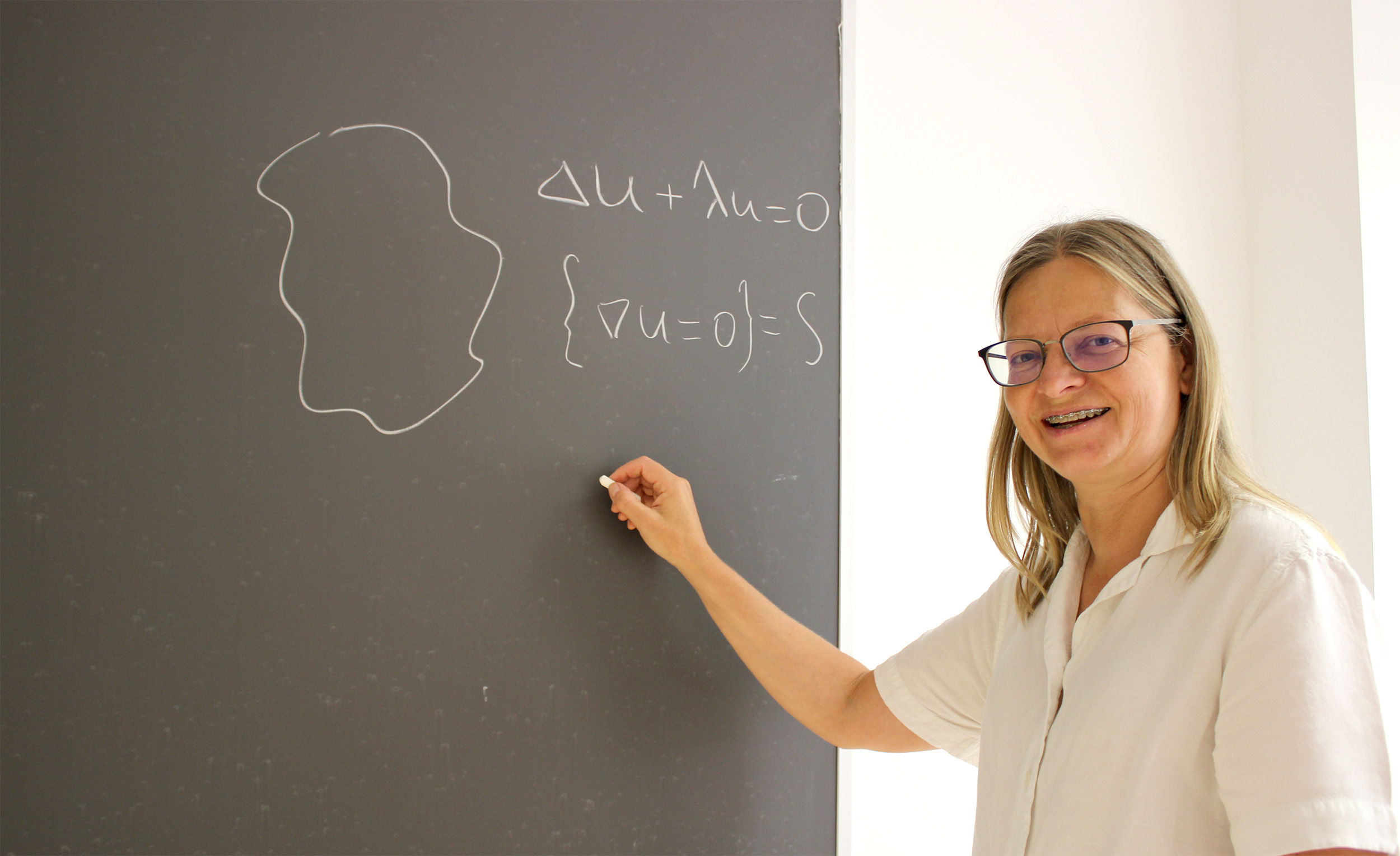
Malinnikova works at ICMAT on a project concerning invariant subspaces of certain operators, in the group locally coordinated by Eva Gallardo (ICMAT-UCM). Image: Laura M. Iraola/ICMAT
Encouraging young people to pursue mathematics
When you were a secondary-school student, you won the gold medal at the International Mathematical Olympiad three times. Do you think that experience influenced your career?
Yes, undoubtedly, although not so much because of winning as because of the pleasure of solving problems. Taking part in mathematics circles and competitions helped me discover that this was what I was really passionate about. It also gave me confidence when I went to university. At the same time, I realised that mathematics is not a sport. What interests me most now is learning, enjoying myself and exploring ideas.
Do you think these kinds of initiatives are important for encouraging young people to take an interest in mathematics?
Yes, although they are not the only route. Some students really enjoy competing, and for them Olympiads can be a tremendous source of motivation and confidence. But there are also people who prefer to work through problems at their own pace and can go on to become excellent mathematicians. What matters is that there are different kinds of opportunities for people to discover mathematics.
Are you still involved in this or any other initiative aimed at encouraging young people to pursue mathematics?
I am currently a member of the board of Omega, a new organisation in the United States that has launched a mathematics competition. We held the first edition last May in Denver, with around 180 students taking part from across the country. The most rewarding thing was seeing how these boys and girls, who feel isolated in their schools because they hardly know anyone else interested in mathematics, received an enormous boost of energy and motivation when they came into contact with other young people.
I also occasionally give talks in California, particularly as part of competitions and summer camps aimed at girls. I also visit mathematics clubs in schools. I am not particularly convinced by the idea of being a role model, but I do think it is important for young women to see very different kinds of women enjoying mathematics. It is important to show younger generations that there is no single way to build a successful career.
What do you think the situation is like for women in mathematical research?
I have two daughters, and for a long time I thought I would not want them to pursue an academic career because it can be very demanding. I no longer see it that way. I think all professions present challenges when it comes to balancing personal and professional life. Today, it is possible to build a fulfilling career while also having a family. Although there are still differences between men and women, the situation is much better than it was decades ago and continues to move in the right direction.
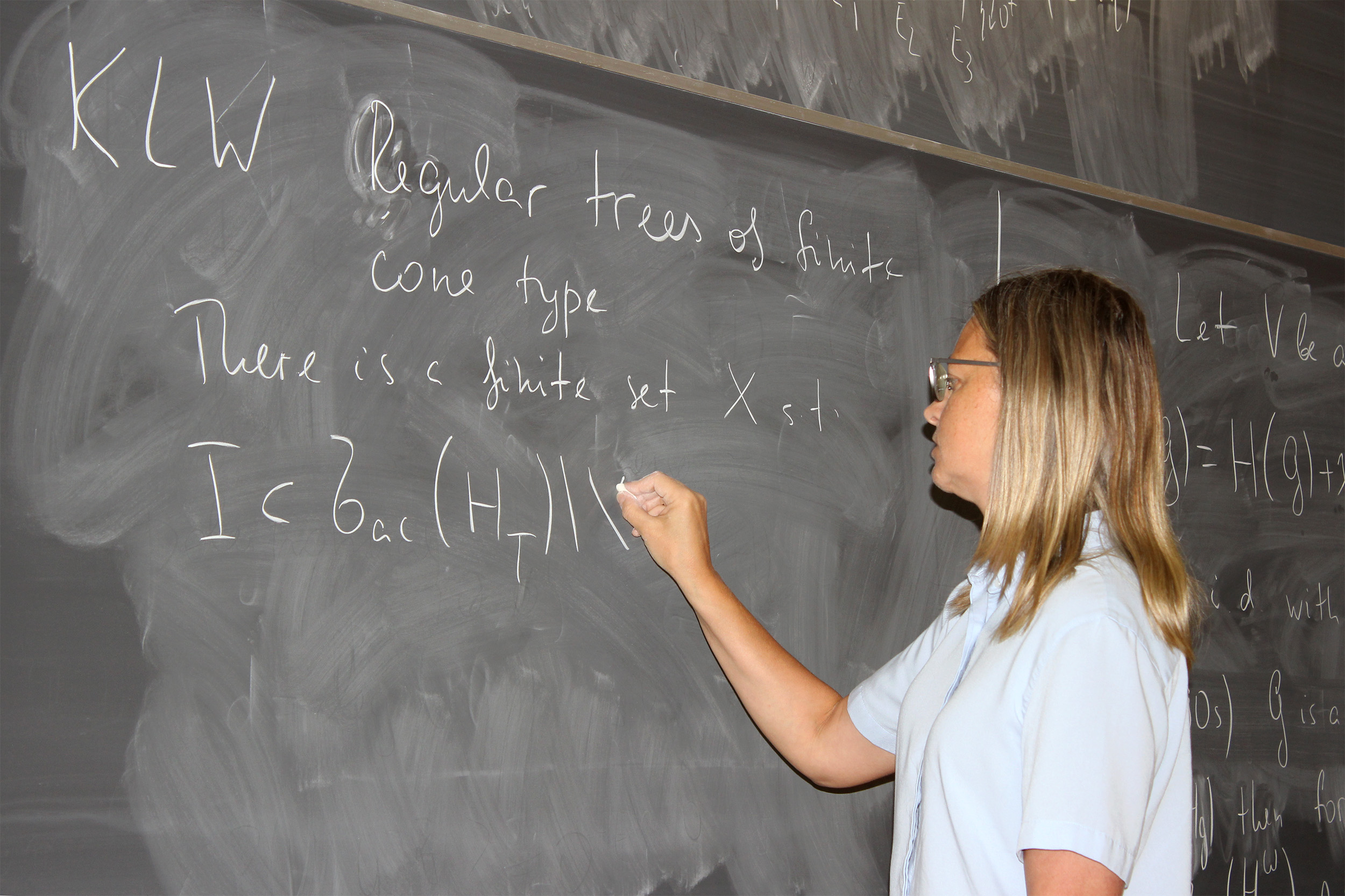
The researcher during her visit to ICMAT. Image: Laura M. Iraola/ICMAT
And finally, what do you enjoy doing when you are not doing mathematics?
The truth is that mathematics is, in a way, also my hobby. Sometimes, after spending the day on administrative or teaching duties, I come home wanting to do mathematics for pleasure. Apart from that, I really enjoy hiking in California and attending classical music concerts.
—
This is an automatic translation from an original Spanish text