
David Ríos Insua’s research starts from complex real-world decision-making problems, which he tackles with mathematical tools from fields such as Bayesian statistics, machine learning, and risk analysis.
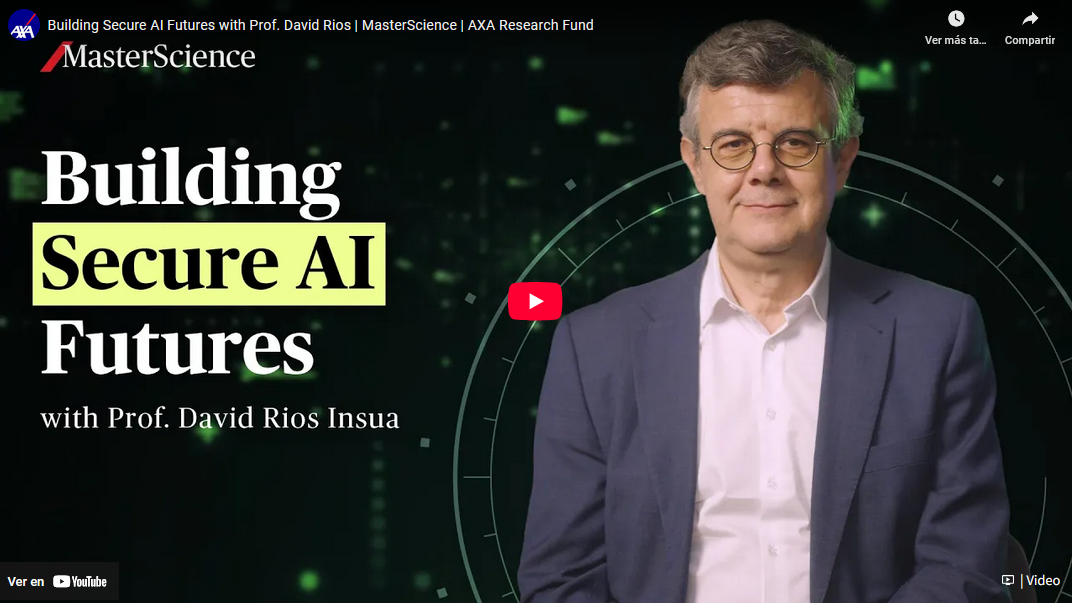
Artificial intelligence (AI) is redefining numerous aspects of our daily lives, from entertainment to healthcare and the workplace. This transformative potential also entails a series of risks, which David Ríos Insua, research professor in Risk Analysis and Data Science at CSIC in ICMAT, dissects in a new scientific outreach masterclass funded by the AXA Research Fund. The three-chapter series ‘Building Secure AI Futures’ is now available on the foundation’s YouTube channel.
“Artificial intelligence is not neutral. Its impact will depend on how we, as a society, decide to use it,” says Ríos. “The key is to understand its risks so we can manage them effectively,” he adds. In this outreach initiative, aimed at the general public, the mathematician clearly and rigorously addresses the challenges posed by AI, which are significantly different from the cyber risks we already know.
The masterclass is available in English (with the option to add Spanish and other language subtitles) and aims to serve as an educational and awareness tool for one of the greatest technological and ethical challenges of our time.
The chapters are as follows:
Chapter 1: The Hidden Risks of Artificial Intelligence
Although its origins date back to the 1950s, it is in recent years that AI has begun to profoundly transform the world. Beyond generative models, AI relies on machine learning, statistics, and logic to make predictions and real-impact decisions. Every technological advance is accompanied by new uncertainties: for every benefit, a risk can also emerge.
Chapter 2: How Artificial Intelligence Threatens Politics, Economy, and Society
The World Economic Forum has highlighted the impact of AI-driven disinformation as one of the main global threats. This technology not only affects politics and the media but is also reshaping the labor market, the production system, and the way essential services like healthcare are provided.
Chapter 3: The Path to Safer AI
What tools can be used to ensure the ethical and secure development of artificial intelligence? From European regulation to international initiatives, David Ríos outlines the keys to establishing responsible governance of this technology. This final chapter of the series encourages action—from individual to institutional levels—to ensure that AI development is oriented towards collective well-being.
David Ríos Insua: Mathematics for Decision Making
David Ríos Insua is a CSIC research professor at ICMAT and a member of the Royal Academy of Exact, Physical and Natural Sciences. His research starts from complex real-world decision-making problems, which he tackles with mathematical tools from fields such as Bayesian statistics, machine learning, and risk analysis. His work has had applications in reservoir management, critical infrastructure protection, social robotics, and, in recent years, in adversarial risk analysis.
Adversarial risk analysis allows for decision-making in conflict situations, such as cybersecurity or counter-terrorism, using mathematical tools from Bayesian statistics and game theory. To make predictions and optimize strategies, this model considers adversaries to be intelligent and capable of adapting to response actions against risk, unlike traditional methods which assume risks are fixed. This approach has proven especially useful in contexts where threats are uncertain and changing, as is the case in the field of AI.
On this topic, Ríos directed the AXA-ICMAT Chair in Adversarial Risk Analysis at ICMAT. Ríos is also a professor of Statistics and Operations Research at the Complutense University of Madrid (UCM), currently on leave. A graduate in Mathematical Sciences from UCM, Ríos obtained his doctorate in Computer Science from the University of Leeds (UK), under the supervision of Simon French. After that, he has been a professor and researcher at various international institutions, including the universities of Manchester, Leeds, Purdue, Duke, Paris-Dauphine, Aalto, Rey Juan Carlos, Polytechnic University of Madrid, and Shanghai University of Science and Technology. He has also been a member of the International Institute for Applied Systems Analysis (IIASA) in Vienna, the Istituto di Matematica Applicata e Tecnologie Informatiche in Milan, and the Statistical and Applied Mathematical Sciences Institute (SAMSI) in Durham, where he directed two research programs.
He is the author and editor of more than 20 monographs, including Sensitivity Analysis in MODM (Springer), Statistical Decision Theory (Wiley), Bayesian Analysis of Stochastic Process Models (Wiley), and Adversarial Risk Analysis (Taylor & Francis). He has published more than 160 scientific articles and book chapters. He has been an invited speaker on 70 occasions and has supervised 27 doctoral theses and 31 master’s theses.
His personal interests include surfing, travel (especially in northern Galicia), and learning with his daughters.
—
This content has been automatically translated. The original text may differ slightly.