
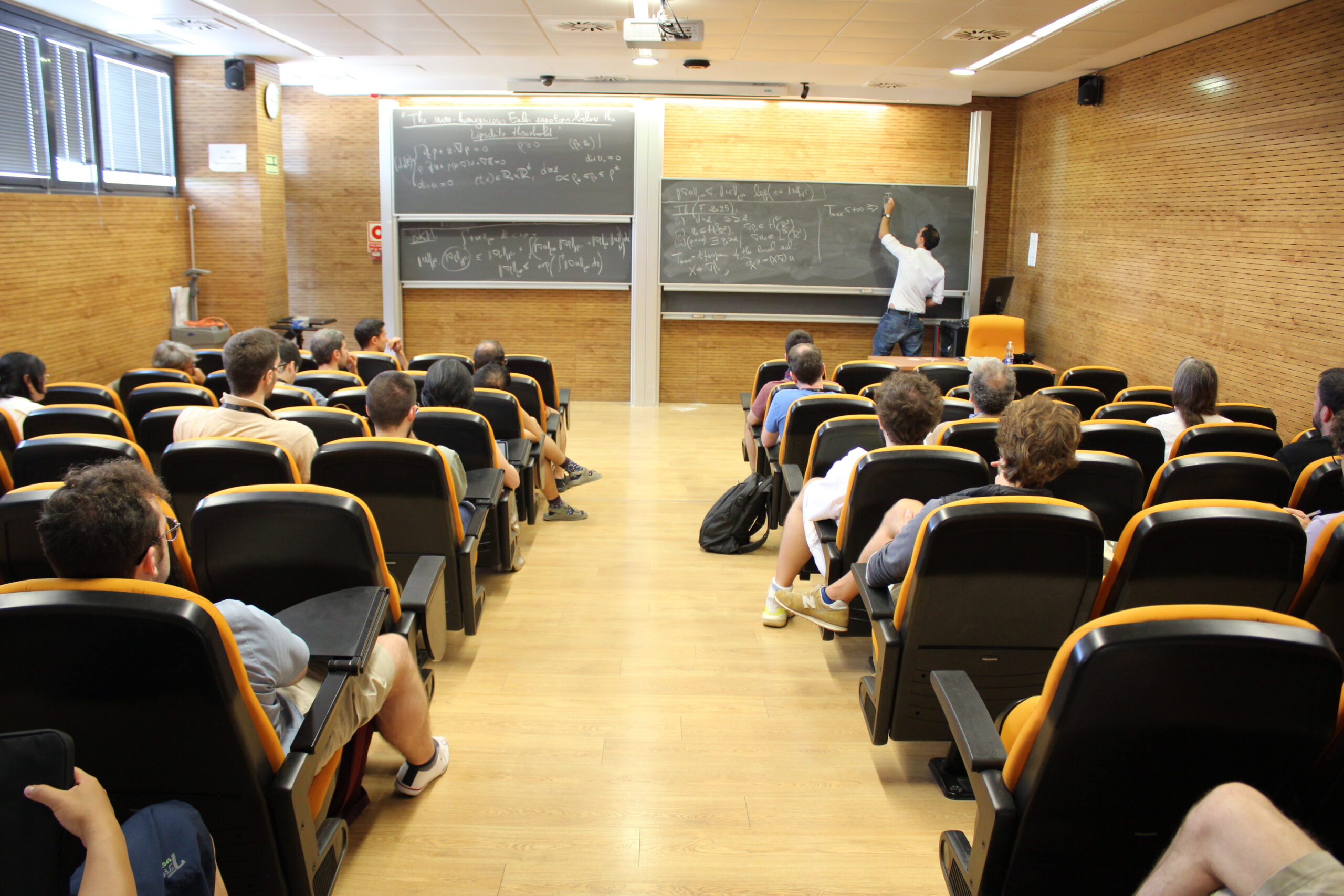
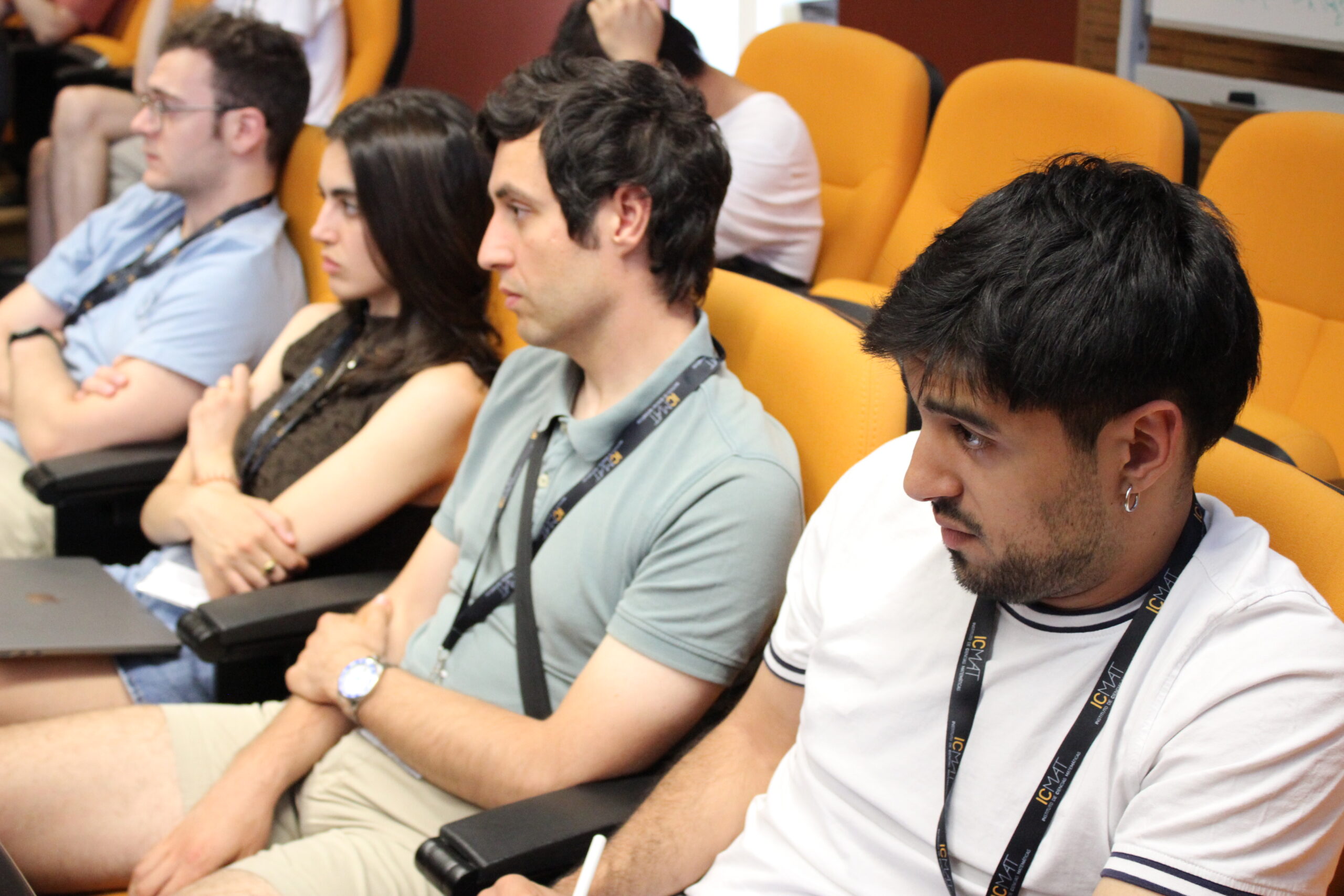
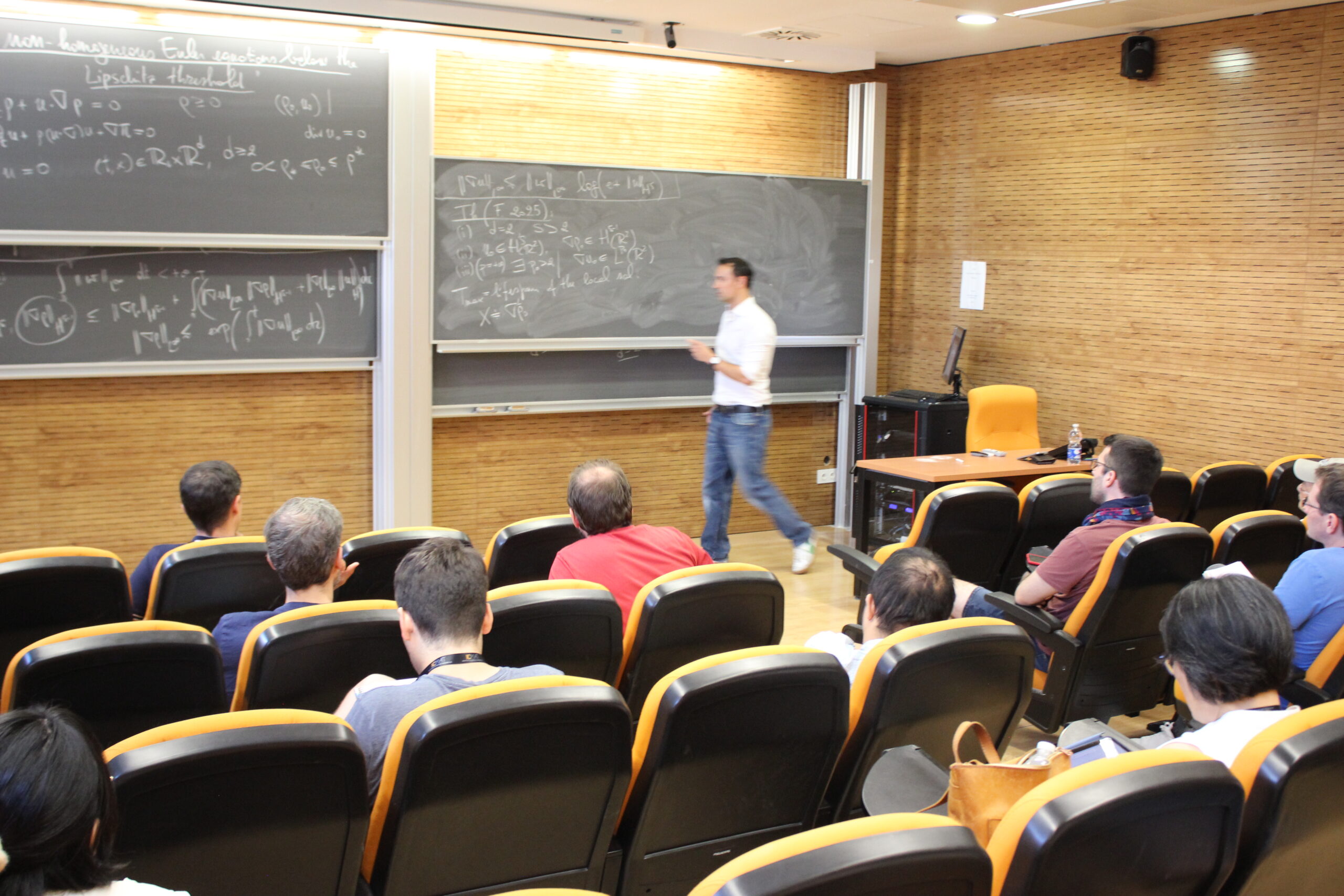
The ‘Modern Perspectives on the Mathematics of Fluids’ conference brings together around 40 experts in the mathematical equations governing fluids. Image: Ágata Timón/ICMAT
Why do vortices form in the ocean or the atmosphere? Can a wave break in a finite time given smooth initial data? These questions, which appear to be purely physical, are in fact some of the most profound open problems in modern mathematical analysis. The behaviour of incompressible fluids, such as water or air, is governed by Euler’s and Navier–Stokes’ equations. Although they were formulated in the 19th century, our mathematical understanding of them remains incomplete. In fact, determining whether the solutions to the Navier-Stokes equations can develop singularities (that is, whether velocities or their derivatives can become infinite in a finite time) is one of the seven Millennium Problems set by the Clay Mathematics Institute, for which a prize of one million dollars is offered.
This week, specialists from around the world in the mathematical understanding of fluid behaviour have gathered at the Institute of Mathematical Sciences (ICMAT) and CUNEF University, as part of the international conference ‘Modern Perspectives on the Mathematics of Fluids’.
The conference, held from 15 to 19 June, was organised by Diego Córdoba (ICMAT-CSIC), Óscar Domínguez (CUNEF University), Alberto Enciso (ICMAT-CSIC), Daniel Peralta-Salas (ICMAT, Madrid) and Luis Martinez-Zoroa (CUNEF University).
The talks at the event addressed, amongst other topics, the stability of shear flows (flows in which layers of fluid move at different speeds), inviscid damping and vorticity mixing – phenomena that explain how perturbations in an ideal fluid can dissipate without the need for viscosity, solely due to the geometry of the flow. These are areas in which ICMAT researchers have made significant contributions in recent years.
Hosting the conference reinforces ICMAT’s role as a leading centre in the mathematical analysis of partial differential equations and fluid mechanics.
This is an automatic translation from Spanish.