
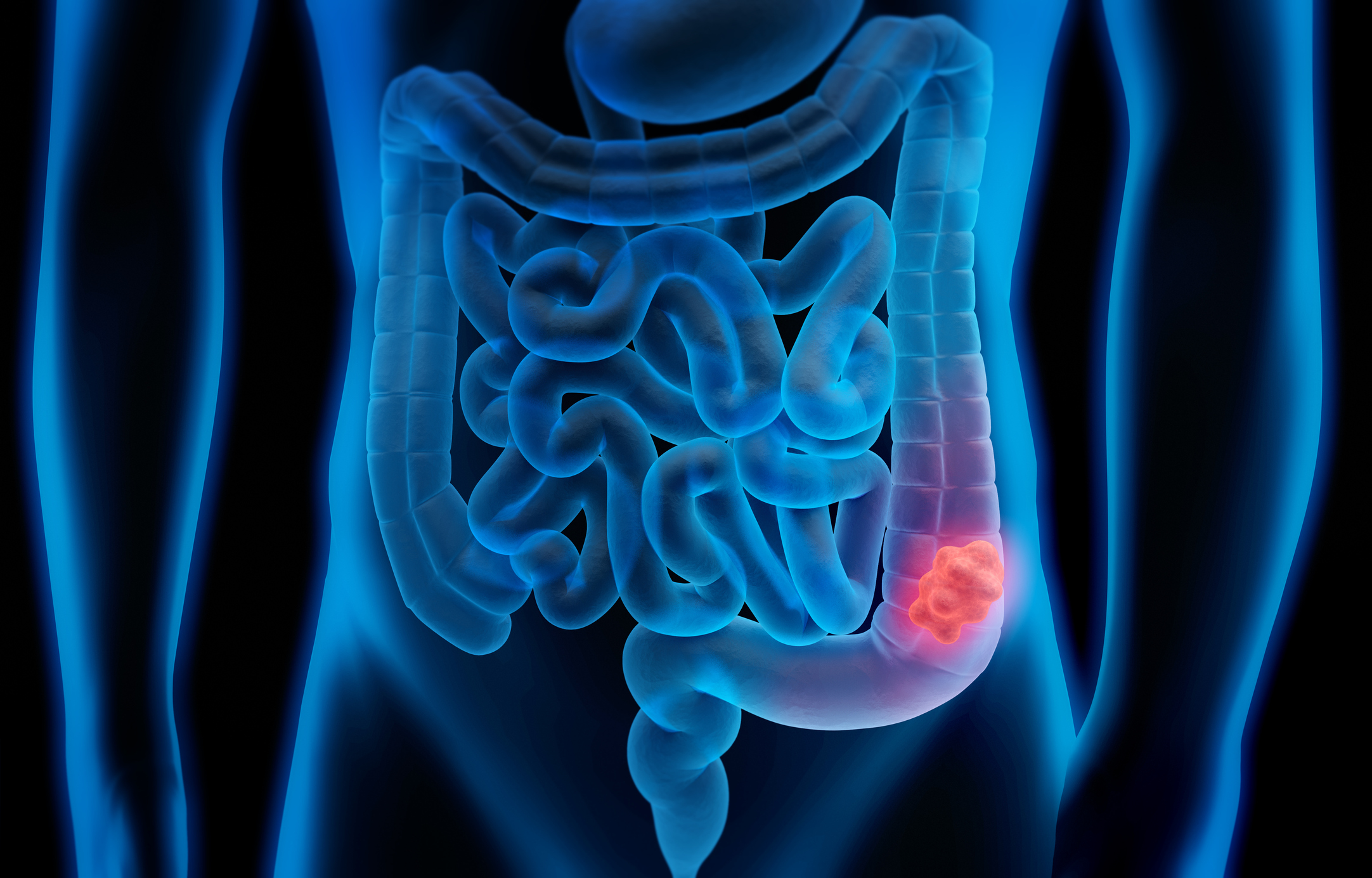
Medical illustration of Colorectal Cancer – Polyp. Image: iStock
CSIC and ICMAT Communication
A team from the Spanish National Research Council (CSIC), a body attached to the Ministry of Science, Innovation and Universities, has developed a mathematical model to identify a better strategy for the early detection of colorectal cancer. The study, published in Computers in Biology and Medicine, shows that a strategy for screening based on a more personalised approach increases the number of early-stage cases detected, while using the same resources as the current one.
Colorectal cancer is the third most common type of cancer worldwide: it accounts for 10% of cases and 12% of cancer-related deaths. Early detection of the disease is key to tackling it. Most screening programmes are usually based solely on age; that is, they consist of giving the same type of test to all people over a certain age, in order to detect early cases of the disease.
The model, designed by Daniel Corrales and David Ríos, CSIC researchers at the Institute of Mathematical Sciences (ICMAT), together with Marino J. González from the University of La Rioja, identifies a set of characteristics associated with a high probability of developing this type of cancer. These include, in addition to age –confirmed as the variable most strongly associated with the disease–, the presence of other conditions such as diabetes and hypertension, smoking and alcohol consumption, or body mass index. Based on this information, the study establishes a risk level for each person, to whom a specific action for early detection is suggested. According to the study, in medium-risk cases, the current test –based on detecting blood in faeces– is the most efficient. However, if the risk is higher, another type of test, such as a stool DNA test, would be advisable.
“Our proposal makes it possible to thoroughly evaluate existing national colorectal cancer screening programmes, as well as to compare them with other strategies,” says David Ríos, CSIC research professor at ICMAT. “The results show that a personalised strategy detects a higher number of early cases among the population, which may, in the long run, reduce mortality from this disease and also the expenditure of resources on treatment,” he adds.
Bayesian networks to analyse risk factors
Within the framework of the European project Oncoscreen, the researchers have designed a statistical graphical model known as a Bayesian network to analyse risk factors. “It is a diagram that makes it possible to clearly and simply represent the complex web of relationships between different relevant medical conditions,” explains Daniel Corrales, CSIC doctoral researcher at ICMAT.
The network is made up of nodes, representing the variables of interest –for example, the presence of cancerous cells, age, body mass index or diabetes–, and arcs between nodes, which indicate the association between them. “If there is an arc between two nodes in the model, this means that the two variables they represent have a relationship of dependence,” Corrales explains. These relationships are quantified through conditional probabilities, which represent the likelihood of a particular event occurring –for example, having diabetes– if another event occurs –for example, being over 60 years old. Each node incorporates a probability table showing the possible values of that variable, according to the available information. “It is a visual tool that makes interpretation easier for experts,” says Ríos.
Mathematics to support decision-making
By introducing patient data, the network makes it possible, among other things, to compute their risk of developing colorectal cancer –the initial objective of the study. Once this information has been obtained, it is incorporated into a decision model that suggests what action to take in each case. “To this end, a multi-attribute utility function is also taken into account, covering the cost of the test, the information it provides and how uncomfortable it is for the patient,” Corrales describes.
Using this tool, most of the general population would not be assigned any test, since their risk is generally very low. “But when the risk increases, it is important to know which test to assign, taking into account, on the one hand, how many tests of each type are available in the screening programme and, on the other, how well each type of test detects the presence of cancer,” Ríos details.
According to their results, for high-risk cases it would be advisable to use tests that are more sensitive than the current ones, that is, “those with a greater ability to correctly detect people with the disease, minimising the possibility of false negatives,” Corrales explains. According to the study, a stool DNA test, although more expensive, may be more suitable than the standard test for higher-risk patients. “To support the selection of the optimal tests, those with the maximum expected utility according to the studied criteria are sought,” the authors comment.
To design the model, the researchers combined expert knowledge of this disease with machine learning extracted from data from two million patients. “In a first phase we reviewed the existing research on risk factors for colorectal cancer and held discussions with doctors. Then, we confirmed this information with data provided by collaborating medical centres,” says Corrales.
The conclusions of this study will be used to evaluate the new technologies for early detection of CRC being developed in the ONCOSCREEN project by collaborating research centres and universities.
References:
- Corrales, D., Insua, D. R., & González, M. J. (2025). A decision analysis model for colorectal cancer screening. Computers in Biology and Medicine, 196, 110755. https://doi.org/10.1016/j.compbiomed.2025.110755
- Corrales, D., Santos-Lozano, A., López-Ortiz, S., Lucia, A., & Insua, D. R. (2024). Colorectal cancer risk mapping through Bayesian networks. Computer Methods and Programs in Biomedicine, 257, 108407. https://doi.org/10.1016/j.cmpb.2024.108407
—
Note: This is an automatic translation. Some nuances may differ from the original Spanish version.