
David Ríos is an expert in Bayesian risk analysis, statistics and machine learning. Image: Laura M Iraola/ ICMAT.
ICMAT-CSIC researcher receives the SEIO – BBVA Foundation Award for an article proposing a Bayesian approach to protect artificial intelligence systems from adversarial attacks.
A paper by David Ríos Insua, CSIC research professor at ICMAT, has been awarded in the 7th edition of the Spanish Society of Statistics, Operations Research and Data Science (SEIO) – BBVA Foundation Awards 2026, in the category of Best contribution from Statistics and Operations Research to Data Science. The award recognises the article “Adversarial Machine Learning: Bayesian Perspectives,” co-authored with Roi Naveiro (CUNEF Universidad), Víctor Gallego (Komorebi AI and IE University) and Jason Poulos (Harvard Medical School), and published in the Journal of the American Statistical Association, a high-impact statistics journal.
The paper, developed while Naveiro and Gallego were members of ICMAT and the team led by Ríos, together with Poulos, was visiting the Statistical and Applied Mathematical Sciences Institute (USA), addresses one of the major challenges facing artificial intelligence today: how to protect machine learning systems from malicious attacks. Such attacks can affect numerous critical systems: image recognition algorithms, spam filters or bank fraud detection systems, among many others. If someone deliberately manipulates the data, even fully operational systems can fail in surprising ways.
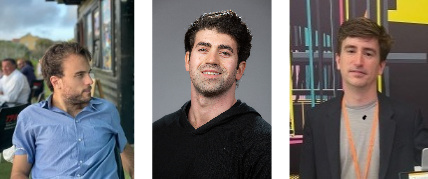
From left to right: Roi Naveiro, Jason Poulos and Víctor Gallego, co-authors of the award-winning paper. Images from the researchers’ personal websites.
For example, by attaching small black-and-white stickers to a real sign, researchers managed to trick a self-driving car’s traffic sign recognition system into mistaking a stop sign for a speed limit sign. Or, as shown in the image below, slight modifications to a vehicle’s number plate are enough to prevent it from being read by automatic recognition systems. The changes are almost imperceptible to the human eye, but they are enough to make many of the algorithms used misclassify the information, repeatedly.
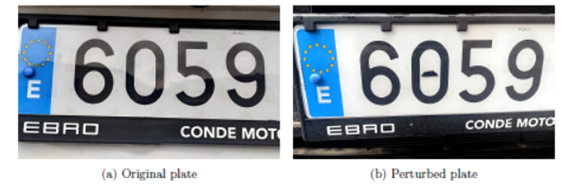
On the left, the original number plate. On the right, the plate modified to fool the image recognition programme. Image courtesy of Ríos.
In response to these vulnerabilities, adversarial machine learning has emerged as a field studying how these systems behave when an intelligent adversary is actively trying to deceive them. Unlike most existing approaches, which rely on game theory (and assume that attacker and defender know, or can infer, each other’s beliefs and preferences), Ríos Insua and his co-authors propose an alternative: modelling the uncertainty about the adversary’s beliefs, capabilities and intentions through Bayesian statistics, without needing to assume this mutual knowledge, which is rarely present in real-world situations.
“The central idea is to make coherent probabilistic predictions about the adversary’s likely behaviour and integrate them into the AI system, so that its predictions are more robust against such attacks. This increases the security of the decisions made by AI-based systems, which will boost society’s trust in these revolutionary technologies, already applied in critical domains such as defence, transport, cybersecurity, health and finance,” explains Ríos.
David Ríos Insua
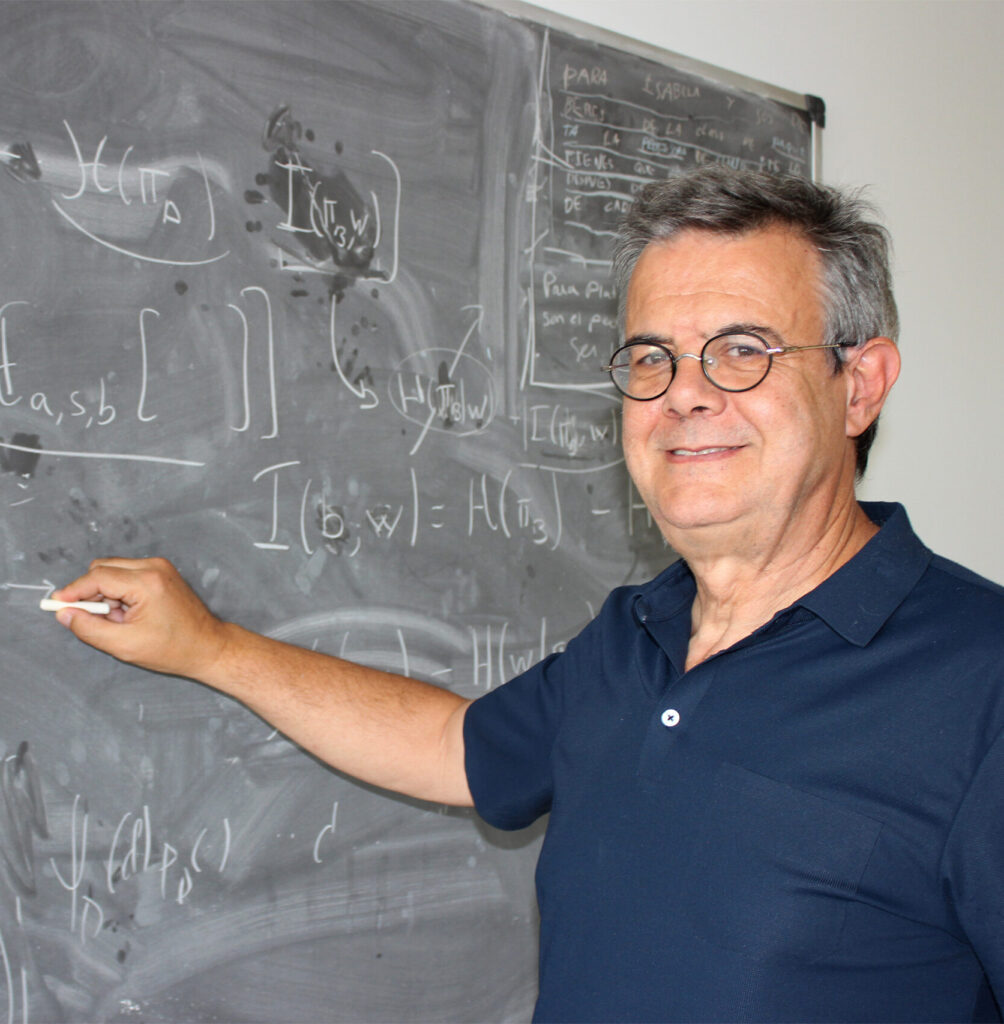
David Ríos, in his office at ICMAT. Image: Laura M Iraola/ ICMAT.
David Ríos Insua is a CSIC research professor at ICMAT and a full member of the Royal Spanish Academy of Exact, Physical and Natural Sciences. A specialist in Bayesian risk analysis, statistics and machine learning, and in decision analysis and its applications in security, cybersecurity and health, among other fields, he is the author of more than twenty monographs on these subjects.
From 2014 to 2023 he headed the AXA-ICMAT Chair in Adversarial Risk Analysis and holds a chair in Statistics and Operations Research at Universidad Complutense de Madrid (currently on leave). He has previously been a professor at Duke University (USA), Purdue University (USA), Aalto University (Finland), Paris-Dauphine University (France), the University of Shanghai for Science and Technology (China), CNR-IMATI (Italy), the Czech Academy of Sciences (UTIA), Universidad Politécnica de Madrid and Universidad Rey Juan Carlos. In 2018 he received the ISBA DeGroot Prize and in 2019 the Edelman Award.
SEIO – BBVA Foundation Awards
The SEIO – BBVA Foundation Awards, now in their seventh edition, have recognised a total of five contributions in statistics, operations research and data science, selected by an international jury chaired by Albert Satorra (Universitat Pompeu Fabra).
This is an automatic translation from an original Spanish text