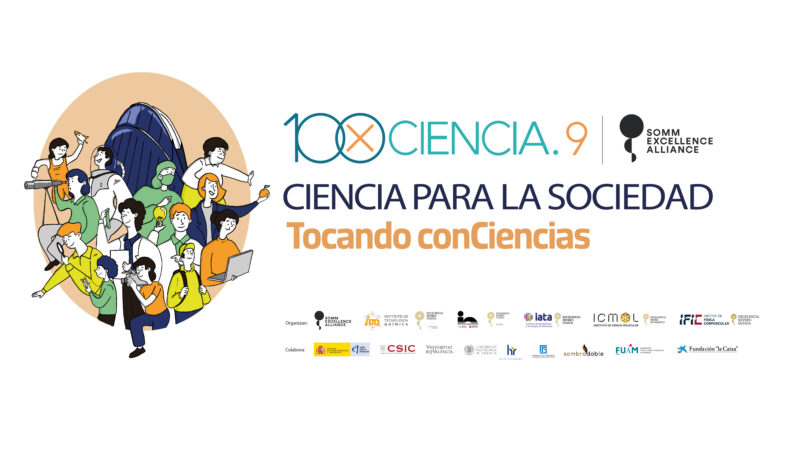
On 13 and 14 November, 100xCiencia.9 is being held at CaixaForum València, the annual meeting of the SOMMa Alliance, made up of institutions recognised under the Severo Ochoa Centres of Excellence and María de Maeztu Units (CEX) programme of the Ministry of Science, Innovation and Universities, among which is ICMAT. The meeting can also be followed online on SOMMa’s YouTube channel.
The ninth edition of the congress is held under the motto “Science for society, touching consciences”, which aligns with one of the network’s main goals. “The SOMMa alliance is strongly committed to making the scientific work of the centres transcend their walls and become a dialogue with society. We want to share the major scientific achievements of the centres, attract more people to scientific careers, and promote the idea that science is crucial in everyday life and, in particular, in political decision-making,” says Javier Aramayona, director of ICMAT and vice-president of SOMMa.
To this end, the event brings together researchers, institutional representatives, science managers and the public, who “will reflect on how science can help address the major social, environmental and economic challenges of our time,” according to the news published by SOMMa. Representing ICMAT, in addition to Aramayona, will be Diego Córdoba, scientific director of the CEX project at ICMAT, and Esther Fuentes, manager of the same project.
The official opening will feature an address by the Minister of Science, Innovation and Universities, Diana Morant, alongside institutional representatives from the Generalitat Valenciana, the State Research Agency (AEI), the Spanish National Research Council (CSIC) and three Valencian universities — Universitat de València (UV), Universitat Politècnica de València (UPV) and Universidad Miguel Hernández (UMH).
Frontier science to tackle social challenges
Over the two days, in addition to SOMMa Alliance working meetings, there will be round tables with contributions from researchers, managers and institutional representatives. Some will address broad issues affecting all disciplines: science for public policy, talent attraction, or the use of artificial intelligence and data science in scientific progress. Others will focus on current research topics such as the development of advanced materials and nanotechnology for industry and health, or the scientific challenges of longevity.
There will also be two invited lectures: “Our vision from ITQ on the binomial of knowledge generation and transfer: a historical overview”, by Avelino Corma (Institute of Chemical Technology, CSIC), and “Integrity in research: good scientific practices”, by Pilar Goya (Institute of Medical Chemistry, CSIC).
In addition, on Friday, 14 October, from 17:00 to 20:00, there will be a wide-ranging outreach programme open to the general public, featuring sessions on music and science, extreme weather, bioinformatics, sustainable energy, fungal research, particle physics, astrophysics, luminescent chemistry, neuroscience and electromagnetic phenomena, combining dissemination, art and interactive experimentation.
This year’s event is organised by five institutions in the Valencian Community accredited under SOMMa: the Institute of Agrochemistry and Food Technology (IATA-CSIC), the Institute of Molecular Science (ICMol-UV), the Institute of Chemical Technology (ITQ-UPV/CSIC), the Institute of Corpuscular Physics (IFIC-UV/CSIC) and the Institute of Neurosciences (IN-CSIC/UMH).
About SOMMa
The SOMMa Alliance (Severo Ochoa and María de Maeztu) brings together the majority of research centres and units of excellence in Spain, recognised for their international leadership, scientific impact and contribution to innovation. “The SOMMa Alliance helps to structure Spain’s system of scientific excellence, providing a platform for centres to collaborate scientifically,” explains Aramayona.
The Ministry of Science, Innovation and Universities’ programme for “Severo Ochoa” Centres of Excellence and “María de Maeztu” Units of Excellence (CEX) aims to strengthen these institutions and is aimed at public-sector centres and units of excellence, as well as non-profit private research institutions “whose scientific leadership is internationally recognised, with the capacity to contribute decisively to advancing the frontiers of knowledge and generating high-impact results, as well as to exert a driving effect on the Spanish Science, Technology and Innovation System,” according to the AEI website.
Since 2011, the first year of the CEX programme, ICMAT has been continuously accredited with four Severo Ochoa awards (the latest, currently in force, in 2024). “Currently, each grant amounts to €4.5 million over four years, along with a strong commitment to predoctoral training through 10 doctoral fellowships,” explains Aramayona. This enables the centre to implement its scientific strategy, which includes Distinguished Professors and Laboratories programmes, postdoctoral contract offers and a large number of international scientific events.