




Program
Schedule
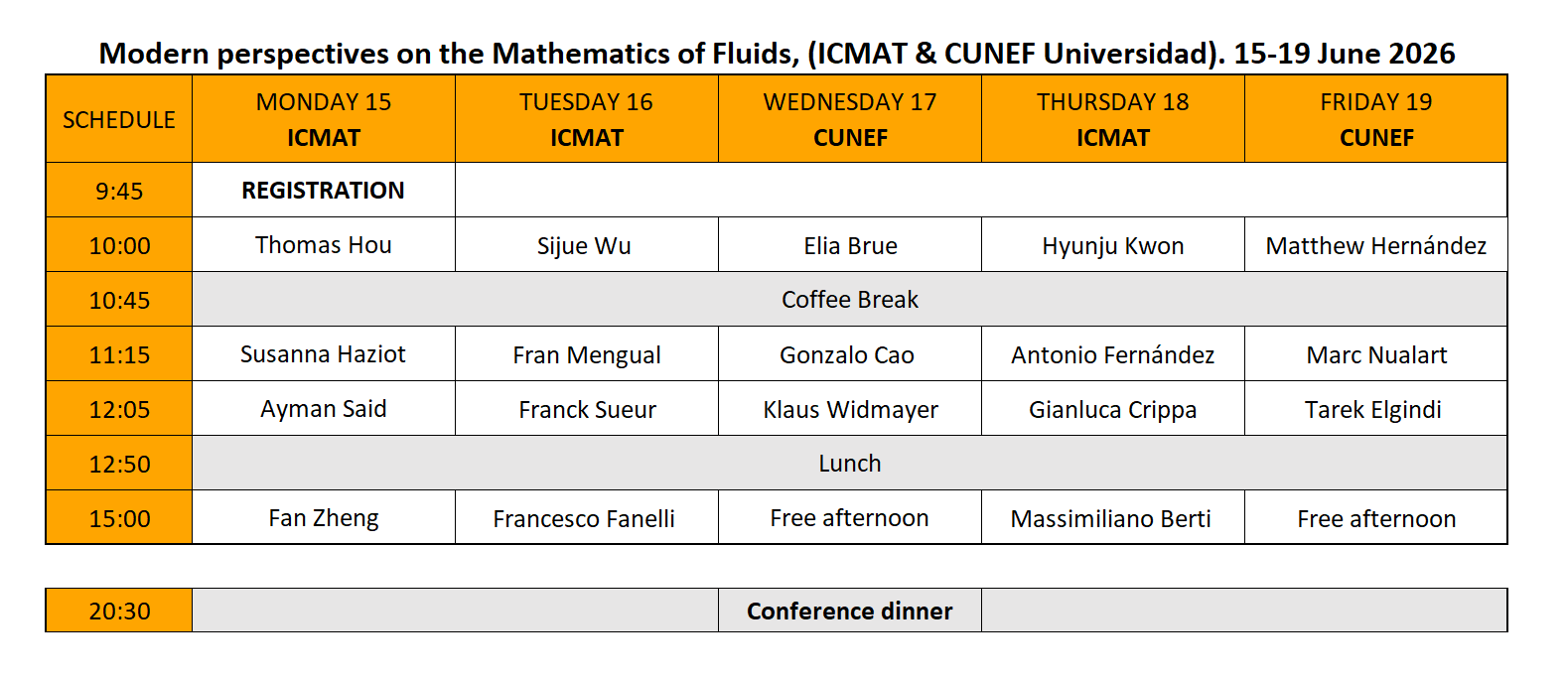
About the Conference dinner:
Restaurant Sal Gorda
How to arrive
Speakers
|
|
Programme
Marc Nualart - Asymptotic Stability of Shear Flows in Inviscid Fluid models.
Abstract: Shear flow velocity fields are stationary solutions to several physically relevant fluid equations such as the Euler and Boussinesq equations. In this talk we shall review recent progress in the stability analysis of these solutions, ranging from classical results involving spectral descriptions to current stability mechanisms based on vorticity mixing and inviscid damping.
Fan Zheng - Finite time singularities for 3D hypodissipative Navier-Stokes equations
Abstract: The question of singularity formation in fluid dynamics remains one of the most challenging open problems in mathematical physics. In this talk, we present new results showing that solutions to 3D hypodissipative Navier--Stokes equations with smooth initial data and an external forcing that is integrable in \(C^{1+\epsilon}\) can break down in finite time. The dissipation in the equation amounts to 0.1 orders of derivative, or \((-\Delta)^{0.046}\). I will also discuss extensions that allow for more dissipation and rougher forcing.
Gianluca Crippa - Singular limits in some nonlinear continuity equations
Abstract: In this talk, I will review recent results obtained in several joint works on singular limits for nonlinear partial differential equations with a continuity equation structure. I will present results on nonlocal approximations of continuity equations, where the advecting velocity field depends on the solution through a convolution with a family of kernels converging to a Dirac delta, as well as on vanishing viscosity approximations and related regularizations, including schemes with a numerical flavor. In particular, I will discuss consequences for the vanishing viscosity problem for the two-dimensional Euler equations. I will also show how these approximations converge to solutions with stronger properties than general weak solutions. Finally, I will briefly address quantitative aspects of these singular limits, including convergence rates.
Francisco José Mengual Bretón - Unstable vortices and sharp nonuniqueness for the forced SQG equation
Abstract: We present a nonuniqueness result for the forced SQG equation in supercritical Sobolev spaces. A key step is the construction of smooth, compactly supported vortices exhibiting nonlinear instability. We also address the dissipative case, including nonuniqueness of Resnick solutions for SQG, as well as below the Ladyzhenskaya–Prodi–Serrin class for the 2D Navier–Stokes equation. This is joint work with Á. Castro, D. Faraco, and M. Solera.
Francesco Fanelli - The non-homogeneous Euler equations below the Lipschitz threshold
Abstract: The incompressible Euler equations are well-known to be globally well-posed in the case of space dimension $d=2$, both in the strong solutions framework and in the Yudovich framework. No results of that kind are known for the non-homogeneous (that is, density-dependent) incompressible Euler system.
In this talk, we show that both problems (\textsl{i.e.}, global well-posedness and theory \textsl{\`a la Yudovich} for the density-dependent case) can be reduced to the study of a non-linear geometric quantity, which encodes the regularity of the velocity field along the level lines of the density. Such a geometric regularity places itself below the Lipschitz threshold.
Hyunju Kwon - Non-conservation of generalized helicity in 3D Euler flows
Abstract: Recently, there has been significant research into the non-conservation of total kinetic energy in Euler flows, which has led to Onsager’s theorem and its intermittent version. In this talk, I will discuss an analogous question for another conserved quantity: helicity. I will present the first example of a weak solution to the 3D Euler equations in C^0_t(H^{\frac12-}\cap L^{\infty-}) for which the helicity, defined in a generalized sense, is not conserved in time. The talk will be based on recent collaboration with Matthew Novack and Vikram Giri.
Antonio Fernandez - Desigularization of vortex sheets for the Euler equations
Abstract: In this talk we show how to regularize vortex sheets by means of smooth, compactly supported vorticities that asymptotically evolve according to the Birkhoff-Rott vortex sheets dynamics. More precisely, consider a vortex sheet initial datum $\omega_{\rm sing}^0$, which is signed Radon measure supported on a co-dimension one manifold. We construct a family of initial vorticities $\omega_\varepsilon^0 \in C_c^{\infty}(\mathbb{R}^n)$, $n = 2,3$, converging to $\omega_{\rm sing}^0$ distributionally as $\varepsilon to 0^{+}$, and show that the corresponding solutions to the incompressible Euler equations, $n = 2,3$, converge to the measure defined by the Birkhoff-Rott system with initial datum $\omega_{\rm sing}^0. The talk is based on joint works with A. Enciso and D. Meyer.
Gonzalo Cao - Instability of the 2D Taylor-Green vortex
Abstract: The Taylor-Green vortex (or cellular flow) was introduced by Taylor and Green in 1937, when they posed the question of its stability. Despite tremendous work in the study of stability of vortices, a rigorous answer has remained open for 90 years, both in 2D and in 3D. One reason for this is that the classical techniques (pioneered by Rayleigh, Kelvin, Tollmien or Arnold), are restricted to 1D flows such as shear flows or radial flows
We will explain a new general criterion for stability that is applicable to Hamiltonian systems with finitely many negative directions. This criterion, in combination with computer-assisted techniques, allows us to prove that the 2D Taylor-Green vortex is linearly unstable and to fully determine its spectrum. Moreover, the same criterion, combined with "pen & paper" proof, allows us to prove that the 2D Taylor-Green is linearly stable under odd symmetry.
Klaus widmayer - On the effect of rotation or stratification on the stability of viscous 3d Couette flow
Abstract: As is well known, perturbations of Couette flow in the Navier-Stokes equations experience phase mixing, which stabilizes fluid motion. In the presence of suitable rotational forces or stratification, additionally dispersive internal gravity or inertial waves arise. These two mechanisms are of fundamentally different nature and relevant in complementary dynamical regimes. We will discuss how their combined effect leads to a quantitatively improved stability
This is based on joint work with M. Coti Zelati and A. Del Zotto.
Elia Brue - Two-dimensional Euler flows beyond Yudovich
Abstract: I will survey some recent advances in the study of weak solutions to the two-dimensional incompressible Euler equations. The focus will be on solutions with $L^p$-integrable vorticity, a natural class connecting the classical Yudovich theory with more singular regimes. After reviewing some background and mathematical context, I will discuss recent developments revealing new flexibility phenomena at low integrability
Matthew Blair Hernandez - Splash-squeeze singularities and breakdown of analyticity for the ideal MHD equations
Abstract: In this talk we will discuss the construction of splash singularities for the free boundary ideal incompressible MHD equations in scenarios where an exterior magnetic field in the vacuum gets squeezed as the splash forms. Moreover, we discuss how the phenomenon leads to breakdown of analyticity when starting from analytic initial data.
Thomas Hou - Nonuniqueness of Leray–Hopf Solutions for the Unforced 3D Incompressible Navier–Stokes Equations
Abstract: The nonuniqueness of Leray–Hopf solutions to the unforced 3D incompressible Navier–Stokes equations is a central open problem in mathematical fluid dynamics. In joint work with Yixuan Wang and Changhe Yang, we develop the first rigorous computer-assisted proof of such nonuniqueness. Inspired by earlier work in this area, we construct a Leray–Hopf solution in a self-similar setting and then prove the existence of a second solution by studying the linearized operator around this profile and showing that it admits an unstable perturbation. Our approach combines a novel high-precision numerical method for computing candidate solutions with a rigorous framework for establishing exact solutions in their neighborhood. A key ingredient is the decomposition of the linearized operator into a coercive part and a compact perturbation, followed by a finite-rank approximation of the compact part up to a small error. We then rigorously verify, by computer-assisted proof, the invertibility of the linearized operator restricted to the image of this finite-rank approximation. This yields a certified unstable eigenpair and, consequently, a second solution—indeed, infinitely many Leray–Hopf solutions.
Sussana Haziot - On the global regularity theory for the Peskin problem
Abstract: The Peskin problem models the flow of blood through the heart valves, derived by Charles Peskin to understand the mechanism of valve disease.
This talk will first describe the 2D theory, proving global well-posedness of the disk for general smooth elastic tension on the boundary. This is joint work with Eduardo Garcia-Juarez.
In the second part of the talk, I will present a new, recent result, in which we address the major open problem of proving the global asymptotic stability of the sphere in the 3D setting. This is joint work with Eduardo Garcia-Juarez and Yoichiro Mori.
Ayman Said - Generic small-scale creation in the two-dimensional Euler equation
Abstract: In this talk I will present a recent result in collaboration with Thomas Alazard (CNRS-École Polytechnique). While it is well known that the Cauchy problem for the two-dimensional incompressible Euler equation is globally well-posed for smooth initial data, we show that for a dense $G_\delta$ set of initial data, the solutions lose regularity in infinite time, thereby confirming a long-standing conjecture of Yudovich in the smooth setting.
Sijue Wu - The quartic integrability of water waves and related fluid free boundary problems
Abstract: TBA.
Franck Sueur - Fixed and adjoint vorticity observables for incompressible flows
Abstract: We introduce fixed and adjoint vorticity observables for incompressible Euler and Navier--Stokes flows. These are scalar distributions obtained by pairing the vorticity with a vector probe. In the fixed regime, the probe is prescribed independently of the solution. We prove that, for any weak solution, the corresponding observable satisfies a local balance law with an explicit flux and an explicit source. Both are local differential bilinear expressions involving the probe, the fluid velocity, and the stress-energy tensor.
The source vanishes when the probe curl is a Killing field. This gives local versions of the usual linear and angular vorticity impulses. Conversely, these Killing curls are the only universal source-cancelling fixed probes for this local balance.
In the adjoint regime, the terminal probe is prescribed at the final time and transported backward by the adjoint equation. For smooth velocities, this gives an exact source-free local balance. For rough velocities, we introduce Onsager-type observable defects in the coarse-graining limit. We prove vanishing criteria, sharpness results, and nonzero examples, including adjoint defects generated by bounded shear flows and by conormal terminal probes.
Massimiliano Berti - Equivariant critical point theory and bifurcation of 3d gravity-capillary Stokes waves
Abstract: We present novel existence results of 3d gravity-capillary periodic traveling waves. In particular we prove the bifurcation of multiple, geometrically distinct truly 3dStokes waves having the same momentum of any non-resonant 2d Stokes wave. This unexpected clustering phenomenon of Stokes waves, observed in physical fluids, is a fundamental consequence of the Hamiltonian nature of the water waves equations, their symmetry groups, and novel topological arguments based on equivariant Morse-Conley theory. Joint work with T. Barbieri and M. Mazzucchelli.
Tarek Elgindi - Aspects of steady solutions to the incompressible Euler equation
Abstract: I will discuss the rigidity and flexibility of steady solutions to the 2d Euler equations.